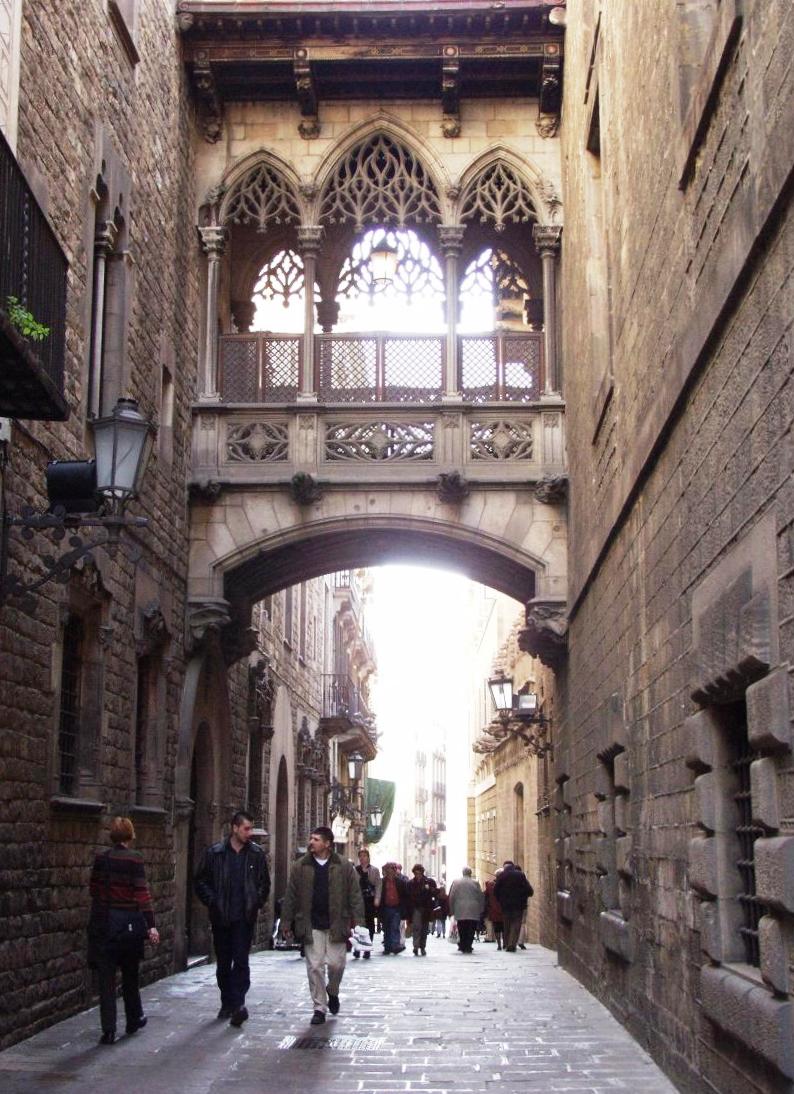
Carrer del Bisbe is a narrow medieval street connecting the Cathedral to the Plaça Sant Jaume, lined with Gothic façades and arched passageways. It is in Barcelona, Spain. Most visitors spend 15–25 min here. The free Lokali audio guide runs 5 minutes.
✓ Verified August 2026 · how we write these guides
Visitor facts
| Time needed | 15–25 min |
|---|---|
| Lokali audio guide | 5 min · free |
| Type | Street |
| Best for | Photography |
| Location | Barcelona, Spain |
| Coordinates | 41.3824, 2.1756 |
| Languages | 45, in the Lokali app |
The story
You walk down a narrow stone street, hemmed in by tall walls that rise close on either side. The light down here is dim and cool, even at midday. Then you look up, and a bridge crosses the air above your head. It is pale carved stone, worked as fine as lace, joining the two buildings on opposite sides of the lane. This is the Bishop's Bridge, on Carrer del Bisbe.
Stop in the middle of the street and tip your head back. The bridge is covered in detail. Pointed arches, slim columns, and delicate stone tracery wrap around an enclosed walkway. It looks like something lifted straight out of the Middle Ages. It seems to have stood here for five or six hundred years.
It has not. The bridge is far younger than it appears to be. It was built in 1928, well into the early twentieth century. The architect was Joan Rubió i Bellver, a man who had worked closely alongside Antoni Gaudí and learned the craft from him. What reads to your eye as medieval is in fact a careful, loving imitation of the medieval.
There is a reason it fools the eye so well. In Rubió's time, the city set out to make this old district look more uniformly medieval than it ever truly was. Plain walls were dressed in Gothic detail. Old buildings were reshaped to match. This bridge was the boldest stroke in that whole effort, and it remains the most famous piece of it.
The bridge has a real job to do. It links the Palace of the Generalitat, the seat of the Catalan government, on one side of the street, to the Casa dels Canonges, an official residence, on the other. The covered stone walkway let people cross from one building into the other without ever coming down into the public street.
Rubió first imagined this bridge as only one piece of a much larger plan. He wanted to rework the whole quarter in this same style. Most of that grand plan was never built. The bridge now stands as a fragment of a bigger idea, a single finished sentence from a book that was mostly left blank.
Now look closely at the underside of the bridge, right at its center. Carved into the stone there is a skull, and straight through the skull runs a dagger. It is a strange, dark detail to find tucked beneath all that delicate, lace-like beauty. Once you have seen it, you will find it hard to look away.
Many legends cling to this skull. One says that if you walk beneath the bridge backward while looking up at it, you will be granted a wish or good luck. Another claims that whoever pulls out the dagger will bring disaster down on the city. These are only stories, with no fact behind them, but people still repeat them with a smile.
Whatever the truth of the carving, it does its work on you. It draws your eye upward, sparks the imagination, and sends you searching for meaning in cold stone. The architect plainly wanted this street to feel charged with age and mystery, and the dark little skull is a key part of that design.
Lower your gaze and look along the street itself. Carrer del Bisbe is narrow and straight, paved in large stone slabs. The walls rise high on both sides, so the daylight comes down thin and gray. In the early morning the street is quiet. By midday it fills with people, many of them stopped and pointing their cameras straight up.
Walk the full length of the street. At one end it opens toward the great cathedral. At the other it reaches the Plaça de Sant Jaume, where the city hall and the government palace face each other across an open square. In just a few short steps you pass between the old centers of church and state.
Stand beneath the bridge one more time. Think about how recent it really is, and yet how completely it convinces everyone who passes under it. It is not a fake, exactly. It is a piece of the early twentieth century dreaming hard about the Middle Ages, drawn and built by a real craftsman with real and patient skill.
Then walk on, out toward the light at the end of the street. The bridge will hang there behind you, holding its skull and its secret. It is a reminder that a city is always partly a story it tells about itself, and that some of the oldest-looking things in it are the very newest of all.
Key facts
What to look for
Practical tips
Common questions
How long do you need at Carrer del Bisbe?
Plan 15–25 min. That is the time most visitors spend at Carrer del Bisbe. The free Lokali audio guide adds about 5 minutes of narration you can listen to as you walk, so it fits inside your visit rather than adding to it.
Is there a free audio guide to Carrer del Bisbe?
Yes — the Lokali app narrates Carrer del Bisbe free of charge in 50+ languages. It covers the history, what to look for on site and practical tips, and it works offline once downloaded.
Where is Carrer del Bisbe?
Carrer del Bisbe is in Barcelona, Spain, at 41.3824, 2.1756. Tap the map link on this page for directions from where you are.
What should you know before visiting Carrer del Bisbe?
Come early morning to see the street empty.
What is Carrer del Bisbe known for?
Bishop's Bridge built in 1928, not truly medieval.
What is the best time to visit Carrer del Bisbe?
Walk slowly and look up — the buildings lean inward, and shadows pool in the stone archways.
On the map
Opens directions to Carrer del Bisbe from your location.
Reference
More to see in Barcelona


Hear Carrer del Bisbe in your language
The full story, narrated, in 50+ languages. Download it before you go and it plays offline, at your own pace, with no ticket and no tour group.