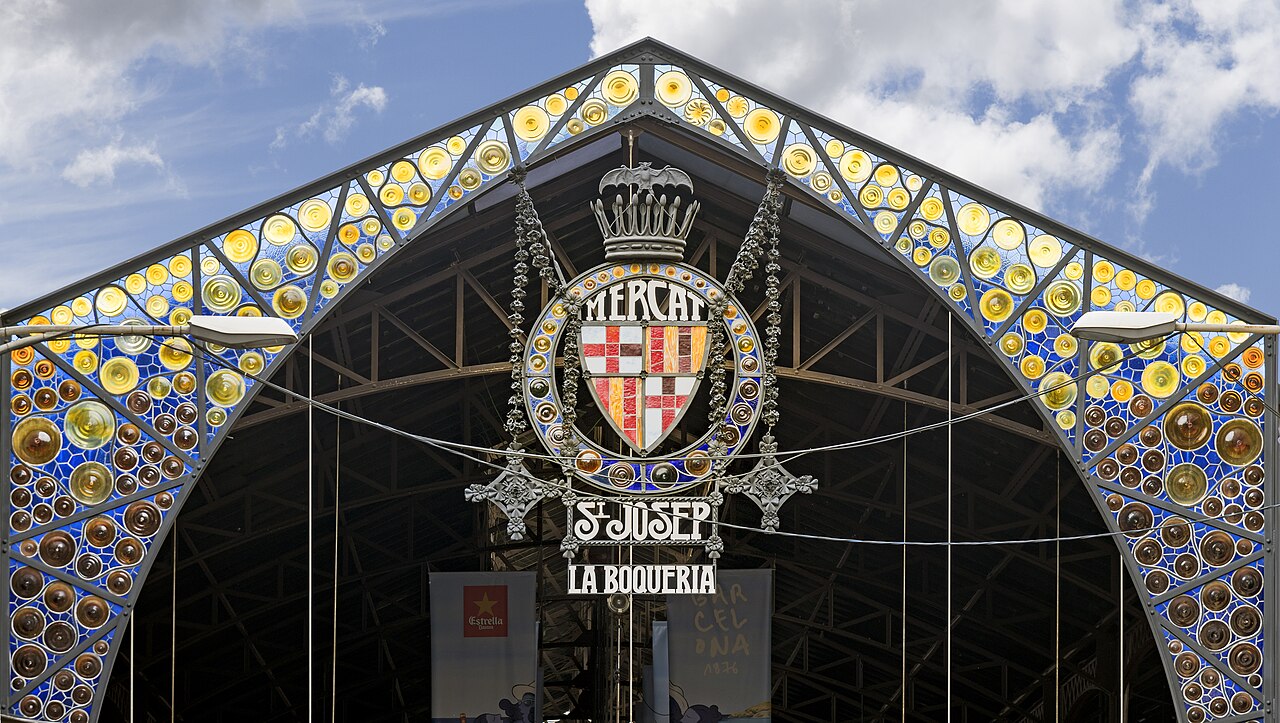
La Boqueria Market
41.3817° N · 2.1694° E · Food Market
La Boqueria Market is a food market in Barcelona, Spain. Barcelona's central produce and food market since 1840, occupying a steel-and-glass hall near the Ramblas. Most visitors spend 30–45 min here. The free Lokali audio guide runs 9 minutes.
✓ Verified August 2026 · how we write these guides
Visitor facts
| Time needed | 30–45 min |
|---|---|
| Lokali audio guide | 9 min · free |
| Type | Food Market |
| Best for | Local life |
| Location | Barcelona, Spain |
| Coordinates | 41.3817, 2.1694 |
| Languages | 45, in the Lokali app |
The story
The first thing that hits you is the colour — pyramids of strawberries glowing under halogen, mounds of saffron-yellow chanterelles, whole tuna split open to reveal flesh the colour of a sunset. La Boqueria sprawls just off La Rambla, a covered market hall where Barcelona has bought its daily bread, its fish, its olives since the eighteen-forties. The iron roof overhead filters the Mediterranean light into a soft, even glow, and the noise — vendors calling prices, knives on cutting boards, the hiss of jamón slicers — folds into a kind of rhythm.
The name comes from the Catalan word for goat, a nod to the livestock traders who gathered here centuries before the permanent structure went up. By the early nineteenth century, the city needed a proper market to replace the tangle of open-air stalls clogging the old town streets. The architect Mas Vilà designed the iron framework in 1840, and the hall opened in stages over the next few decades. The entrance canopy, a swooping modernist addition, arrived much later, in the nineteen-fifties, and now frames the threshold like a theatre proscenium.
Step past the flower stalls at the front — they are a relatively recent addition, positioned to catch tourists — and the market opens into a grid of permanent stands, each family-run, some for three or four generations. The fish vendors cluster near the centre, their stalls packed with ice and the morning's catch from the Costa Brava. Monkfish, octopus, clams the size of your palm, sardines arranged in silver rows. The smell is clean, briny, not unpleasant if you lean into it.
To the left, the fruit sellers build their displays like still lifes — persimmons in autumn, cherries in late spring, always something seasonal at the peak of ripeness. Many of these vendors source directly from small farms in the Catalan hinterland, and they will let you taste before you buy. A few stands specialize in exotic imports — dragon fruit, passion fruit, mangosteen — but the best purchases are the local varieties, the things that do not travel well and taste of this particular stretch of coast.
The jamón ibérico stands occupy prime real estate near the Rambla entrance. Whole legs hang from metal racks, and the cutters work with surgical precision, shaving translucent slices that melt on the tongue. The best jamón comes from acorn-fed pigs raised in Extremadura or Andalusia, cured for two or three years until the fat turns sweet and nutty. Prices climb steeply for the top grades, but even a small cone of offcuts, bought for a few euros, gives you the essential experience.
La Boqueria has always walked a line between neighbourhood market and tourist spectacle. In recent years, that balance has tilted. The smoothie bars and paella stands near the entrance cater almost exclusively to visitors, and locals complain that rising rents have pushed out some of the older, more specialized vendors. But deeper into the hall, past the first few rows, you still find the butchers selling rabbit and tripe, the spice merchants with their sacks of pimentón and cumin, the women selling salt cod soaked and ready for bacalao.
The market operates every day except Sunday, opening early — some vendors arrive before dawn to set up — and closing by mid-afternoon. Mornings are the best time to visit, when chefs from the city's restaurants come to source ingredients and the crowds have not yet thickened. By late morning, the central aisles become a slow shuffle of selfie sticks and shopping bags, and the vendors grow weary of questions asked in halting English.
One detail most visitors miss: the ceramic tiles on some of the older stall fronts, hand-painted scenes of harvests and fishing boats, installed in the early twentieth century and now half-hidden behind price signs and product displays. They are fragments of an earlier Barcelona, when this market was the city's larder and not yet a landmark.
If you buy something — a handful of olives, a wedge of Manchego, a paper cone of jamón — find a perch at one of the small counter bars deeper in the hall. Order a glass of vermouth, the local aperitif, and watch the vendors work. The rhythm of the place reveals itself when you stop moving through it and let it move around you.
When you leave, the light outside on La Rambla will feel harsh after the soft glow under the iron roof. The market's entrance will already be crowded again, a fresh wave of visitors pressing in. But the taste of that jamón, or the smell of those strawberries, will linger — a reminder that Barcelona, for all its grand boulevards and Gaudí spires, still runs on the small transactions of buying and selling food, the same commerce that has filled this hall for nearly two centuries.
Key facts
What to look for
Practical tips
Common questions
How long do you need at La Boqueria Market?
Plan 30–45 min. That is the time most visitors spend at La Boqueria Market. The free Lokali audio guide adds about 9 minutes of narration you can listen to as you walk, so it fits inside your visit rather than adding to it.
Is there a free audio guide to La Boqueria Market?
Yes — the Lokali app narrates La Boqueria Market free of charge in 50+ languages. It covers the history, what to look for on site and practical tips, and it works offline once downloaded.
Where is La Boqueria Market?
La Boqueria Market is in Barcelona, Spain, at 41.3817, 2.1694. Tap the map link on this page for directions from where you are.
What should you know before visiting La Boqueria Market?
Visit before ten in the morning to avoid crowds.
What is La Boqueria Market known for?
Iron framework designed by Mas Vilà in 1840.
What is the best time to visit La Boqueria Market?
Arrive before 10 a.m.
On the map
Opens directions to La Boqueria Market from your location.
More to see in Barcelona


Hear La Boqueria Market in your language
The full story, narrated, in 50+ languages. Download it before you go and it plays offline, at your own pace, with no ticket and no tour group.