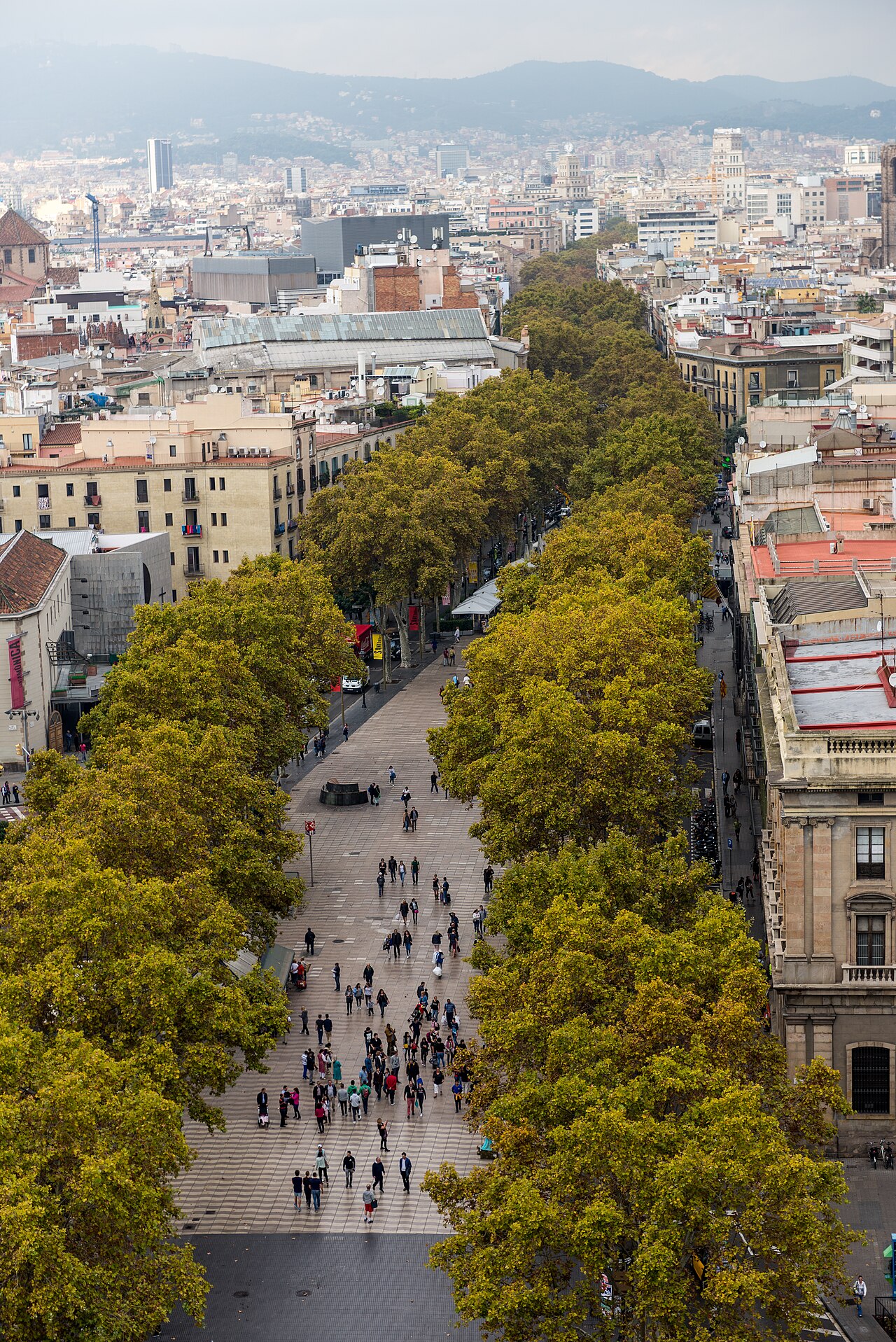
La Rambla is a street in Barcelona, Spain. Barcelona's most famous tree-lined avenue, stretching 1.2 km from Plaça de Catalunya to the waterfront. Most visitors spend 30–45 min here. The free Lokali audio guide runs 6 minutes.
✓ Verified August 2026 · how we write these guides
Visitor facts
| Time needed | 30–45 min |
|---|---|
| Lokali audio guide | 6 min · free |
| Type | Street |
| Best for | Local life |
| Location | Barcelona, Spain |
| Coordinates | 41.3819, 2.1716 |
| Languages | 45, in the Lokali app |
The story
The sound reaches you first. Footsteps in their thousands, a busker's guitar, birds in the plane trees overhead, the rattle of a flower seller arranging her buckets. You have arrived at La Rambla, the long walking street that runs like a spine down the middle of old Barcelona.
It stretches a little over a kilometer, a straight green corridor from the wide Plaça de Catalunya at the top all the way down to the harbor, where a tall column lifts a statue of Christopher Columbus toward the sea. You could walk the whole length in twenty minutes. Most people take far longer, because the street will not let you hurry. There is always one more thing to catch your eye, one more reason to slow your pace.
The name itself is old and tells a story. It comes from an Arabic word for a sandy riverbed, the kind that fills with water only when the rains come. That is what this once was. A stream ran along the edge of the medieval city walls here, dry for much of the year, and over the centuries the watercourse was paved and the walls came down. The river became a road for people.
Strictly speaking, there is not one Rambla but several, joined end to end. As you walk, the name shifts beneath your feet from one stretch to the next. Locals often speak of them in the plural, the Ramblas, a chain of small promenades that together make one long and famous walk.
Start at the top, beside a modest iron fountain called the Font de Canaletes. The tradition says that anyone who drinks its water is bound to return to Barcelona one day. When the city's football club wins a great match, crowds gather at this very spot to celebrate. Take a sip if you like. It is a cheap promise, and a lovely one.
Keep walking and the street performs for you. Human statues stand frozen until a coin drops in their hat. Painters sell quick portraits. For generations this stretch was lined with stalls selling flowers and caged birds and newspapers, and though the trade has thinned over time, the flower sellers still bring their color to the middle of the walk. Pause a moment to watch a portrait take shape under an artist's hand, line by patient line.
Halfway down, an opening on your right leads into the Boqueria, one of the great food markets of Europe. Pyramids of fruit. Hanging legs of cured ham. Fish laid out on crushed ice, still smelling of the morning sea. Even if you buy nothing at all, step inside for the noise and the color, then come back out to the calm of the trees. This market has fed the families of the city for well over a hundred years.
Watch the ground as you go. Set into the pavement near the market is a round mosaic by the artist Joan Miró, all bold red, yellow, and blue. Many people stride straight across it without ever looking down. Now that you know it is there, you will see his shapes underfoot, a small gift from one of the city's most loved painters.
A little further along stands the Liceu, Barcelona's grand opera house. It has burned down and been rebuilt more than once, and still its doors open for music night after night. From the outside it looks almost plain. Behind that quiet facade lies one of the most storied stages in all of Spain. Ask at the box office, and on many days you can step inside for a short guided look.
The street also divides two different worlds. On one side spreads the medieval Gothic Quarter, a maze of narrow stone lanes. On the other lies the Raval, long a working district, now full of small shops and life. La Rambla is the seam that stitches them together, and you can step off it into either one within a few short paces.
A word of care, gently given. Because so many visitors fill this street, so do pickpockets. Keep your bag closed and held in front of you. Watch your pockets in the thickest of the crowds. None of this should frighten you off. It only asks you to walk with the easy attention of a local rather than the open wonder of a stranger.
When you reach the bottom, stand by the Columbus column where the walk meets the water. Turn and look back up the long green corridor you have just come down. People have strolled this same line for hundreds of years, when it was a stream, then a road, then the beating promenade of a great city. Join the current for a while. La Rambla is best taken slowly, one unhurried step at a time. Let the crowd carry you for a while, and the long walk will give back more than it asks.
Key facts
What to look for
Practical tips
Common questions
How long do you need at La Rambla?
Plan 30–45 min. That is the time most visitors spend at La Rambla. The free Lokali audio guide adds about 6 minutes of narration you can listen to as you walk, so it fits inside your visit rather than adding to it.
Is there a free audio guide to La Rambla?
Yes — the Lokali app narrates La Rambla free of charge in 50+ languages. It covers the history, what to look for on site and practical tips, and it works offline once downloaded.
Where is La Rambla?
La Rambla is in Barcelona, Spain, at 41.3819, 2.1716. Tap the map link on this page for directions from where you are.
What should you know before visiting La Rambla?
Keep bags closed and zipped against pickpockets.
What is La Rambla known for?
A pedestrian boulevard just over one kilometer long.
What is the best time to visit La Rambla?
Walk it early morning before crowds.
On the map
Opens directions to La Rambla from your location.
Reference
More to see in Barcelona


Hear La Rambla in your language
The full story, narrated, in 50+ languages. Download it before you go and it plays offline, at your own pace, with no ticket and no tour group.