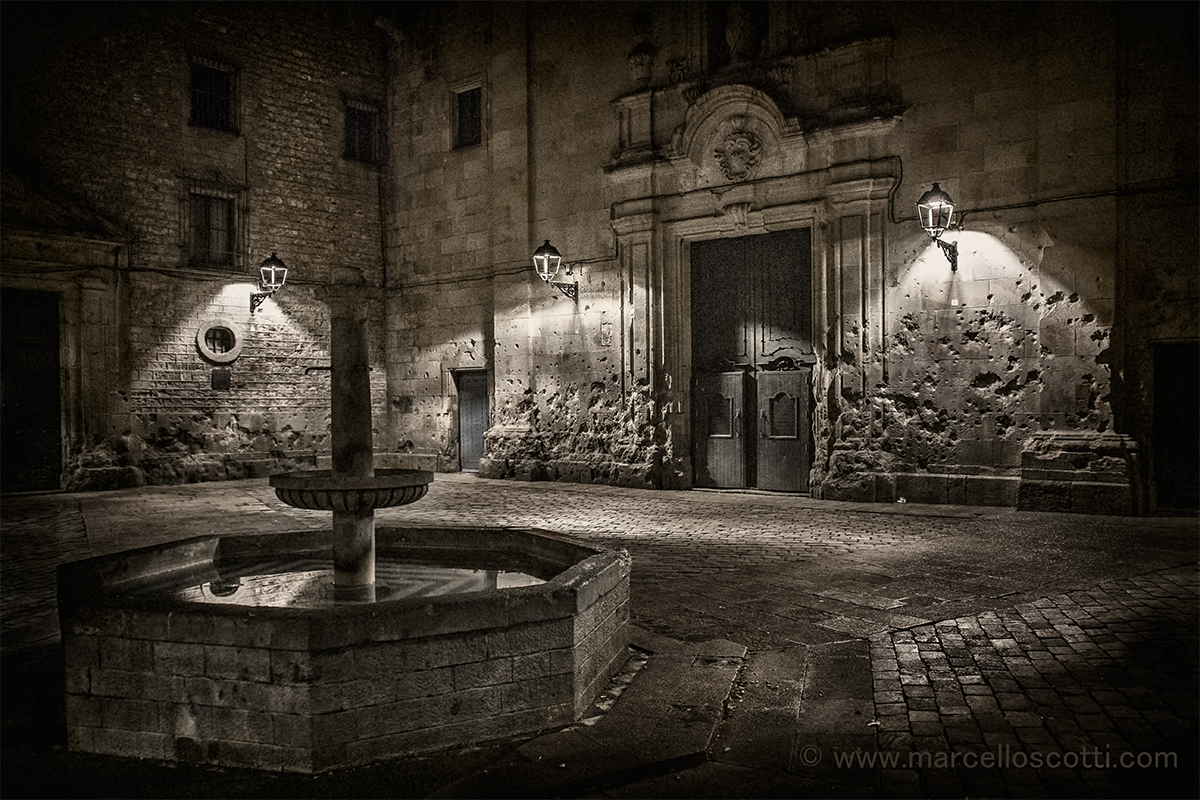
Plaça de Sant Felip Neri
41.3832° N · 2.1710° E · Square
Plaça de Sant Felip Neri is a small, intimate plaza enclosed by 17th-century buildings and the church of Sant Felip Neri. It is in Barcelona, Spain. Most visitors spend 15–25 min here. The free Lokali audio guide runs 5 minutes.
✓ Verified August 2026 · how we write these guides
Visitor facts
| Time needed | 15–25 min |
|---|---|
| Lokali audio guide | 5 min · free |
| Type | Square |
| Best for | History |
| Location | Barcelona, Spain |
| Coordinates | 41.3832, 2.1710 |
| Languages | 45, in the Lokali app |
The story
You turn off a busy lane, pass through a short, dark passage, and the sound of the city falls away behind you. A small square opens out, shaded by a few trees. Water trickles from a stone fountain in the middle of it. After the crowds you left only a few steps back, the quiet here is sudden and surprisingly deep. This is the Plaça de Sant Felip Neri.
Let your eyes adjust to the calm. The square is small and almost closed in on itself. Stone buildings rise on every side. An octagonal fountain stands at the center, its basin worn smooth. A few trees lean over the water and drop shade across the paving. Benches wait at the edges for anyone who wants to sit.
In front of you stands a church. This is the church of Sant Felip Neri, named for a priest who lived in Rome in the sixteenth century. The building is in the baroque style and was raised in the middle of the eighteenth century, around 1750. Its front is plain and heavily weathered now, the color of old bone, with a simple doorway and a single round window above.
Now look closely at that front wall. It is covered in small holes and scars. The stone looks bitten, pitted across its whole lower face. These marks are not the slow wear of ordinary time. They were torn into the stone in a single violent moment, and the square has kept them ever since.
The marks date from the Spanish Civil War. On a cold January morning in 1938, warplanes bombed this part of the old city. A bomb fell directly on the square. Many people were killed here in an instant. Among the dead were a large number of children, who had come to shelter close by the church. The scars across the wall are the work of that blast.
For a long time, some people told a different story, saying the marks came from a firing squad. Historians have since traced them to the bombing. Knowing the truth changes how the square feels. The quiet you walked into is not only peaceful. It is also a kind of remembering.
Stand by the fountain for a while. Listen to the water as it falls. The sound is soft and steady, and it fills the whole small space. This gentle, constant noise is part of why the square feels so set apart from everything pressing in around it. People come here on purpose, to sit alone, to think, to escape the heat and the moving crowds for a few minutes.
Look around at the other buildings. One of them is the old house of the shoemakers' guild, moved here stone by stone in the twentieth century. Inside is a small museum of footwear, with shoes that span many centuries. The square gathers these fragments of old Barcelona into one quiet corner.
There is a school on the square as well. On weekday mornings you may hear children's voices spilling out across the stone. The sound carries an extra weight in this place, given what happened here. Life goes on in the same square that holds such a hard memory, and the two sit side by side.
Notice the surface of the paving. It is uneven, polished by many feet over many years. Moss grows in the cracks where the shade keeps the stone damp. The trees filter the daylight into soft, shifting patterns on the ground. In the early morning, before the day warms up, the square can feel almost untouched.
Take a slow walk around the edge. Hold your hand near, but not on, the scarred wall. Read the small plaque if you can find it. Notice how the marks climb higher in some places than others, mapping the spread of a blast that happened long before you were born.
This is a place that asks you to slow down. It is not large. There is little to buy here and nothing to climb. What it offers instead is the space to feel the weight of a single hard chapter of the past, held in scarred stone and then softened, a little, by water and green shade.
Before you leave, sit on a bench for a moment. Let the fountain fill the silence. Look once more at the wounded wall and then up into the green of the trees. The square holds grief and calm in the same small space, and it lets you hold both at once, quietly, before you walk back into the bright, noisy city.
Key facts
What to look for
Practical tips
Common questions
How long do you need at Plaça de Sant Felip Neri?
Plan 15–25 min. That is the time most visitors spend at Plaça de Sant Felip Neri. The free Lokali audio guide adds about 5 minutes of narration you can listen to as you walk, so it fits inside your visit rather than adding to it.
Is there a free audio guide to Plaça de Sant Felip Neri?
Yes — the Lokali app narrates Plaça de Sant Felip Neri free of charge in 50+ languages. It covers the history, what to look for on site and practical tips, and it works offline once downloaded.
Where is Plaça de Sant Felip Neri?
Plaça de Sant Felip Neri is in Barcelona, Spain, at 41.3832, 2.1710. Tap the map link on this page for directions from where you are.
What should you know before visiting Plaça de Sant Felip Neri?
Approach quietly; people come here to reflect.
What is Plaça de Sant Felip Neri known for?
Baroque church of Sant Felip Neri built around 1750.
What is the best time to visit Plaça de Sant Felip Neri?
This quiet corner feels removed from the Quarter's bustle.
On the map
Opens directions to Plaça de Sant Felip Neri from your location.
Reference
More to see in Barcelona


Hear Plaça de Sant Felip Neri in your language
The full story, narrated, in 50+ languages. Download it before you go and it plays offline, at your own pace, with no ticket and no tour group.