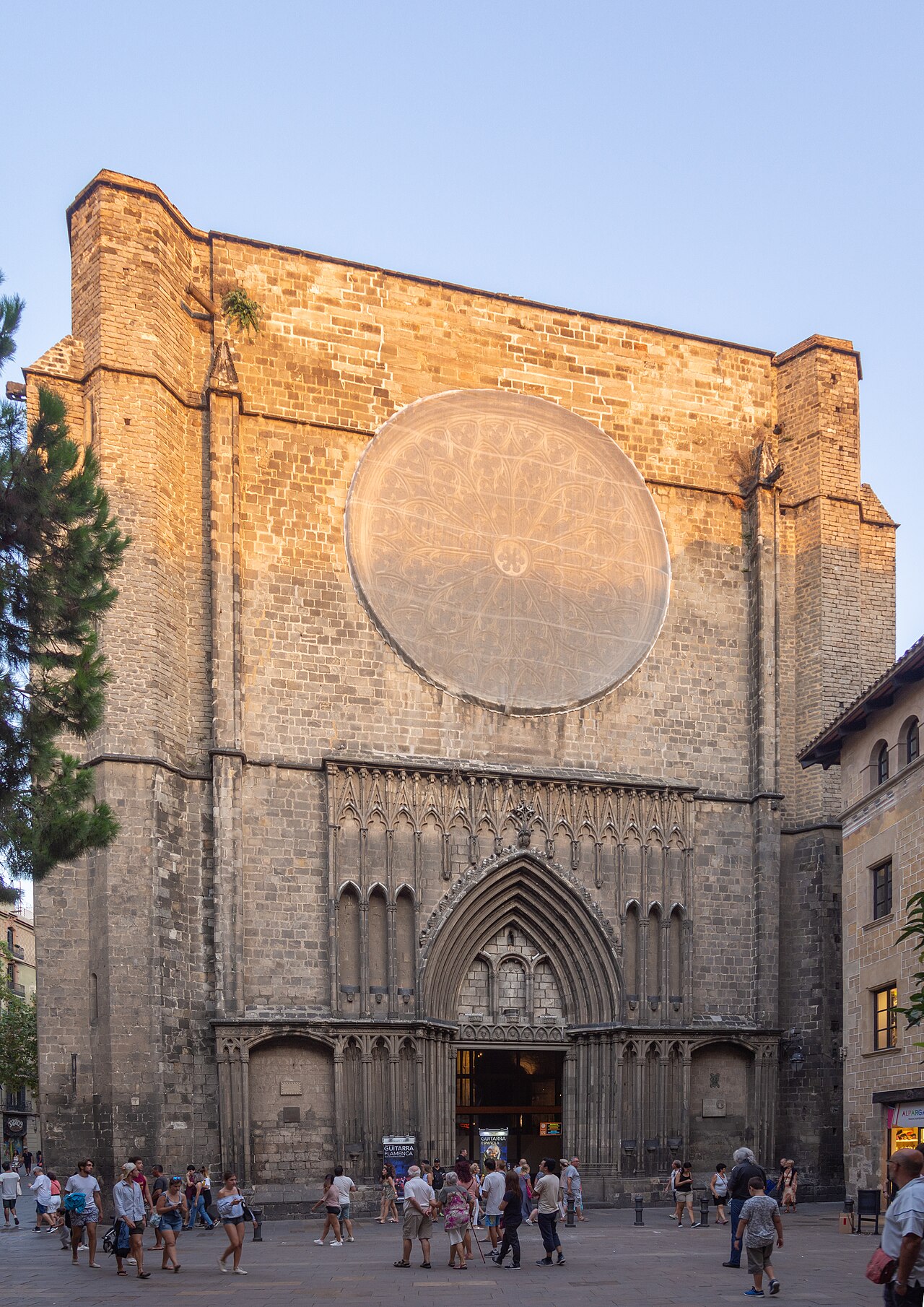
Santa Maria del Pi is a 14th-century Gothic church with a fortress-like exterior and one of the largest rose windows in the world. It is in Barcelona, Spain. Most visitors spend 30–45 min here. The free Lokali audio guide runs 5 minutes.
✓ Verified August 2026 · how we write these guides
Visitor facts
| Time needed | 30–45 min |
|---|---|
| Lokali audio guide | 5 min · free |
| Type | Church |
| Best for | Local life |
| Location | Barcelona, Spain |
| Coordinates | 41.3805, 2.1688 |
| Languages | 45, in the Lokali app |
The story
A narrow lane gives way without warning, and the space opens in front of you. A small square. A single tree stands near the wall, its branches dark against pale stone. Above it rises a broad, flat front, wide and almost bare. This is Santa Maria del Pi. The name means Saint Mary of the Pine. A pine has grown on this spot for centuries, and one grows here still.
Look at the front of the church. It is broad and plain, with little carving to draw the eye. The stone is the color of honey and ash. This is Catalan Gothic, a local style that chose width over height and calm walls over busy ornament. The builders worked through the fourteenth century. The main body of the church was finished around 1391.
At the center of the front sits a great round window. This is the rose window. For a long time people have counted it among the largest in any Gothic church. The stone tracery spreads outward like the spokes of a wheel. The colored glass behind it catches fire when the afternoon sun swings around the building and pours through.
The window you see is not the first one. In 1936, at the start of the Spanish Civil War, the church was set alight. The old glass was lost in the flames. The rose was rebuilt in the years that followed, drawn along the lines of what stood before. When you look up at it, you see memory and repair as much as medieval craft.
Step inside if the doors stand open. The change is sudden. Outside there is daylight and the murmur of the square. Inside there is one long, wide hall, dim and cool. Catalan Gothic churches were often built as a single nave, with no side aisles to break the space. The effect is open and still. Your eye travels straight down to the altar.
Side chapels line the walls between the great stone buttresses. Each one holds its own small world of candles, gold leaf, and carved saints with painted faces. The light is low and warm, the air faintly sweet with old smoke. Sound softens here. Your footsteps echo once against the stone and then fade into the quiet, and you find yourself slowing down without meaning to.
The church is bound to Sant Josep Oriol, a priest who served here in the late seventeenth and early eighteenth centuries. He was known for tending the poor and the sick of this neighborhood. People came to him hoping to be healed. His memory is still kept carefully inside these walls.
Outside again, walk around to the smaller square tucked behind the church. This is the Plaça de Sant Josep Oriol. Painters often set up their easels here. The tables of nearby cafes spill across the stone. It is a fine place to sit, order something cold, and tip your head back to look up.
The bell tower rises on one side of the church. It has eight sides, a tall octagon of pale stone. It climbs more than fifty meters above the rooftops. From the foot of it, the tower looks slender and very high against the sky. Its bells have measured out the hours for this corner of the city across many lifetimes.
Look closely at the doors of the church. The wood is heavy and dark, studded with rows of black iron. Run your eyes along the joins between the stones. Here and there you may catch the small marks left by the masons who cut each block by hand. Once you notice them, you see them everywhere.
On many weekends a small market fills the front square. Honey, cheese, and cakes are sold from simple wooden stalls run by makers from the countryside. The smell of sugar and warm beeswax drifts across the old paving. Children chase pigeons in loose circles around the base of the tree while their parents stand and talk in the sun.
This church was not raised to overwhelm anyone. There are grander buildings a short walk from here. What this one offers instead is steadiness. For seven hundred years it has stood at the heart of its neighborhood, holding weddings, funerals, and ordinary afternoons like this one.
Stand a moment before you go. The pine, the plain stone face, the round window burning softly overhead. Let the noise of the city drop away. The square will still be here tomorrow, and the tree will still be green, and that quiet endurance is the truest thing the place has to say.
Key facts
What to look for
Practical tips
Common questions
How long do you need at Santa Maria del Pi?
Plan 30–45 min. That is the time most visitors spend at Santa Maria del Pi. The free Lokali audio guide adds about 5 minutes of narration you can listen to as you walk, so it fits inside your visit rather than adding to it.
Is there a free audio guide to Santa Maria del Pi?
Yes — the Lokali app narrates Santa Maria del Pi free of charge in 50+ languages. It covers the history, what to look for on site and practical tips, and it works offline once downloaded.
Where is Santa Maria del Pi?
Santa Maria del Pi is in Barcelona, Spain, at 41.3805, 2.1688. Tap the map link on this page for directions from where you are.
What should you know before visiting Santa Maria del Pi?
Step inside to feel the sudden cool and hush.
What is Santa Maria del Pi known for?
Main church body completed around 1391 in Catalan Gothic.
What is the best time to visit Santa Maria del Pi?
The interior is surprisingly austere and light-filled.
On the map
Opens directions to Santa Maria del Pi from your location.
Reference
More to see in Barcelona


Hear Santa Maria del Pi in your language
The full story, narrated, in 50+ languages. Download it before you go and it plays offline, at your own pace, with no ticket and no tour group.