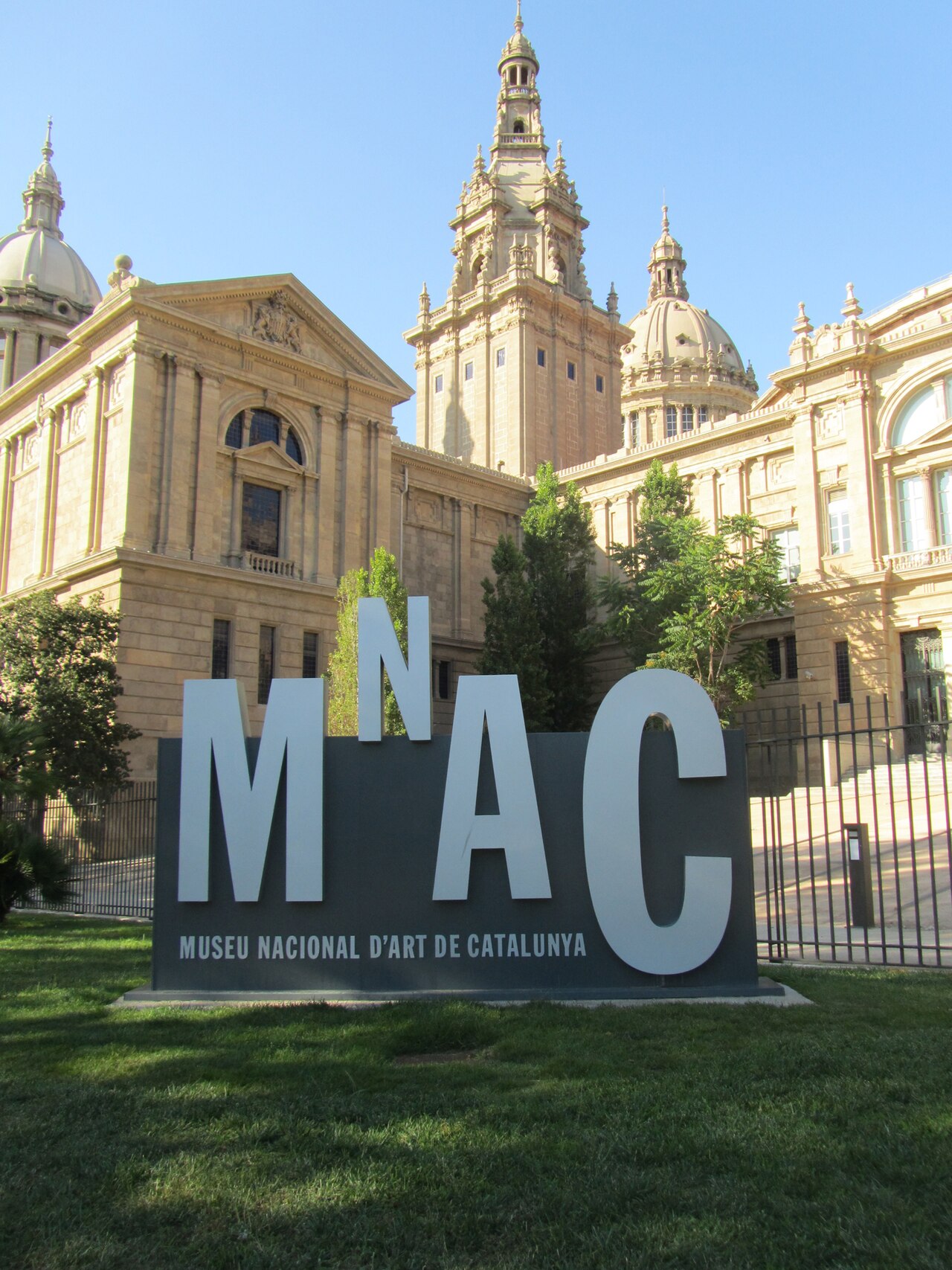
National Art Museum of Catalonia
41.3687° N · 2.1542° E · Museum
National Art Museum of Catalonia is a museum in Barcelona, Spain. Housed in a 1929 Palau Nacional with sweeping Barcelona views, this museum holds one of Europe's finest Romanesque art collections alongside medieval, Renaissance, and modern Catalan…. Most visitors spend 2–3 hours here. The free Lokali audio guide runs 5 minutes.
✓ Verified August 2026 · how we write these guides
Visitor facts
| Time needed | 2–3 hours |
|---|---|
| Lokali audio guide | 5 min · free |
| Type | Museum |
| Best for | Editors' pick |
| Location | Barcelona, Spain |
| Coordinates | 41.3687, 2.1542 |
| Languages | 45, in the Lokali app |
The story
Look up the hill. A palace rises above long stairways and falling water. Its dome stands against the sky like a crown. This is the Palau Nacional, the National Palace of Montjuïc. Inside it lives the National Art Museum of Catalonia, known as MNAC.
The building looks centuries old, but it is not. Workers raised it for the 1929 International Exposition, when Barcelona invited the world to Montjuïc. The palace was the centerpiece of the fair. Its architects gave it wide stone wings, four towers, and a great dome. They modeled the dome on Saint Peter's Basilica in Rome.
The fair ended, and the palace found a second life. In 1934 it opened as a museum of Catalan art. In 1990 Catalonia joined its medieval collection and its modern collection into a single national museum. After years of careful restoration, the whole building opened again in 2004. Its rooms now cover a thousand years of art.
The Romanesque collection is the heart of the museum. Many experts call it the finest collection of Romanesque wall painting anywhere. These murals come from small stone churches in the Pyrenees mountains. Artists painted them in the eleventh, twelfth, and thirteenth centuries, grinding their colors from earth and minerals. For generations, shepherds and farmers prayed beneath them by candlelight.
In the early twentieth century, art dealers began to cut such paintings from church walls and sell them abroad. Catalan institutions decided to act before everything was lost. Restorers peeled the murals from the walls with great care and carried them down to Barcelona. The museum then built curved rooms shaped like the original churches, so each painting sits as it once did.
One image draws every visitor. It comes from the church of Sant Climent de Taüll, high in a mountain valley. Painters finished it around 1123. Christ sits inside an almond of light. His right hand is raised in blessing. His gaze is calm and very direct. The reds and blues are still deep after nine hundred years. Stand close and study the brushwork. Then step back and let the whole wall speak. A copy now hangs in the mountain church, so the image lives in both places.
Walk on, and the centuries move with you. The Gothic rooms glow with golden altarpieces from the fourteenth and fifteenth centuries, including panels by Jaume Huguet. Painted saints stand in quiet rows. Look at the small scenes below the main figures. They show tools, clothes, ships, and food of their time. Later galleries hold Renaissance and Baroque works, among them paintings by El Greco, Zurbarán, and Velázquez.
Upstairs, the museum turns modern. Around 1900, Barcelona was a city of new money and bold ideas. The style called Modernisme filled its homes with curved wood, iron, and colored glass. Here you can see furniture that Antoni Gaudí designed for private houses. Nearby hangs a famous painting by Ramon Casas. It shows the artist and his friend Pere Romeu riding a tandem bicycle. That canvas once hung in Els Quatre Gats, the tavern where the young Picasso first showed his work.
At the center of the building lies the Oval Hall. It is one of the largest indoor halls in the city. Royalty opened the 1929 exposition under this roof. A grand organ rises over the space, and concerts still fill it with sound. Even empty, the hall makes you feel small in a pleasant way.
Do not leave without going up. The terraces and the rooftop viewpoint face the whole city. Streets run in straight lines toward the sea. You can pick out the towers of the Sagrada Família and the green hill of Tibidabo. Below the palace, water stairs descend toward the Magic Fountain, built for the same fair in 1929. On show evenings its jets move with music and colored light, though schedules change, so check before you wait.
Give the museum two or three hours. Weekday mornings are quiet, and the Romanesque rooms feel almost private then. Outdoor escalators climb the hill from Plaça Espanya, so the walk up is easier than it looks. Bus 150 also serves the hill if your legs are tired. The museum café is a good place to rest your feet.
Before you go, think of the journey these paintings made. They were born on cold chapel walls, high in mountain silence. Mule tracks and early roads carried them down to the coast. Now they rest inside a palace, warm and softly lit, visited by people from every country. The mountains are far away. The stillness around the paintings is the same.
Key facts
What to look for
Practical tips
Common questions
How long do you need at National Art Museum of Catalonia?
Plan 2–3 hours. That is the time most visitors spend at National Art Museum of Catalonia. The free Lokali audio guide adds about 5 minutes of narration you can listen to as you walk, so it fits inside your visit rather than adding to it.
Is there a free audio guide to National Art Museum of Catalonia?
Yes — the Lokali app narrates National Art Museum of Catalonia free of charge in 50+ languages. It covers the history, what to look for on site and practical tips, and it works offline once downloaded.
Where is National Art Museum of Catalonia?
National Art Museum of Catalonia is in Barcelona, Spain, at 41.3687, 2.1542. Tap the map link on this page for directions from where you are.
What should you know before visiting National Art Museum of Catalonia?
Ride the outdoor escalators up from Plaça Espanya.
What is National Art Museum of Catalonia known for?
Palau Nacional built for the 1929 International Exposition.
What is the best time to visit National Art Museum of Catalonia?
Arrive early morning to have the upper galleries nearly to yourself.
On the map
Opens directions to National Art Museum of Catalonia from your location.
Reference
More to see in Barcelona


Hear National Art Museum of Catalonia in your language
The full story, narrated, in 50+ languages. Download it before you go and it plays offline, at your own pace, with no ticket and no tour group.