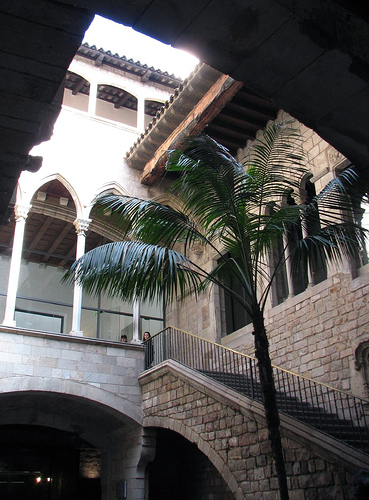
Picasso Museum is a museum in Barcelona, Spain. Housed in five adjoining medieval palaces in the Gothic Quarter, this museum holds the world's most comprehensive collection of Picasso's early works, from childhood sketches through…. Most visitors spend 1–2 hours here. The free Lokali audio guide runs 9 minutes.
✓ Verified August 2026 · how we write these guides
Visitor facts
| Time needed | 1–2 hours |
|---|---|
| Lokali audio guide | 9 min · free |
| Type | Museum |
| Best for | Editors' pick |
| Location | Barcelona, Spain |
| Coordinates | 41.3860, 2.1915 |
| Languages | 45, in the Lokali app |
The story
The stone underfoot is cool and uneven, worn smooth by centuries of footsteps in these medieval palaces. Five mansions, actually — their courtyards and staircases stitched together along Carrer de Montcada, one of the oldest streets in Barcelona's Gothic Quarter. The air inside holds that particular museum quiet, broken only by the creak of old beams and the shuffle of visitors moving from room to room.
Pablo Picasso never lived in Barcelona, not permanently. But he arrived here as a teenager in 1895, when his father took a teaching post at the art school. The city became his laboratory. He haunted the cafés of Els Quatre Gats, sketched prostitutes and beggars in the Barri Gòtic, soaked up the anarchist energy of a port city in ferment. By the time he left for Paris in 1904, Barcelona had shaped the artist he would become.
This museum holds the world's most complete collection of his early work — more than four thousand pieces, donated by Picasso himself and by his longtime secretary Jaume Sabartés. What you see here is not the Cubist titan of art history textbooks. You see a boy learning to draw. Academic studies from his teenage years hang in the first galleries — perfectly rendered pigeons, a man in a beret, his sister Lola at communion. The technique is flawless, almost frightening for a fifteen-year-old. You realize he mastered the rules before he broke them.
The Blue Period rooms come next, and the light seems to drop. Gaunt figures, beggars, the urban poor of Barcelona rendered in cold cerulean and Prussian blue. These paintings have a weight to them, a melancholy that feels specific to this city at the turn of the twentieth century — a place of stark contrasts, wealth and poverty pressed close together in narrow streets. Picasso was twenty, twenty-one years old. Already he was painting loneliness like a physical substance.
Then the museum pivots. An entire floor is devoted to Las Meninas, Picasso's obsessive reworking of the Velázquez masterpiece. Fifty-eight paintings, all created in 1957, all variations on the same seventeenth-century scene of the Spanish royal court. He painted it over and over, deconstructing the composition, isolating figures, shifting perspectives. Some are rendered in sombre greys, others explode in colour. It is like watching a man argue with history, with his own Spanish identity, with the act of seeing itself.
The building matters as much as the art. These Gothic palaces date to the thirteenth and fourteenth centuries, built for Barcelona's merchant elite when the city was a Mediterranean trading power. High ceilings, exposed stone, iron-grilled windows looking onto interior courtyards. The museum opened here in 1963, while Franco still ruled Spain and Picasso — a vocal opponent of the regime — refused to set foot in the country. He never saw this place. But he sent his work anyway, a quiet defiance.
Upstairs, the ceramics surprise most visitors. Plates, jugs, owl-faced vases — hundreds of pieces Picasso made in the south of France in his later years, playful and immediate. He treated clay like a sketchbook, pressing faces into wet surfaces, painting bulls and fish in quick, confident strokes. After the emotional gravity of the Blue Period, these pieces feel like exhales.
The museum is busiest mid-morning, when tour groups flood the narrow galleries. Early afternoon sees a lull, and you can linger in front of individual works without jostling. The Las Meninas floor, in particular, rewards slow looking — the paintings are hung close together, and you start to see the obsessive rhythm of Picasso's process, the way he circled the same problem day after day.
Carrer de Montcada itself is worth the visit. Step outside and you are in one of the few streets in Barcelona that still feels medieval — tall stone facades, dim passageways, the occasional glimpse of a palm tree in a hidden courtyard. The neighbourhood, El Born, has kept its tangled layout, its human scale. It is the opposite of the grand boulevards Picasso would have known in Paris.
Before you leave, glance up at the wooden ceilings in the main stairwell. The beams are original, fourteenth-century Catalan pine, darkened by age and smoke. Picasso's work hangs beneath timbers that were already ancient when he was born. There is something fitting in that — the old city holding the young artist, the stone and wood outlasting the revolutions he painted.
Key facts
What to look for
Practical tips
Common questions
How long do you need at Picasso Museum?
Plan 1–2 hours. That is the time most visitors spend at Picasso Museum. The free Lokali audio guide adds about 9 minutes of narration you can listen to as you walk, so it fits inside your visit rather than adding to it.
Is there a free audio guide to Picasso Museum?
Yes — the Lokali app narrates Picasso Museum free of charge in 50+ languages. It covers the history, what to look for on site and practical tips, and it works offline once downloaded.
Where is Picasso Museum?
Picasso Museum is in Barcelona, Spain, at 41.3860, 2.1915. Tap the map link on this page for directions from where you are.
What should you know before visiting Picasso Museum?
Visit early afternoon to avoid morning tour groups.
What is Picasso Museum known for?
Houses over four thousand works by Picasso.
What is the best time to visit Picasso Museum?
The progression from his Blue Period through early Cubism shows his rapid evolution in a way single paintings cannot.
On the map
Opens directions to Picasso Museum from your location.
Reference
More to see in Barcelona


Hear Picasso Museum in your language
The full story, narrated, in 50+ languages. Download it before you go and it plays offline, at your own pace, with no ticket and no tour group.