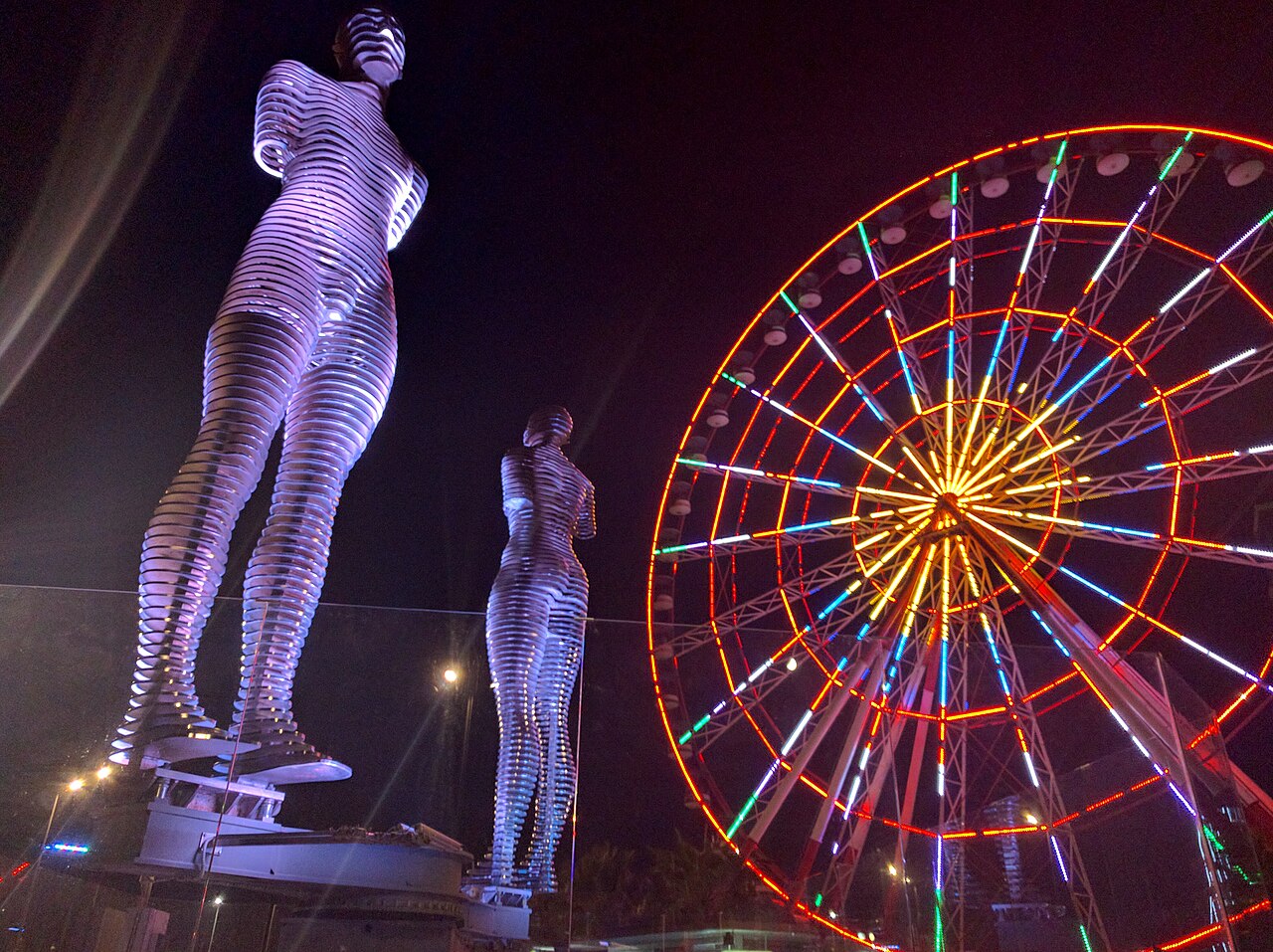
Ali and Nino Statue is a sculpture in Batumi, Georgia. Two eight-meter moving steel figures that merge and pass through each other in a seven-minute cycle, representing the tragic love story from Kurban Said's novel. Most visitors spend 15–30 min here. The free Lokali audio guide runs 9 minutes.
✓ Verified August 2026 · how we write these guides
Visitor facts
| Time needed | 15–30 min |
|---|---|
| Lokali audio guide | 9 min · free |
| Type | Sculpture |
| Best for | Photography |
| Location | Batumi, Georgia |
| Coordinates | 41.6461, 41.6411 |
| Languages | 45, in the Lokali app |
The story
Two enormous steel figures stand face-to-face on the Batumi waterfront, their silhouettes sharp against the Black Sea sky. Each is eight metres tall, built from hundreds of moving metal segments that slide past one another in a slow, mesmerising dance. Every ten minutes, the figures begin to glide forward — Ali and Nino, lovers from opposite worlds, meeting in an embrace before passing through each other and drifting apart again. The cycle repeats endlessly, day and night, a kinetic sculpture that never quite resolves.
The statue takes its name from a 1937 novel written under the pen name Kurban Said, a tragic love story set during the First World War and the Russian Revolution. Ali is a Muslim Azerbaijani boy, Nino a Christian Georgian girl, and their romance unfolds against the collapse of empires and the redrawing of borders. The novel became a cult classic across the Caucasus, its authorship still debated, its themes of divided identity and impossible love resonating in a region where frontiers have shifted for centuries. The statue does not illustrate a specific scene from the book — it distills the entire story into a single looping motion.
Georgian sculptor Tamara Kvesitadze designed the work in 2007, and it was installed on Batumi Boulevard three years later. Kvesitadze is known for kinetic pieces that explore memory, separation, and longing, and this is her most ambitious. The figures are not solid — each is a hollow lattice of steel bands, so when they merge, you can see straight through the overlapping layers to the sea beyond. The transparency is deliberate. The lovers cannot hold one another; they occupy the same space for a few seconds and then the mechanism pulls them apart again, back to their starting positions, ready to repeat.
The movement is powered by electric motors hidden in the circular concrete base. The steel segments are mounted on rails that rotate at different speeds, creating the illusion of fluidity. Engineers spent months calibrating the timing so the embrace happens smoothly, without grinding or jerking. When the figures align, the lattice forms a dense, almost human shape — two bodies recognisable as lovers. As they pass through each other, the outline fragments into abstraction, just metal and air and the rhythm of the motors.
Batumi Boulevard stretches for seven kilometres along the coast, lined with palms and cafés and Soviet-era lamp posts, and the statue sits roughly midway, near the old port. The setting is intentional. Batumi has always been a crossroads — Ottoman, Russian, Georgian, a city rebuilt and renamed with each empire. The statue faces west, toward Turkey, where the novel's Ali flees at the end of the story. Nino is left behind in Baku, separated by a new border. The sculpture turns that geography into motion, the lovers forever approaching and never arriving.
Visit at dusk and the figures are backlit by the sunset, their steel frames glowing orange and pink. Visit after dark and spotlights flood the base, casting long shadows that stretch across the promenade. The movement looks different depending on where you stand. From the side, the figures seem to slide past like trains on parallel tracks. From the front, the embrace is direct and heartbreaking, two shapes colliding and dissolving. Most visitors walk a slow circle around the base, watching the cycle from every angle, trying to catch the exact moment of contact.
The statue has become a symbol of Batumi, reproduced on postcards and city branding, but it is more than a landmark. It is a public clock, a meditation on borders, a reminder that some stories do not end with resolution. Locals bring first dates here, newlyweds pose for photos during the embrace, and older couples sit on the benches nearby, watching the figures turn. The sculpture does not ask you to choose sides or interpret the novel. It simply moves, over and over, patient and relentless.
Kvesitadze has said she wanted the work to feel like a breath — inhale as the figures approach, exhale as they separate. The rhythm is slow enough that you can stand still and feel it, a pulse in steel and air. The lattice design means the sculpture never blocks the view of the sea. Even when the lovers are locked together, you can see the waves through the gaps, the horizon line unbroken. The transparency is the point. Love in the Caucasus, the work suggests, has always been something you can see through but never quite hold.
Stay for two full cycles if you can. The first time, you watch the mechanics — the rails, the motors, the engineering. The second time, you stop thinking about how it works and just see two people reaching for each other across a divide that will not close. The sea behind them is the same sea that appears in the novel's final pages, the same coastline where borders were drawn and families split. The statue does not offer comfort. It offers repetition, the same motion morning and night, a love story that plays on loop because the story never had another ending.
When you walk away, glance back once. The figures are already moving again, preparing for the next embrace. The promenade stretches in both directions, palms swaying, the sound of the waves constant beneath the hum of the motors. Batumi rebuilt itself a dozen times, but this statue — this one gesture, repeated endlessly — has become the image the city holds up to the world. Two figures meeting and parting, steel and空air, a story that belongs to everyone who has ever stood on a border and looked across.
Key facts
What to look for
Practical tips
Common questions
How long do you need at Ali and Nino Statue?
Plan 15–30 min. That is the time most visitors spend at Ali and Nino Statue. The free Lokali audio guide adds about 9 minutes of narration you can listen to as you walk, so it fits inside your visit rather than adding to it.
Is there a free audio guide to Ali and Nino Statue?
Yes — the Lokali app narrates Ali and Nino Statue free of charge in 50+ languages. It covers the history, what to look for on site and practical tips, and it works offline once downloaded.
Where is Ali and Nino Statue?
Ali and Nino Statue is in Batumi, Georgia, at 41.6461, 41.6411. Tap the map link on this page for directions from where you are.
What should you know before visiting Ali and Nino Statue?
Visit at sunset for backlit silhouettes.
What is Ali and Nino Statue known for?
Designed by Georgian sculptor Tamara Kvesitadze in 2007.
What is the best time to visit Ali and Nino Statue?
Arrive just before the full cycle begins—locals know the exact timing—and watch from the seaside angle where the figures align with the horizon.
On the map
Opens directions to Ali and Nino Statue from your location.
More to see in Batumi


Hear Ali and Nino Statue in your language
The full story, narrated, in 50+ languages. Download it before you go and it plays offline, at your own pace, with no ticket and no tour group.