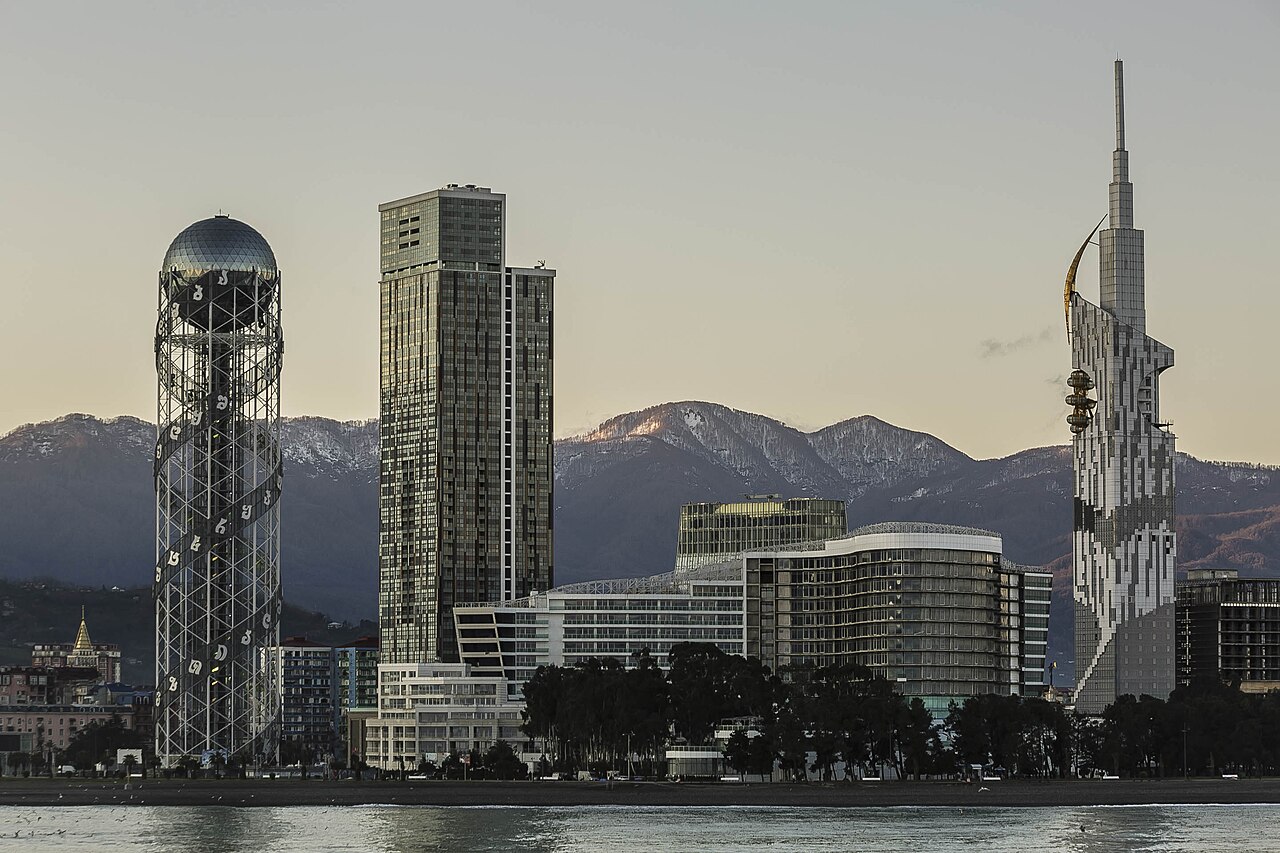
Batumi Boulevard is a seven-kilometer seaside promenade stretching along the Black Sea coast, lined with palm trees, sculptures, and cafés. It is in Batumi, Georgia. Most visitors spend 1–2 hours here. The free Lokali audio guide runs 9 minutes.
✓ Verified August 2026 · how we write these guides
Visitor facts
| Time needed | 1–2 hours |
|---|---|
| Lokali audio guide | 9 min · free |
| Type | Promenade |
| Best for | Editors' pick |
| Location | Batumi, Georgia |
| Coordinates | 41.6422, 41.6386 |
| Languages | 45, in the Lokali app |
The story
The sound hits you first — waves rolling onto dark stones, the hiss of foam drawing back, a rhythm older than the city itself. Batumi Boulevard stretches along the Black Sea coast for seven kilometres, a ribbon of palms and flowerbeds and promenades that has been the city's living room for more than a century. The air tastes of salt and carries the faint sweetness of magnolia in the warmer months. Underfoot, the pavement shifts between old flagstones and modern tile, each section telling a different chapter of the city's relationship with the water.
The boulevard began in the eighteen-nineties, when Batumi was a new oil port under the Russian Empire and the city fathers wanted a European-style seafront to match the wealth pouring in from the Caucasus pipelines. They planted palms — an exotic choice for this latitude, possible only because the subtropical climate here is the mildest on the eastern Black Sea. Those early trees are mostly gone now, replaced and replanted over generations, but the idea stuck. Today the boulevard mixes species from five continents: Mediterranean cypresses, Japanese maples, South American monkey-puzzles, all thriving in the humid warmth.
Walk north from the port and you pass through distinct eras of the city's life. The older stretches near the lighthouse retain a quieter, almost Belle Époque character — wrought-iron benches, low stone balustrades, a human scale. Further along, the boulevard widens and the planting becomes denser, almost jungle-like in summer. Locals come here in the early morning and late evening, when the heat backs off and the light turns gold over the water. Fishermen set up along the rocks. Families spread blankets. Teenagers cluster around the cafés that spill onto the pavement.
The modern sections, built in the two-thousands, are louder and more theatrical. Here the city installed fountains that dance to music, a towering Ferris wheel, a colonnade of white pillars that photographs beautifully against the blue of the sea. There is a moving sculpture of a man and woman — Ali and Nino, from a famous novel set partly in this region — who approach each other, merge for a moment, then pass through and separate again. The piece runs on a loop every ten minutes and draws crowds at sunset.
Scattered along the length of the boulevard are small pavilions and kiosks, some dating back decades, others brand new. In summer they sell churchkhela — strings of walnuts dipped in grape must, a Georgian sweet that looks like candles and tastes of concentrated autumn. There are stalls for corn on the cob, for ice cream, for coffee served thick and sweet in tiny cups. The smells layer over each other as you walk: charcoal, sugar, brine, flowers.
Batumi sits at the edge of the Lesser Caucasus, and on clear days you can see the mountains rising green and steep to the east, their tops sometimes dusted with snow even when the coast is warm. The contrast is part of the city's character — tropical palms in the foreground, alpine peaks in the distance, the sea in between. The boulevard is where that geography becomes a postcard, but it is also where the city comes to exhale, to walk off a meal, to argue, to flirt, to sit in silence and watch the light change.
The northern end of the boulevard fades into quieter residential streets and a small botanical garden. The southern end meets the port, where cargo ships and oil tankers still come and go, a reminder that Batumi has always been a working city, not just a resort. Between those two points, the boulevard is neither purely historical nor purely modern — it is a living thing, constantly replanted, repaved, reimagined, but always oriented toward the same horizon.
If you walk here in the late afternoon, the sun drops behind the city and the light comes sideways across the water, turning the surface silver. The mountains darken. The palms stand in silhouette. For a few minutes the whole promenade glows, and you understand why generations of planners and gardeners and city officials have kept pouring effort into this strip of land. It is not grand in the way of imperial boulevards, not ancient in the way of pilgrimage routes, but it is generous and open and it gives the city a place to meet the sea on equal terms.
As you leave, notice the benches facing the water. Most are occupied, even in winter. People sit alone with coffee, or in pairs, or in clusters of friends, all watching the same restless surface. The boulevard does not demand anything of you — no ticket, no schedule, no prescribed route. It simply offers the oldest human pleasure: a place to walk beside the water and let the mind drift.
Key facts
What to look for
Practical tips
Common questions
How long do you need at Batumi Boulevard?
Plan 1–2 hours. That is the time most visitors spend at Batumi Boulevard. The free Lokali audio guide adds about 9 minutes of narration you can listen to as you walk, so it fits inside your visit rather than adding to it.
Is there a free audio guide to Batumi Boulevard?
Yes — the Lokali app narrates Batumi Boulevard free of charge in 50+ languages. It covers the history, what to look for on site and practical tips, and it works offline once downloaded.
Where is Batumi Boulevard?
Batumi Boulevard is in Batumi, Georgia, at 41.6422, 41.6386. Tap the map link on this page for directions from where you are.
What should you know before visiting Batumi Boulevard?
Visit early morning or late evening for best light.
What is Batumi Boulevard known for?
Boulevard stretches seven kilometres along Black Sea coast.
What is the best time to visit Batumi Boulevard?
Walk the southern end near the lighthouse at sunset when locals bring their children to the small amusement rides and the air smells of grilled corn.
On the map
Opens directions to Batumi Boulevard from your location.
More to see in Batumi


Hear Batumi Boulevard in your language
The full story, narrated, in 50+ languages. Download it before you go and it plays offline, at your own pace, with no ticket and no tour group.