
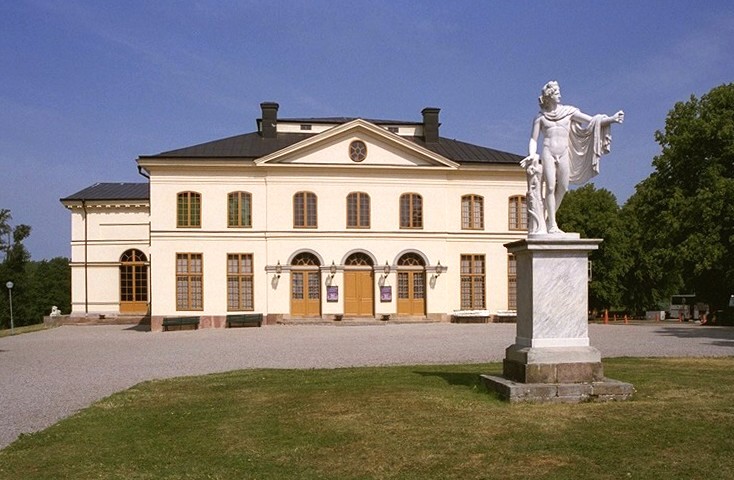
Photo: Jacob Truedson Demitz · Public domain · Wikimedia Commons
Hovgården is an archaeological site on the island of Adelsö in Sweden. UNESCO World Heritage Site together with Birka since 1993. The free Lokali audio guide runs 7 minutes.
✓ Published October 2026 · how we write these guides
Visitor facts
| Lokali audio guide | 7 min · free |
|---|---|
| Type | Archaeological Site |
| Location | Birka, Sweden |
| Coordinates | 59.3600, 17.5200 |
| Languages | 50+, in the Lokali app |
The story
Listen first. Wind moves through the long grass on the slopes. Somewhere below, water laps against a stony shore. The air smells of cut hay and lake water. You are standing on Adelsö, an island in Lake Mälaren. Across a narrow stretch of water lies Björkö, home of the Viking town of Birka. This quiet farmland, with its grassy mounds and old stone church, is Hovgården. More than a thousand years ago, this was where power lived.
The name gives a clue. In Old Swedish, a hov was linked to a royal estate or a household of authority, and gården means the farm. Historians believe this was a royal estate in the Viking Age. From here, a king or his representative could watch over the trade at Birka across the water. Merchants came to Birka. Kings, it seems, stayed here on Adelsö. The two places worked as a pair, and that is why they share one listing.
In 1993, Birka and Hovgården were added together to the UNESCO World Heritage List. The listing recognises them as a single landscape. One side held the busy market town. The other side held the estate of the ruler who protected it, and who probably took a share of its wealth. As you look across the strait, picture longships and trading boats moving between the islands. On a calm day, the distance feels very short.
Now turn your eyes to the large, rounded mounds on the rise near the church. These are burial mounds, and locals have long called them the King's Mounds. They are much bigger than ordinary grave mounds. Building them took many people and many days of work. Size like this was a message. It told every traveller on the lake that an important family ruled here. Some of the mounds have been investigated by archaeologists, but much about who lies inside them is still uncertain.
That uncertainty is worth holding on to. Popular tales sometimes name famous kings as the people buried here. Those stories are folklore, not proven history. What archaeologists can say is simpler and still remarkable. These mounds belong to the elite of the Viking Age and earlier, and they sit on the highest ground, facing the water. Whoever raised them chose this spot so that the dead could be seen.
Here is a detail many visitors miss. Excavations near the mounds have found traces of large buildings, including what appears to be a great hall. A hall like this was the heart of a royal estate. It was a place for feasts, for gifts, for oaths of loyalty. Nothing of it stands today. The ground is grass again. But under your feet, the post holes and floors of that world are still there, waiting quietly.
Walk down toward the water, near the ferry landing, and you will find a runestone. This is one of the most important texts on the island. It dates from the late Viking Age. The runes say that a man named Tolir, a royal steward, had the stone carved together with his wife, Gylla. The inscription also says a king named Håkon ordered the carving. That makes it rare. It is a written trace of royal power, standing right where boats once arrived.
Think about what that means. Most runestones remember a father, a son, or a husband. This one also records an office, the king's steward, the man who ran the estate in the king's name. It shows that Hovgården was more than a legend of chieftains. It was an organised place, with roles and duties. The carving runs in a serpent band, a common style for runestones in this part of Sweden. Look closely, and you can follow the snake's body with your eyes.
The story of Hovgården did not end with the Vikings. Birka faded away in the late tenth century, but the royal estate continued. In the late thirteenth century, a Swedish king built a brick palace here, called Alsnö hus. Today only low ruins remain, close to the shore. Yet this modest spot carries a big moment in Swedish history. Around 1280, a royal decree called the Ordinance of Alsnö was issued here. Historians often link it to the start of a Swedish nobility, because it freed those who served the king on horseback from certain taxes.
So stand by those ruins for a moment. This is a second surprise of the island. A place best known for Viking graves is also tied to the medieval birth of a noble class. The same stretch of shore saw both. The Viking hall and the brick palace stood centuries apart, but they served the same purpose. Both were places where a ruler showed his power over the lake and its traffic.
Now look at Adelsö church, with its white walls and its steep roof. Its oldest parts are medieval, from the time when Christianity was taking root in this region. Its position matters. It stands close to the pagan mounds, as if the new faith settled right beside the old. You can see the whole story of change in one view. Mounds for the old gods, a church for the new, and the lake that connected them all.
Today Hovgården is farmland and pasture. Sheep and cattle may graze among the monuments in summer, and their grazing keeps the grass short around the mounds. Paths cross the fields, and small signs explain the main sites. It is a quiet place. There are no great walls or towers. The power of the site is in the landscape itself, in how the ground rises, where the water bends, and what you can see from each point.
Before you leave, climb back up to a high spot near the mounds. Face the water and look toward Björkö. Notice the light on the lake, the dark line of the trees, the gentle shape of the islands. Kings once stood near here and looked at the same view, counting boats and measuring their wealth. Listen again to the wind in the grass. Then walk down slowly, past the church and the stones, carrying a little of this long, quiet history with you.
Key facts
What to look for
Practical tips
Common questions
Is there a free audio guide to Hovgården?
Yes — the Lokali app narrates Hovgården free of charge in 50+ languages. The guide runs about 7 minutes, covers the history, what to look for on site and practical tips, and works offline once downloaded.
Where is Hovgården?
Hovgården is near Birka, Sweden, at 59.3600, 17.5200. Tap the map link on this page for directions from where you are.
What is Hovgården known for?
UNESCO World Heritage Site together with Birka since 1993. Viking Age royal estate facing the trading town of Birka.
What should you look for at Hovgården?
Large grassy King's Mounds on the rise near the church. Serpent band of runes on the stone near the ferry. Low brick ruins of Alsnö hus close to the shore.
What should you know before visiting Hovgården?
Reach Adelsö by the car ferry from Munsö. Wear sturdy shoes for grassy, uneven paths between mounds.
On the map
Opens directions to Hovgården from your location.
More to see near Hovgården



Hear Hovgården in your language
The full story, narrated, in 50+ languages. Download it before you go and it plays offline, at your own pace, with no ticket and no tour group.