
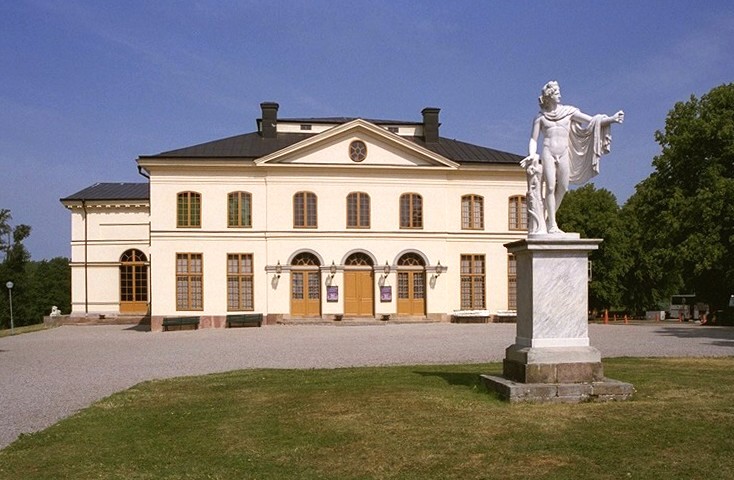
Photo: Xauxa Håkan Svensson · CC BY-SA 3.0 · Wikimedia Commons
Gripsholm Castle is a castle in Strängnäs Municipality, Sweden. Named after medieval noble Bo Jonsson Grip. The free Lokali audio guide runs 8 minutes.
✓ Published October 2026 · how we write these guides
Visitor facts
| Lokali audio guide | 8 min · free |
|---|---|
| Type | Castle |
| Location | Strängnäs, Sweden |
| Coordinates | 59.2561, 17.2192 |
| Official website | royalpalaces.se |
| Languages | 50+, in the Lokali app |
The story
Listen first. Water laps against the rocks below the walls, and somewhere a gull calls across Lake Mälaren. The brick under your gaze is a deep, weathered red, softened by centuries of wind off the lake. Round towers rise at the corners, heavy and squat, crowned with dark caps. This is Gripsholm Castle, standing at the edge of the small town of Mariefred. It looks less like a fairy-tale palace and more like a fortress that slowly learned to be a home.
The name comes from a man called Bo Jonsson Grip. He was one of the most powerful nobles in medieval Sweden, and in the late fourteenth century he built a stronghold on this small islet. The word holm means a small island in Swedish. So Gripsholm simply means Grip's island. Very little of his castle survives above ground today. What you see now belongs mostly to a later and far more ambitious builder.
That builder was Gustav Vasa, the king who broke Sweden away from the Kalmar Union with Denmark and founded a royal dynasty. From the 1530s he raised a new castle here, built for defence as much as for comfort. Look at the thickness of the towers. They were designed for an age of cannon, when walls had to absorb heavy shot. Gustav Vasa was a careful, suspicious ruler, and his castles show it. Gripsholm was a place to hold, not only a place to live.
Here is the first detail many visitors miss. The town beside you takes its name from a monastery. Before the castle rose, Carthusian monks lived nearby in a house called Pax Mariae, which means the peace of Mary. Mariefred is the Swedish form of that name. During the Reformation, Gustav Vasa closed the monastery and took its property for the crown. According to tradition, materials from the monastery went into the new castle walls. So the peace of Mary may still be inside this fortress.
The castle soon became a stage for family drama. Gustav Vasa's sons did not trust one another. His eldest, King Eric the Fourteenth, imprisoned his half-brother Duke John here, together with John's wife, the Polish princess Catherine Jagiellon. Their son Sigismund was born during that captivity. That baby later became king of both Poland and Sweden. Later still, the brothers' positions reversed, and Eric himself became a prisoner. Few buildings in Scandinavia hold so much royal rivalry within their walls.
Walk into the courtyards and the mood changes. The inner yard is enclosed and quiet. The walls block the wind, and voices sound closer here. Look for the shifts in brickwork and window shapes as you move around. Each century added rooms, staircases and new floors without removing everything that came before. The building shows layers of use, like rings in a tree. Kings came and went, and each one adjusted the castle to the taste and needs of their time.
Now the second surprise. Hidden inside one of the round towers is a small, perfect theatre. It was created for King Gustav the Third in the late eighteenth century. Gustav the Third loved drama. He wrote plays, staged them, and even acted in them himself. His theatre here is intimate, with tiers of seating curving around a compact stage. It is one of the best-preserved theatres of its period in Europe. Imagine candlelight on painted scenery, and the king watching from his place.
Gripsholm has another life as a gallery of faces. The castle holds the Swedish State Portrait Collection, begun in the early nineteenth century. It is one of the oldest national portrait collections in the world. Room after room, men and women of Swedish history look down from the walls. You will see monarchs in armour and silk, but also scientists, writers, artists and actors. The collection still grows today. Modern figures from Swedish public life continue to join the older faces.
Pause in front of a few portraits, and notice how they change across the centuries. Early panels are stiff and formal, with heavy fabrics and serious eyes. Later works grow softer and more personal. Closer to our own time, photography and new styles appear. Walking through these rooms is like turning the pages of a family album for an entire nation. It is easy to rush. Try instead to choose one face in each room and really look.
Outside, near the approach to the castle, look for stones that are far older than the bricks. Two carved runestones stand here. One is linked to the story of Ingvar the Far-Travelled, a Viking leader who led an expedition east in the eleventh century. Many of his men never came home, and families raised stones across this region to remember them. The runes on this stone honour a brother of Ingvar. It is a direct voice from the Viking Age, carved into rock.
Nearby you may also see two old bronze cannons. Locals call them the boar and the sow. According to the usual account, they were taken as war trophies from Russia in the late sixteenth century. Children love to touch them, and the metal is worn smooth in places by many hands. Their nicknames show the Swedish humour that softens even objects of war. Look at the decoration on the barrels and the green tones of aged bronze.
Gripsholm also lives in literature. The German writer Kurt Tucholsky set a light, summery novel here, simply called Gripsholm Castle, published in the early 1930s. It follows a couple on holiday by the lake and captures a gentle Swedish summer. Tucholsky left Germany as the political climate darkened, and he spent his last years in Sweden. He is buried in the churchyard of Mariefred, not far from the castle. Many German readers still come here because of his book.
Getting here can be part of the experience. In summer, an old steamship travels across the lake from Stockholm to Mariefred, and a heritage steam railway runs from the nearby junction. Mariefred itself is small and walkable, with wooden houses, a church and a quiet harbour. Take time after your visit to walk along the waterline. From the shore you can see the castle's full silhouette reflected in the lake, especially on still mornings and evenings.
Before you leave, stand back and take in the whole building once more. The red walls, the dark towers, the water all around. A medieval noble chose this rock, a Reformation king rebuilt it, a theatre-loving monarch filled it with music, and a nation hung its faces inside. As you walk away, listen again to the water against the stones. It was here before Bo Jonsson Grip arrived. It will still be here long after today's visitors have gone home.
Key facts
What to look for
Practical tips
Common questions
Is there a free audio guide to Gripsholm Castle?
Yes — the Lokali app narrates Gripsholm Castle free of charge in 50+ languages. The guide runs about 8 minutes, covers the history, what to look for on site and practical tips, and works offline once downloaded.
Where is Gripsholm Castle?
Gripsholm Castle is in Strängnäs, Sweden, at 59.2561, 17.2192. Tap the map link on this page for directions from where you are.
What is Gripsholm Castle known for?
Named after medieval noble Bo Jonsson Grip. Present castle begun by Gustav Vasa in the 1530s.
What should you look for at Gripsholm Castle?
Runestone honouring a brother of Ingvar the Far-Travelled. Two bronze cannons nicknamed the boar and the sow. Changing brickwork patterns around the inner courtyard.
What should you know before visiting Gripsholm Castle?
Arrive by summer steamship from Stockholm for the classic approach. Walk the shoreline afterward for full reflected views.
When is the best time to visit Gripsholm Castle?
Arrive by summer steamship from Stockholm for the classic approach.
On the map
Opens directions to Gripsholm Castle from your location.
More to see near Gripsholm Castle



Hear Gripsholm Castle in your language
The full story, narrated, in 50+ languages. Download it before you go and it plays offline, at your own pace, with no ticket and no tour group.