
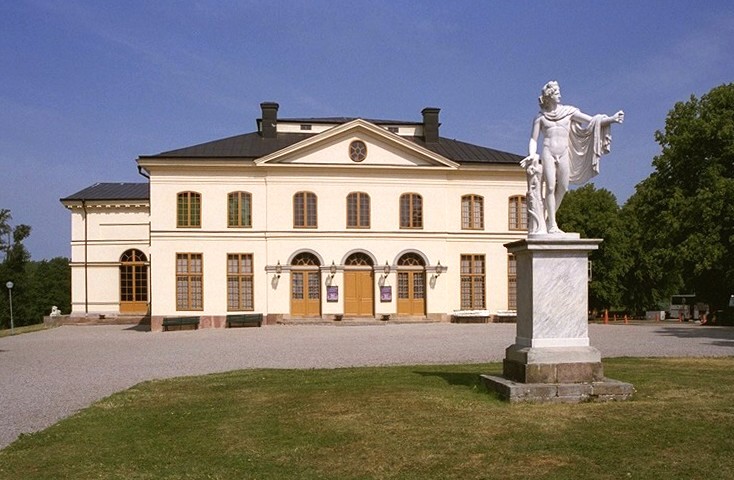
Photo: ROFI44WIK · CC BY-SA 3.0 · Wikimedia Commons
Tullgarn Palace is a royal palace in Södertälje Municipality, Sweden. Built in the 1720s for Count Magnus Julius De la Gardie. The free Lokali audio guide runs 7 minutes.
✓ Published October 2026 · how we write these guides
Visitor facts
| Lokali audio guide | 7 min · free |
|---|---|
| Type | Palace |
| Location | Södertälje, Sweden |
| Coordinates | 58.9503, 17.5844 |
| Languages | 50+, in the Lokali app |
The story
Listen first. Gravel shifts under your shoes, and somewhere beyond the trees there is the low sound of water. The air here carries salt and cut grass together. In front of you stands a long, pale palace with neat rows of windows. It does not tower over you. It sits calmly in the landscape, as if it has always belonged to this quiet stretch of coast south of Stockholm. This is Tullgarn Palace, and it has been a country retreat for Swedish royalty for a long time.
Tullgarn began as a nobleman's house, not a royal one. In the 1720s, the estate belonged to Count Magnus Julius De la Gardie, a member of one of Sweden's most powerful aristocratic families. The house was built for him in the style of the period: symmetrical, orderly, and restrained. The design is generally credited to the French-born architect Joseph Gabriel Destain. Look at the facade and you can see that early eighteenth-century taste. Balance matters more than ornament here.
At that time, Sweden was coming out of a long and exhausting period of war. The great age of Swedish military power had ended, and the nobility turned to building comfortable homes on their estates. Tullgarn belongs to that moment. It is not a fortress and it is not a show of conquest. It is a house made for living well, close to the water, with fields and woods around it. That quiet purpose still shapes the feeling of the place today.
Later in the eighteenth century, the estate passed to the Crown. King Gustav the Third gave Tullgarn to his younger brother, Duke Fredrik Adolf. This is the first surprise for many visitors. The palace you see is closely tied not to a ruling king but to a royal brother, a prince with time, money, and a strong interest in fashionable interiors. Under the duke, the rooms inside were transformed into something new.
That new style is called Gustavian. It is the Swedish version of neoclassicism, the late eighteenth-century fashion that looked back to ancient Greece and Rome. In Sweden, it took a lighter form. Think of soft greys and pale blues, white plaster, slender furniture legs, and delicate garlands. Compared with the heavy gold of earlier courts, Gustavian rooms feel cool and airy. Tullgarn holds some of the finest examples of this style anywhere in the country.
As you walk through the duke's rooms, notice how light moves across the walls. The colours are chosen to catch the pale northern daylight that comes off the water. Mirrors placed between windows double that light. Chairs stand against the walls, as they would have in the period, ready to be pulled into the room for conversation or cards. Nothing here is accidental. These rooms were designed as a complete picture, where furniture, walls, and light work together.
Then, about a century later, Tullgarn changed again. In the late nineteenth century, the palace became the summer home of the future King Gustav the Fifth and his wife, Victoria of Baden. Victoria was German by birth, and she brought tastes from the continent with her. She loved Tullgarn deeply and spent long summers here. Under her care, many rooms were redecorated in the fashions of her own era.
This is the second surprise. Tullgarn is really two palaces inside one building. On one side, you find the pale elegance of the eighteenth century. On the other, you find the darker, richer interiors of the late nineteenth century, with carved wood, heavy textiles, and revival styles inspired by earlier European periods. Walking from one to the other feels like turning a page between two very different chapters of royal life.
Victoria's rooms tell us a lot about how royal families lived around 1900. These were not formal state rooms for receptions. They were spaces for summer comfort: reading, family meals, letters, and rest. The decoration shows the fashion of the time for warm, enclosed, layered interiors. Compare the bright Gustavian rooms to these, and you can almost feel the change in how people wanted a home to feel, from airy and public to cosy and private.
Outside, the park extends toward the water. Much of it follows the English landscape style, which became popular in Sweden in the late eighteenth century. Instead of strict geometric beds, it offers winding paths, open lawns, and carefully placed groups of trees. The idea was to make nature look natural, even when every view had been planned. Take a few minutes to walk away from the house, then turn around. The palace is framed by trees, exactly as intended.
The setting is part of the story. Tullgarn lies in Södertälje Municipality, in a rural landscape of farms, forest, and inlets of the Baltic Sea. For royal families, this was the point. It was close enough to reach from Stockholm, yet far enough to feel like a real escape. Even today, the drive here passes fields and red farmhouses, and the palace appears almost suddenly at the end of the approach.
Tullgarn is still one of the Swedish royal palaces, managed by the Royal Court, and the rooms are shown to visitors mainly during the summer season. That seasonal rhythm suits the place. It was always a summer house, and it still lives most fully when the days are long and the light lasts late into the evening. Guided tours take you through the interiors, so you see the rooms the way they are meant to be seen.
Before you leave, stand still for a moment on the gravel in front of the house. Look at the plain, even rhythm of the windows, and remember the two worlds behind them: a duke's pale, careful elegance and a queen's warm summer rooms. Listen again for the water beyond the trees. As you walk back toward the road, notice how quickly the palace slips behind the green, and how the quiet of the countryside returns.
Key facts
What to look for
Practical tips
Common questions
Is there a free audio guide to Tullgarn Palace?
Yes — the Lokali app narrates Tullgarn Palace free of charge in 50+ languages. The guide runs about 7 minutes, covers the history, what to look for on site and practical tips, and works offline once downloaded.
Where is Tullgarn Palace?
Tullgarn Palace is in Södertälje, Sweden, at 58.9503, 17.5844. Tap the map link on this page for directions from where you are.
What is Tullgarn Palace known for?
Built in the 1720s for Count Magnus Julius De la Gardie. Design generally credited to architect Joseph Gabriel Destain.
What should you look for at Tullgarn Palace?
Pale grey and blue tones in the Gustavian rooms. Mirrors placed between windows to double the daylight. Dark carved wood in the late nineteenth-century rooms.
What should you know before visiting Tullgarn Palace?
Plan your visit for summer, when the interiors are shown. Book a guided tour to see the palace rooms.
When is the best time to visit Tullgarn Palace?
Plan your visit for summer, when the interiors are shown.
On the map
Opens directions to Tullgarn Palace from your location.
More to see near Tullgarn Palace



Hear Tullgarn Palace in your language
The full story, narrated, in 50+ languages. Download it before you go and it plays offline, at your own pace, with no ticket and no tour group.