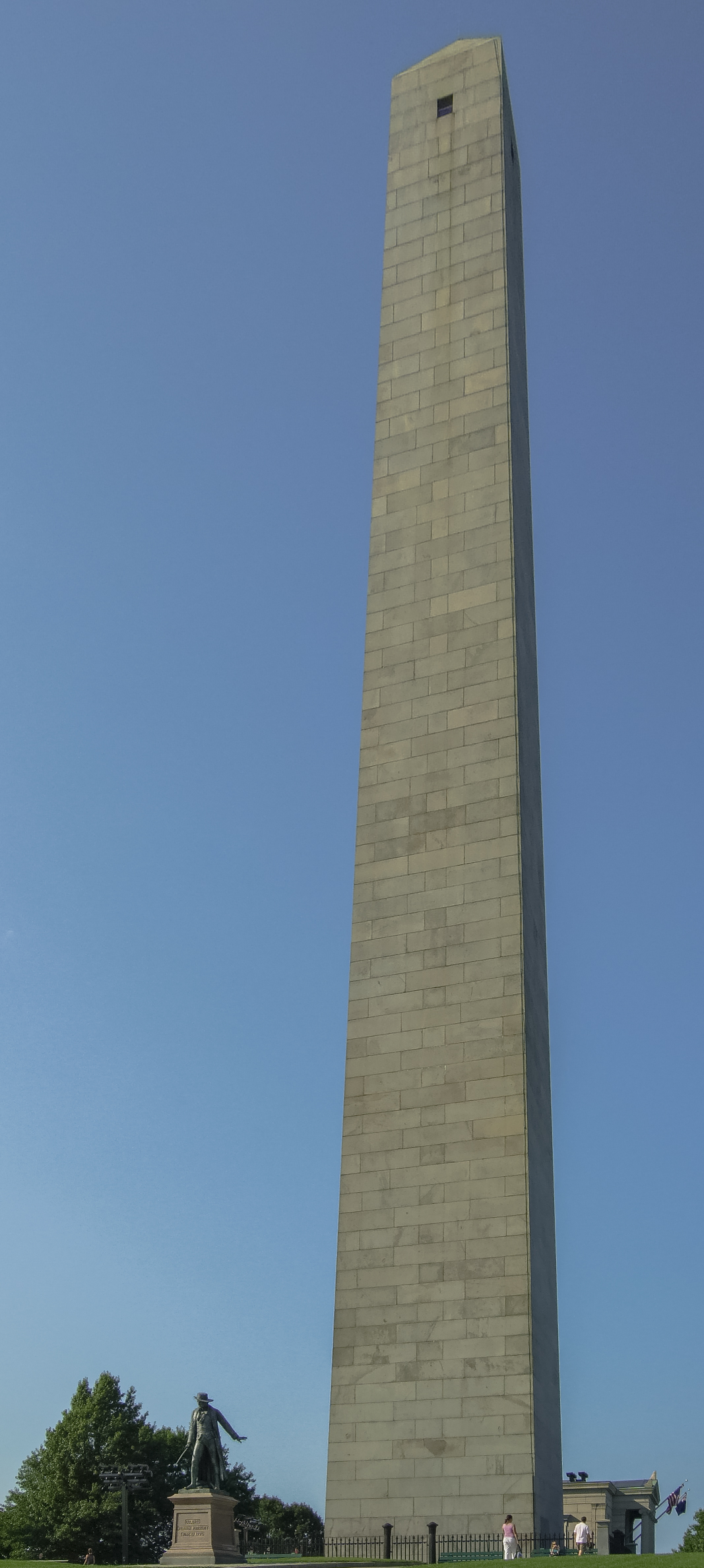
Photo: Diego Delso · CC BY-SA 4.0 · Wikimedia Commons
Bunker Hill Monument is a military museum. It is in Boston, United States. The battle was fought on June 17, 1775. The free Lokali audio guide runs 7 minutes.
✓ Published October 2026 · how we write these guides
Visitor facts
| Lokali audio guide | 7 min · free |
|---|---|
| Type | Museum |
| Location | Boston, United States |
| Coordinates | 42.3764, -71.0608 |
| Languages | 50+, in the Lokali app |
The story
Start at the bottom of the hill. Feel the slope under your feet as you climb toward the grey shaft at the top. The granite is cool to the touch, even on a summer afternoon. Around you, the brick row houses of Charlestown sit close together, with narrow sidewalks and old trees. Somewhere below, traffic hums across the bridges into Boston. Up here it is quieter. You can hear wind across the open lawn, and the soft echo of footsteps from inside the obelisk.
This is the Bunker Hill Monument. It marks one of the first major battles of the American Revolution, fought on June 17, 1775. Here is the first surprise, and most visitors miss it. You are not actually standing on Bunker Hill. You are on Breed's Hill, a lower rise closer to the harbour. Bunker Hill itself is a short walk to the northwest. The colonial forces were ordered to fortify Bunker Hill, but they dug in here instead. The battle kept the more famous name anyway.
Picture this hilltop on the night before the battle. Some weeks earlier, after the fighting at Lexington and Concord, thousands of colonial militiamen had surrounded British-held Boston. On the night of June 16, a force of these men climbed this hill in the dark. They worked fast with shovels and picks. By dawn they had built an earthen fort, called a redoubt, on the summit. British sailors on warships in the harbour woke up to a surprise.
The British commanders decided to attack directly. Their soldiers crossed the water by boat and marched up these slopes in formation. Twice the colonial defenders drove them back with heavy fire. On the third assault, the defenders ran low on gunpowder. They fought with musket butts and stones, then retreated across the narrow neck of land behind them. By the end of the day, the British held the hill. Most of Charlestown below had burned.
So why build a monument to a battle the colonists lost? Because the cost to the British was enormous. More than a thousand of their soldiers were killed or wounded in a single afternoon. That was far more than the colonial losses. The battle showed that ordinary farmers and tradesmen could stand against professional troops. It changed what both sides believed was possible, and it made a long war almost certain.
You have probably heard the famous order: "Don't fire until you see the whites of their eyes." It is often credited to Colonel William Prescott, or to General Israel Putnam. Historians are not sure anyone actually said it here. Similar phrases appear in earlier European wars. The practical meaning was real, though. The defenders had little powder, and every shot needed to count. So they waited until the enemy came very close.
Look at the bronze statue in front of the obelisk. That is William Prescott, who commanded the men in the redoubt. He holds a sword and leans forward, as if watching the slope below. Many people also remember Doctor Joseph Warren, a Boston physician and patriot leader. He chose to fight here as an ordinary volunteer and was killed in the final assault. His death made him one of the first great martyrs of the Revolution. A statue of Warren stands inside the small lodge at the base.
Now look up at the obelisk itself. An obelisk is a tall, four-sided stone pillar that narrows to a pyramid point, a form first used in ancient Egypt. This one rises 221 feet, roughly 67 metres. The architect was Solomon Willard. The granite came from quarries in Quincy, south of Boston. To move such heavy blocks, builders created the Granite Railway, horse-drawn cars on tracks. It is often called one of the first commercial railways in the United States. Here is your second surprise: an American railway history begins with this monument.
The monument took a long time to finish. The cornerstone was laid in 1825, on the fiftieth anniversary of the battle. The Marquis de Lafayette, the French general who had fought for American independence, attended the ceremony. The statesman Daniel Webster gave the main speech. Then the money ran out. Construction stopped and started for years. In the 1840s, a large fair helped raise funds, and women organisers played a central role in that effort. The monument was finally completed and dedicated in 1843, with Webster speaking again.
There is a quiet link between this hill and Paris. According to a well-known story, Lafayette took soil from Bunker Hill home to France. When he died, that earth was placed on his grave. The details vary in different tellings. But Americans still place a flag at his tomb in Paris. It is a small reminder that this was not only a local fight. Other nations watched, and some of them joined.
If you go inside, you will find a spiral stone staircase of 294 steps. There is no elevator. The stairwell is narrow, and the walls are close on both sides. Your breath gets louder as you climb. Small openings at the top give views over Charlestown, the harbour, and the towers of downtown Boston. Across the street, the Bunker Hill Museum displays exhibits about the battle and a large painted panorama of the fighting.
This hill is also the end point of the Freedom Trail. The trail is a red line of brick and paint that links historic sites across Boston. Many walkers finish here, tired, after crossing the Charlestown Bridge. The monument is part of Boston National Historical Park, and park rangers often give short talks on the lawn. Listen to them if you can. They know the ground well, and they can point to where the redoubt likely stood.
Before you leave, take a slow turn around the base. Notice how the granite blocks fit tightly together, with thin lines between them. Notice how the city has grown up close around this open square of grass. Families sit on the benches. Dogs pull their owners along the paths. Nearly two and a half centuries ago, men dug trenches on this same slope through a summer night. Now, as you walk down the hill, the streets of Charlestown are calm and ordinary. That calm is part of the story too.
Key facts
What to look for
Practical tips
Common questions
Is there a free audio guide to Bunker Hill Monument?
Yes — the Lokali app narrates Bunker Hill Monument free of charge in 50+ languages. The guide runs about 7 minutes, covers the history, what to look for on site and practical tips, and works offline once downloaded.
Where is Bunker Hill Monument?
Bunker Hill Monument is in Boston, United States, at 42.3764, -71.0608. Tap the map link on this page for directions from where you are.
What is Bunker Hill Monument known for?
The battle was fought on June 17, 1775. Most of the fighting happened on Breed's Hill.
What should you look for at Bunker Hill Monument?
Bronze statue of William Prescott facing the slope. Statue of Doctor Joseph Warren inside the lodge. Tight joints between the Quincy granite blocks.
What should you know before visiting Bunker Hill Monument?
Wear good shoes for the steep walk uphill. Climb all 294 steps only if you are comfortable.
On the map
Opens directions to Bunker Hill Monument from your location.
More to see in Boston


Hear Bunker Hill Monument in your language
The full story, narrated, in 50+ languages. Download it before you go and it plays offline, at your own pace, with no ticket and no tour group.