
Isabella Stewart Gardner Museum
42.3382° N · 71.0991° W · Museum
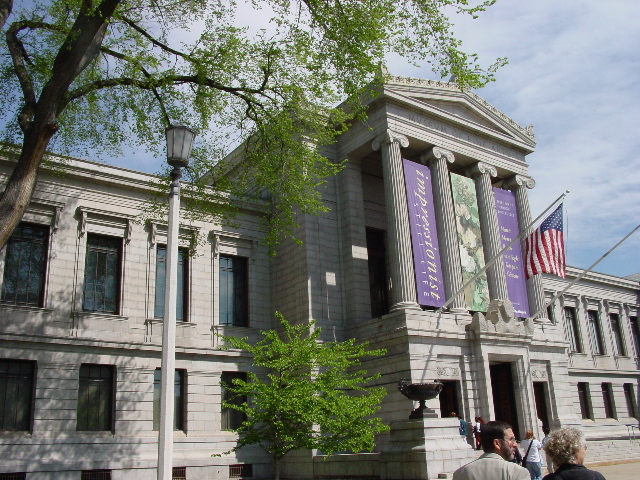
Photo: Biruitorul · Public domain · Wikimedia Commons
Isabella Stewart Gardner Museum is an art museum in Boston, Massachusetts, United States. The museum first opened to the public in 1903. The free Lokali audio guide runs 7 minutes.
✓ Published October 2026 · how we write these guides
Visitor facts
| Lokali audio guide | 7 min · free |
|---|---|
| Type | Museum |
| Location | Boston, United States |
| Coordinates | 42.3382, -71.0991 |
| Official website | gardnermuseum.org |
| Languages | 50+, in the Lokali app |
The story
Before you notice the paintings, you notice the light. It falls from a glass roof four storeys up, softened and warm, onto a courtyard full of living plants. The air is cooler here, and slightly damp, like a greenhouse. Somewhere water trickles. The noise of Boston's Fenway neighbourhood, the traffic and the buses, seems to stop at the walls. You are standing inside a Venetian-style palace that sits a long way from Venice.
This place exists because of one woman, Isabella Stewart Gardner. She was born in New York and married into a wealthy Boston family. She travelled widely, and she collected with a sharp eye and real conviction. Boston society found her unconventional, and stories about her spread quickly. Some of those stories are true. Others grew in the retelling. What is certain is that she built this house to hold her collection. She lived in it, and she shared it with the public.
The building opened to visitors in 1903. Its design takes inspiration from the old palaces along the Grand Canal in Venice. Look up at the courtyard walls. You will see pointed windows, carved balconies, and pale stone framed in soft pink. Many of these architectural pieces came from Europe. Gardner had real fragments of old buildings shipped across the ocean and set into new walls. So the facade around you is part reconstruction and part genuine antique, built to face inward rather than out to the street.
The courtyard is the heart of the museum, and it changes with the seasons. Gardeners rotate the plants throughout the year, so the colours you see today may be different next month. In spring, there is a long tradition of hanging nasturtiums. These are long trailing vines of orange flowers, and they fall many metres from the balconies above. At any time of year, the green and the stone together create a calm, enclosed world. Many visitors simply sit here for a while before they go upstairs.
Now look down. Near the centre of the courtyard floor lies an ancient Roman mosaic. Its central figure is Medusa, the woman from Greek myth whose gaze turned people to stone. Do not worry... she is set into the floor, and she is quite safe to look at. It is a small surprise that many visitors walk past without noticing. A piece of ancient Rome lies at your feet, surrounded by flowers, under a Boston sky.
Here is the detail that makes this museum unlike almost any other. Gardner arranged every room herself. She chose which painting hung beside which chair, which textile lay on which table. In her will, she asked that the arrangement stay as she left it. Nothing was to be added, and nothing was to be moved around. So when you walk through these galleries, you see her vision more or less intact. There are few wall labels in the old rooms. The museum asks you to look, not read.
This gives the rooms a domestic feeling. Paintings hang close together, sometimes high and sometimes low. Furniture, ceramics, letters, and books share the space with great works of art. Light comes through windows and is often kept low to protect fragile objects. Your eyes may need a moment to adjust. It can feel less like a gallery and more like walking through someone's home after they have just stepped out of the room.
Gardner did not build this collection alone. She worked with advisers, most famously the art historian Bernard Berenson, who helped her find Italian Renaissance paintings. Among her greatest treasures is a painting by Titian, the great Venetian master of the sixteenth century. It shows the myth of Europa, carried off across the sea by the god Zeus in the form of a bull. Many art historians consider it one of the finest Titians outside Europe. It hangs in a room that carries his name.
Another artist was also a friend. John Singer Sargent, the American portrait painter, knew Gardner well. He painted her portrait in the late nineteenth century, and it caused talk in Boston at the time. Downstairs, in a space built to frame it like a stage, hangs his large painting called El Jaleo. It shows a Spanish dancer in motion, lit from below, with musicians behind her. Stand back and watch how the lighting makes her seem to move.
And now, the darkest chapter in the museum's story. In March of 1990, two men dressed as police officers talked their way inside during the night. They tied up the guards and stole thirteen works of art. Among them were a painting by Vermeer called The Concert and Rembrandt's only known seascape, a stormy scene on the Sea of Galilee. It remains one of the largest art thefts in history. More than three decades later, the case is still unsolved, and nothing has been recovered.
Because of Gardner's wishes, the museum did not fill the gaps with other paintings. Instead, the empty frames still hang on the walls in the Dutch Room. This is perhaps the most striking sight in the building. You look at a gilded frame around nothing at all, just the fabric of the wall. The museum continues to offer a large reward for information. Those empty frames are a kind of open question, hanging in plain view.
In 2012, the museum opened a new wing designed by the Italian architect Renzo Piano. It sits beside the old palace and does not try to copy it. The new building uses glass, copper, and clean lines. It holds a concert hall, gallery space for changing exhibitions, and areas for visitors. The contrast is deliberate. The old house stays as Gardner left it, while the new wing lets the museum keep growing in music, contemporary art, and public programmes.
Before you leave, come back to the courtyard one more time. Notice the sound of water, and the way the light has shifted since you arrived. Look at the balconies and imagine Isabella herself looking down at her guests. Then, as you step back into the streets of the Fenway, notice how suddenly the city returns. The traffic, the wind, the brick buildings. Behind you, the flowers keep growing under glass, quietly, just as she intended.
Key facts
What to look for
Practical tips
Common questions
Is there a free audio guide to Isabella Stewart Gardner Museum?
Yes — the Lokali app narrates Isabella Stewart Gardner Museum free of charge in 50+ languages. The guide runs about 7 minutes, covers the history, what to look for on site and practical tips, and works offline once downloaded.
Where is Isabella Stewart Gardner Museum?
Isabella Stewart Gardner Museum is in Boston, United States, at 42.3382, -71.0991. Tap the map link on this page for directions from where you are.
What is Isabella Stewart Gardner Museum known for?
The museum first opened to the public in 1903. Gardner's will asked that her arrangements remain unchanged.
What should you look for at Isabella Stewart Gardner Museum?
Empty gilded frames still hanging in the Dutch Room. Roman mosaic of Medusa set into the courtyard floor. Sargent's El Jaleo framed like a stage downstairs.
What should you know before visiting Isabella Stewart Gardner Museum?
Sit in the courtyard first to let your eyes adjust. Visit in spring to see the hanging orange nasturtiums.
When is the best time to visit Isabella Stewart Gardner Museum?
Visit in spring to see the hanging orange nasturtiums.
On the map
Opens directions to Isabella Stewart Gardner Museum from your location.
More to see in Boston


Hear Isabella Stewart Gardner Museum in your language
The full story, narrated, in 50+ languages. Download it before you go and it plays offline, at your own pace, with no ticket and no tour group.