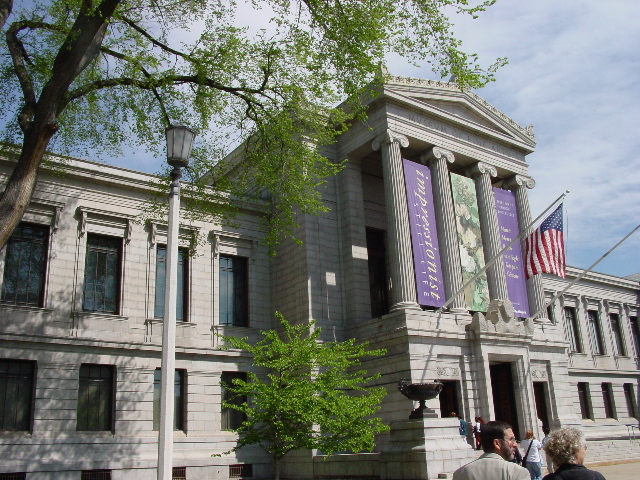
Museum of Fine Arts, Boston
42.3394° N · 71.0942° W · Museum
Photo: Martin~jawiki at Japanese Wikipedia · CC BY-SA 3.0 · Wikimedia Commons
Museum of Fine Arts, Boston is an art museum in Boston, Massachusetts, United States. Founded in 1870 by a group of Boston citizens. The free Lokali audio guide runs 7 minutes.
✓ Published October 2026 · how we write these guides
Visitor facts
| Lokali audio guide | 7 min · free |
|---|---|
| Type | Museum |
| Location | Boston, United States |
| Coordinates | 42.3394, -71.0942 |
| Official website | mfa.org |
| Languages | 50+, in the Lokali app |
The story
Stand for a moment on Huntington Avenue and listen. The green Line trolley rattles past behind you, and ahead rises a long facade of pale grey granite. Tall columns line the front, calm and even, like a row of people waiting in silence. Before you go in, look at the lawn. A bronze rider sits on a horse, arms open, face lifted to the sky. This is where the Museum of Fine Arts begins, on a street locals call the Avenue of the Arts.
That rider has a name. The sculpture is called Appeal to the Great Spirit, by the artist Cyrus Dallin. It shows a Native American man on horseback, and it has stood at this entrance since the early twentieth century. Many visitors walk straight past it. But it is worth a slow look. Dallin grew up in Utah, and he spent much of his career making images of Native American life. Today, the statue also prompts harder questions about how those stories were told, and by whom.
The museum itself is older than this building. It was founded in 1870 by a group of Boston citizens, and it first opened its doors in 1876, the year America marked its hundredth birthday. That first home stood in Copley Square, in a brick building that no longer exists. Boston was growing fast, and so was the collection. By the start of the twentieth century, the museum needed far more space.
So it moved here, to the Fenway area, in 1909. The architect Guy Lowell designed this classical building, with its long galleries and its grand central stairway. Since then, the museum has kept growing in every direction. Today the collection holds close to half a million objects. That number is hard to picture... so think of it this way. You could visit every week for years and still find rooms you have never entered.
Inside, climb the main staircase and look up. The ceiling of the rotunda is covered with murals by John Singer Sargent — the American painter best known for his portraits of wealthy society. Here he worked on something very different: gods, muses, and figures from classical myth, set into the architecture itself. Sargent worked on these paintings in the last years of his life, in the early 1920s. Many people climb these stairs without ever raising their eyes. Take a moment. It changes the whole feeling of the climb.
Sargent appears again in the galleries, and one painting tends to stop people. It is called The Daughters of Edward Darley Boit. Four young sisters stand and sit in a dim, high-ceilinged room. They do not pose neatly together. Two stand back in the shadows, almost swallowed by the dark. Beside the painting, look for two very tall Japanese vases. They appear in the picture too, and the real vases now stand in the gallery next to it.
That painting lives in the Art of the Americas Wing, which opened in 2010. It was designed by the British firm of Norman Foster, and its glass-covered courtyard fills with soft daylight. Inside the wing, the story of the Americas runs from ancient times to the twentieth century. You can trace it floor by floor, from art made long before European contact to paintings from colonial Boston and beyond.
This is also where Boston's revolutionary past comes close. Look for a silver bowl made by Paul Revere — yes, the same Paul Revere who rode at night to warn of British troops. Before he became a legend, he was a silversmith. Nearby hangs his portrait by John Singleton Copley. Revere sits in his shirtsleeves, holding a silver teapot, his tools on the table. It is a portrait of a working man, not a hero, and that is part of its power.
Now for a surprise. This museum holds one of the largest collections of Japanese art outside Japan. In the late nineteenth century, several Bostonians travelled to Japan and brought back paintings, prints, ceramics and Buddhist sculpture. One of them, Okakura Kakuzō, was a Japanese scholar who later worked at the museum itself. Outside, there is a small Japanese garden called Tenshin-en, made of raked gravel, stone and carefully shaped plants. When it is open, it is one of the quietest places in the building.
A second surprise waits in the ancient galleries. For decades in the early twentieth century, the museum ran a joint expedition with Harvard University in Egypt, digging near the great pyramids at Giza. Much of what they found came back here. The best-known piece is a stone statue of the pharaoh Menkaure standing beside his queen. Her arm wraps around his waist. After more than four thousand years, the gesture still looks tender and human.
The European galleries hold some of the most loved pictures in the city. The museum has a large group of paintings by Claude Monet, the French Impressionist who painted light on water, haystacks and cathedrals. Look also for Renoir's Dance at Bougival, a couple turning in each other's arms. And find Paul Gauguin's long painting with the title written in its corner: Where Do We Come From? What Are We? Where Are We Going? It is a question worth carrying through the rest of your visit.
Near the Fenway entrance, on the other side of the building, two giant bronze heads of a baby rest on the ground. One has its eyes open. The other has its eyes closed. They are called Day and Night, by the Spanish artist Antonio López García. Children love to stand beside them, and adults often do too. They are a good reminder that this museum is not only about the past. Its contemporary galleries keep adding new voices.
As you leave, walk out slowly. The granite steps, the columns, the trolley sounds — they return just as they were. But something has changed. You have looked at a pharaoh and his queen, a silversmith with his teapot, four sisters in a dark room. Turn back once and look at the long facade. Somewhere inside, a stranger is standing where you stood, raising their eyes to Sargent's ceiling for the very first time.
Key facts
What to look for
Practical tips
Common questions
Is there a free audio guide to Museum of Fine Arts, Boston?
Yes — the Lokali app narrates Museum of Fine Arts, Boston free of charge in 50+ languages. The guide runs about 7 minutes, covers the history, what to look for on site and practical tips, and works offline once downloaded.
Where is Museum of Fine Arts, Boston?
Museum of Fine Arts, Boston is in Boston, United States, at 42.3394, -71.0942. Tap the map link on this page for directions from where you are.
What is Museum of Fine Arts, Boston known for?
Founded in 1870 by a group of Boston citizens. First opened in Copley Square in 1876.
What should you look for at Museum of Fine Arts, Boston?
Sargent's murals on the rotunda ceiling above the stairs. Japanese vases beside Sargent's painting of the Boit sisters. Paul Revere holding a teapot in Copley's portrait.
What should you know before visiting Museum of Fine Arts, Boston?
Allow at least half a day to explore properly. Pick two or three wings rather than everything.
On the map
Opens directions to Museum of Fine Arts, Boston from your location.
More to see in Boston


Hear Museum of Fine Arts, Boston in your language
The full story, narrated, in 50+ languages. Download it before you go and it plays offline, at your own pace, with no ticket and no tour group.