
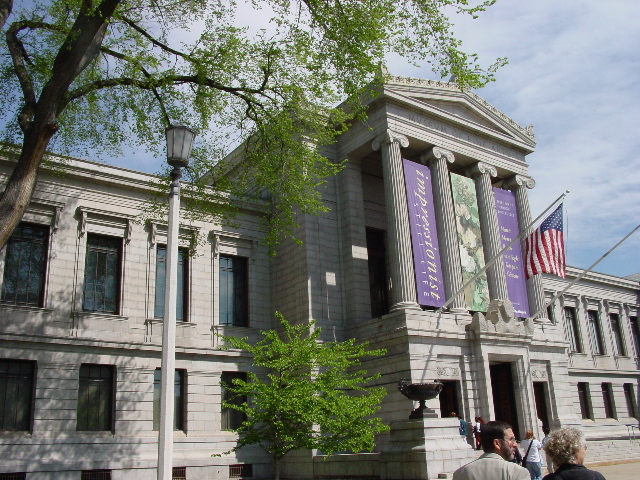
Photo: Kafka Liz · Public domain · Wikimedia Commons
Museum of Bad Art is a museum with branches in Massachusetts, United States and Quebec. It is in Boston, United States. The collection began with a painting found in curbside trash. The free Lokali audio guide runs 7 minutes.
✓ Published October 2026 · how we write these guides
Visitor facts
| Lokali audio guide | 7 min · free |
|---|---|
| Type | Museum |
| Location | Boston, United States |
| Coordinates | 42.3219, -71.0625 |
| Official website | museumofbadart.org |
| Languages | 50+, in the Lokali app |
The story
Listen for a moment. Somewhere nearby, someone is trying not to laugh. Then the laugh comes anyway, short and surprised, and it echoes off a low ceiling. That sound is part of the experience here. You are standing in a museum where the paintings are not hung to make you feel small. They are hung to make you feel human. Look at the frames, the uneven brushwork, the colours that argue with each other. Welcome to the Museum of Bad Art.
The story begins with garbage. In the early 1990s, an antiques dealer named Scott Wilson was walking past trash left out on a Boston-area curb. Among the rubbish he spotted a painting. It showed an elderly woman in a field of flowers, arms raised, with a sky that seemed to be doing something it should not. Wilson kept the frame. Then he looked again at the canvas and decided the picture was the real treasure.
That painting became known as Lucy in the Field with Flowers. Wilson showed it to friends, including Jerry Reilly, and the group began collecting more works like it. At first the paintings hung in a private home, and friends came over to see them. Word spread. Soon the gatherings grew too large for a living room. By the mid-1990s the collection had a name, a mission, and a small public gallery.
And where did that first gallery open? Not in a grand marble hall. It opened in the basement of a community theatre in Dedham, a town just outside Boston. Over the years the collection has moved between several modest spaces in and around the city, including theatre basements. This matters. The museum has always lived in humble rooms, close to ordinary life. That setting is part of the joke, and part of the warmth.
Now, here is the first thing most visitors miss. The museum does not collect just any bad art. There are rules. A work must be original. It must be made with sincere intent. The artist must have truly tried. Mass-produced kitsch does not qualify. Velvet paintings of crying clowns, sold by the thousand, usually do not qualify either. The curators look for something more specific... a real attempt at beauty that went wonderfully wrong.
That is why the laughter here is rarely cruel. Look closely at the piece in front of you. Someone chose that canvas. Someone mixed those colours, perhaps late at night, perhaps with great hope. Maybe they wanted to paint their dog, their city, or their mother. The result missed the target, but the effort is visible in every stroke. The museum describes its works with a kind of affection. The motto is short and honest: art too bad to be ignored.
So where do these paintings come from? Many arrive the way Lucy did. People find them at yard sales, in thrift shops, in attics, or beside the trash. Some come straight from the artists themselves, who donate them with a sense of humour. The curators turn down far more than they accept. It is harder to make it into this collection than you might think. Being merely dull is not enough. A painting has to stop you.
Now turn your attention to the labels on the wall. Read one or two before you look at the painting again. These small texts are a large part of the pleasure. The curators write them in the voice of a serious art museum, with careful observations about composition, mood, and technique. The gap between that formal tone and the picture beside it is where the comedy lives. Many visitors say the labels are their favourite part.
One well-known work in the collection plays with art history directly. It is called Sunday on the Pot with George. The title nods to a famous nineteenth-century painting by Georges Seurat, the French artist who built pictures from thousands of tiny dots. The museum's version keeps the dotted style but places its subject somewhere far less elegant than a riverside park. It is a good reminder that bad art often talks to great art.
Here is the second surprise. This museum has suffered an art theft. In the 1990s, a painting called Eileen disappeared from the gallery. Thefts from major museums make headlines for their millions. This one made headlines for a different reason. The museum responded in its own style, offering a reward of only a few dollars for the painting's return. The story travelled widely, and it showed that even bad art can be wanted badly.
Step back for a moment and think about what this place asks of you. In most galleries, you are told what is good. You nod, and you move on. Here, nobody tells you what to admire. You decide. You might find one painting that you honestly love, mistakes and all. That happens more often than people expect. Taste is personal, and these rooms make that idea very easy to feel.
There is also something quietly local about the museum. It grew from neighbours, friends, and community spaces around Boston, a city full of serious institutions and old universities. This collection answers all that seriousness with a grin. Yet it is run with real care. The paintings are catalogued, framed, and protected. They are treated as a collection, because that is exactly what they are.
Before you leave, choose one painting and give it a full minute. Not a glance — a real minute. Notice the hand behind it. Notice where the artist worked hardest, perhaps on an eye, a cloud, or a strange tree. Notice where they gave up. In that minute, the painting stops being a joke. It becomes a record of one person trying to make something beautiful.
As you walk back out, listen again for that laughter. It may follow you to the door. Outside, the ordinary world returns, with its signs, its traffic, and its strangers. Look around on your way home. Somewhere, perhaps in a shop window or a café wall, there is another sincere painting waiting to be noticed. Now you know how to see it.
Key facts
What to look for
Practical tips
Common questions
Is there a free audio guide to Museum of Bad Art?
Yes — the Lokali app narrates Museum of Bad Art free of charge in 50+ languages. The guide runs about 7 minutes, covers the history, what to look for on site and practical tips, and works offline once downloaded.
Where is Museum of Bad Art?
Museum of Bad Art is in Boston, United States, at 42.3219, -71.0625. Tap the map link on this page for directions from where you are.
What is Museum of Bad Art known for?
The collection began with a painting found in curbside trash. The founding work is called Lucy in the Field with Flowers.
What should you look for at Museum of Bad Art?
Curators' labels written in a solemn, formal museum voice. Sunday on the Pot with George and its dotted style. Uneven brushwork where the artist clearly tried hardest.
What should you know before visiting Museum of Bad Art?
Read each wall label before looking closely at the painting. Check the museum's current location before you travel there.
On the map
Opens directions to Museum of Bad Art from your location.
More to see in Boston



Hear Museum of Bad Art in your language
The full story, narrated, in 50+ languages. Download it before you go and it plays offline, at your own pace, with no ticket and no tour group.