
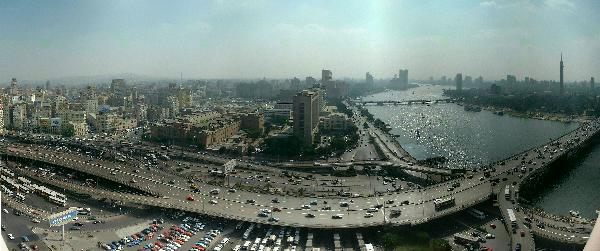
Photo: Mohamedusrii · CC BY 4.0 · Wikimedia Commons
Cairo Tower is a free-standing concrete tower in Zamalek, Cairo, Egypt. Opened in 1961 under President Gamal Abdel Nasser. The free Lokali audio guide runs 7 minutes.
✓ Published October 2026 · how we write these guides
Visitor facts
| Lokali audio guide | 7 min · free |
|---|---|
| Type | Tower |
| Location | Cairo, Egypt |
| Coordinates | 30.0458, 31.2244 |
| Official website | cairotower.net |
| Languages | 50+, in the Lokali app |
The story
Stand at the foot of the tower and tilt your head back. The concrete above you is not smooth. It is woven, a tight crisscross lattice that climbs upward like the skin of a plant stem. Around you, Cairo's traffic hums across the bridges, car horns rise and fall, and a warm breeze comes off the Nile. You are standing on an island in the middle of one of the world's great rivers, beneath one of the city's most recognisable modern shapes.
This is Cairo Tower. It stands on Gezira Island, a long strip of land in the Nile, in the district of Zamalek. Gezira simply means island in Arabic. For centuries this ground was river silt and gardens. Later it filled with sporting clubs, villas and green lawns. Today the tower rises above the treetops here, and you can see it from much of central Cairo. It works as a compass point for anyone lost in the city's streets.
The tower was built in the late 1950s and opened in 1961. Egypt was a very young republic then. The monarchy had ended in 1952, and Gamal Abdel Nasser now led the country. Nasser wanted symbols of a confident, independent Egypt. He backed big projects, from factories to dams. This tower was one of those statements, written in concrete against the sky. It said that modern Egypt could build tall, and build on its own terms.
The architect was an Egyptian, Naoum Shebib. He was known for his work with reinforced concrete, which is concrete strengthened with steel bars inside. Shebib gave the tower a shape with deep roots in Egyptian culture. Look again at that lattice. It is meant to suggest the lotus plant. In ancient Egypt the lotus was a sacred flower. It appears on temple columns, in tomb paintings and in royal symbols. Here, a five-thousand-year-old motif becomes a twentieth-century tower.
Now for a story that many visitors never hear. According to a popular account, often repeated in books and by locals, the money for the tower has a political twist. The tale says that an American agency offered Nasser a large sum, quietly, to win his favour. Nasser, the story goes, did not want the money for himself. He spent it on this tower instead, a very public monument that anyone could see. Treat the details as contested, but the story is part of the tower's identity in Cairo.
Think about what that story means, if it is true. A private gift became a public landmark. A quiet favour became something no one in the city could ignore. Some Cairenes still tell it with a smile, as a joke about pride and defiance. Whatever the full truth, the story shows how Egyptians in that era saw their country. They wanted to stand apart from the great powers of the Cold War, and not be bought by either side.
The tower is roughly 187 metres tall, which made it the tallest structure in Egypt for many years. To put that in context, it is taller than the Great Pyramid of Giza. That comparison mattered to people at the time. Ancient Egypt had built the tallest structures of its age. Modern Egypt, with this tower, reached upward again. Over the decades, newer towers have risen in the region, but this one kept its place in the city's heart.
At the base, take a moment before you go up. Look at the entrance and the stonework around it. Notice how the lattice begins low and then tightens as it rises. Up close, you can see the joints and the weathering on the concrete, marks of sixty years of sun, dust and river air. The tower was renovated in the 2000s, and the work refreshed its interior and lighting. The basic shape, though, is still Shebib's original design.
Inside, a lift carries visitors up the shaft. The ride is short, but your ears may notice the climb. Near the top there is an observation deck that wraps around the tower. There is also a restaurant, which has been known for rotating slowly, so diners see the whole city turn past their table. Step out onto the open deck. The wind is stronger up here. The traffic noise below fades into a low, steady murmur.
Now look out. Cairo spreads in every direction, a sea of rooftops in sand, cream and grey. Below you, the Nile runs north toward the Mediterranean, wide and brown-green, with feluccas, the traditional sailing boats, gliding along the water. To the east, look for the minarets and domes of Islamic Cairo. Further east, the hills of Mokattam rise behind the city. On the island itself you can see the green spaces and sports grounds of Gezira.
Here is something many visitors miss. Face west and southwest on a clear day, and look toward the far edge of the city. You may see the Pyramids of Giza, small triangles on the desert horizon. Haze and dust often hide them, so do not be disappointed if they do not appear. When the air is clean, after wind or rain, the view stretches a long way. Seeing ancient pyramids from a modern tower is a moment few cities can offer.
The light changes the tower's character through the day. At midday the city looks pale and flat under a strong sun. In the late afternoon the stone buildings turn gold, and the river shines like metal. After dark, Cairo becomes a field of lights, with the bridges drawing bright lines across the Nile. The tower itself is lit at night, and from the streets below its lattice glows against the dark sky.
When you come back down, pause again at the base. Listen to the city around you, the horns, the voices, perhaps the call to prayer drifting across the water from a distant mosque. Look up one last time at the lotus lattice rising above you. As you walk toward the bridge, turn around now and then. You will see the tower over the trees, keeping watch over the river, as it has since the early 1960s.
Key facts
What to look for
Practical tips
Common questions
Is there a free audio guide to Cairo Tower?
Yes — the Lokali app narrates Cairo Tower free of charge in 50+ languages. The guide runs about 7 minutes, covers the history, what to look for on site and practical tips, and works offline once downloaded.
Where is Cairo Tower?
Cairo Tower is in Cairo, Egypt, at 30.0458, 31.2244. Tap the map link on this page for directions from where you are.
What is Cairo Tower known for?
Opened in 1961 under President Gamal Abdel Nasser. Designed by Egyptian architect Naoum Shebib.
What should you look for at Cairo Tower?
The crisscross concrete lattice shaped like a lotus stem. Feluccas with white sails moving along the Nile below. Pyramids of Giza on the far southwestern horizon.
What should you know before visiting Cairo Tower?
Choose a clear, low-haze day for the best long views. Go up in late afternoon to see the city turn gold.
When is the best time to visit Cairo Tower?
Go up in late afternoon to see the city turn gold.
On the map
Opens directions to Cairo Tower from your location.
More to see in Cairo


Hear Cairo Tower in your language
The full story, narrated, in 50+ languages. Download it before you go and it plays offline, at your own pace, with no ticket and no tour group.