
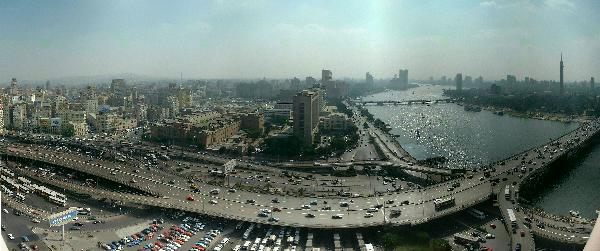
Photo: Frank Schulenburg · CC BY-SA 3.0 · Wikimedia Commons
Qasr El Nil Bridge is a bridge in Egypt. Name means Palace of the Nile, after a vanished palace. The free Lokali audio guide runs 6 minutes.
✓ Published October 2026 · how we write these guides
Visitor facts
| Lokali audio guide | 6 min · free |
|---|---|
| Type | Bridge |
| Location | Cairo, Egypt |
| Coordinates | 30.0437, 31.2297 |
| Languages | 50+, in the Lokali app |
The story
Stand still for a moment and feel the bridge move. It is a faint tremor, rising up through the soles of your feet each time a bus rolls past. The air smells of exhaust, river water and charcoal smoke. Car horns overlap in long, uneven chords. Below the railings, the Nile slides north, wide and brown-green. This is Qasr El Nil Bridge, and for well over a century it has carried Cairo across its river.
The bridge joins two very different parts of the city. Behind you, at the eastern end, lies Tahrir Square and the grid of downtown Cairo. Ahead, at the western end, is Gezira, a long island in the middle of the Nile. Gezira holds the Cairo Opera House, sports clubs, gardens and the leafy district of Zamalek. So, in a few hundred steps, you move from the city's political heart to one of its greenest corners.
The name means "Palace of the Nile." It comes from a royal palace that once stood on the eastern bank near this crossing. That palace was later used as barracks, and the buildings are long gone. Only the name remains. Cairenes often shorten it and simply say "Kobri Qasr El Nil." Kobri is the everyday Egyptian word for bridge. If you ask a taxi driver for directions, that is the phrase to use.
The first bridge on this spot belongs to the age of Khedive Ismail. A khedive was the ruler of Egypt under nominal Ottoman authority. In the 1860s and 1870s, Ismail wanted Cairo to look like a modern European capital. He laid out new boulevards, gardens and squares, and he wanted a permanent crossing to Gezira. That first iron bridge opened around 1871. It was one of the earliest fixed bridges across the Nile in Cairo.
The structure you are standing on now is its replacement. It was built in the early 1930s, during the reign of King Fuad, and opened in 1933. The work was carried out by the British engineering firm Dorman Long. The same company later built the Sydney Harbour Bridge. Look at the steel underneath and along the sides. You can see the riveted plates and girders of interwar engineering, painted over many times since.
Now walk to either end and look for the lions. Four large bronze lions guard the bridge, two at each approach. They are older than the steel beneath you. They were made in the nineteenth century by the French sculptor Henri Alfred Jacquemart, and they were placed here for Ismail's original bridge. When the new bridge rose in the 1930s, the lions stayed. They are the oldest pieces of this crossing you can touch.
Here is a story you will likely hear on the bridge. Locals say the lions have no tongues. According to a popular tale, the sculptor was so ashamed of this mistake that he took his own life. It is folklore, not history. Look closely, and in good light you can judge the mouths for yourself. Egyptians also use the lions in a joke. Someone who stays silent is said to be like the lions of Qasr El Nil.
This bridge also holds a hard chapter of recent history. On the 28th of January 2011, during the uprising against President Hosni Mubarak, protesters marched across it toward Tahrir Square. Riot police met them here. Water cannon and tear gas filled the span, and crowds pushed forward under the spray. Photographs from that afternoon spread around the world. For many Egyptians, this crossing is still linked with that day.
Today the mood is usually gentler, especially after sunset. As the heat drops, families and young couples drift onto the bridge. They lean on the railings and watch the river turn orange and then dark. Vendors set up small carts. You may smell corn roasting on hot coals, or sweet potatoes baked in metal ovens. Others sell glasses of sweet tea, lupin beans in paper cones, or bright balloons for children.
Look down at the water. White-sailed feluccas move slowly between the banks. A felucca is a traditional wooden sailing boat, used on the Nile for thousands of years in one form or another. Now most of them carry visitors and families on short evening trips. Larger party boats also pass, with coloured lights and loud music. Their bass notes carry up to the bridge long before the boats themselves come close.
Turn north and look along Gezira. A slender tower with a lattice surface rises above the trees. That is the Cairo Tower, built in the early 1960s. Its pattern is meant to suggest a lotus plant, a symbol that goes back to ancient Egypt. To the east, the hotels and office blocks of the Corniche line the riverbank. The Corniche is the long riverside road where Cairenes walk in the evenings.
One small surprise for many visitors... the Nile here is not the whole river. Gezira splits it into two channels. The bridge you are on crosses the main, wider channel. On the far side of the island, a narrower arm runs past the Zamalek and Agouza districts. So the island under the Opera House is truly an island, surrounded by moving water, even though the city covers almost every metre of it.
Before you leave, rest your hand on the railing and listen once more. The traffic hums and the river runs on below it. The lions keep their silent watch at each end, as they have for generations. As you walk away, toward Tahrir or toward the gardens of Gezira, notice how the sound of the city changes. The bridge holds both halves of Cairo together, one crossing at a time.
Key facts
What to look for
Practical tips
Common questions
Is there a free audio guide to Qasr El Nil Bridge?
Yes — the Lokali app narrates Qasr El Nil Bridge free of charge in 50+ languages. The guide runs about 6 minutes, covers the history, what to look for on site and practical tips, and works offline once downloaded.
Where is Qasr El Nil Bridge?
Qasr El Nil Bridge is near Cairo, Egypt, at 30.0437, 31.2297. Tap the map link on this page for directions from where you are.
What is Qasr El Nil Bridge known for?
Name means Palace of the Nile, after a vanished palace. First bridge here opened around 1871 under Khedive Ismail.
What should you look for at Qasr El Nil Bridge?
Four bronze lions guarding the two ends of the bridge. The lions' mouths, subject of a local legend. Riveted steel girders along the bridge's sides.
What should you know before visiting Qasr El Nil Bridge?
Come around sunset when locals stroll and vendors appear. Walk the full span from Tahrir toward the Opera House.
When is the best time to visit Qasr El Nil Bridge?
Come around sunset when locals stroll and vendors appear.
On the map
Opens directions to Qasr El Nil Bridge from your location.
More to see in Cairo



Hear Qasr El Nil Bridge in your language
The full story, narrated, in 50+ languages. Download it before you go and it plays offline, at your own pace, with no ticket and no tour group.