
Photo: RoccaCalascio · CC BY-SA 4.0 · Wikimedia Commons
Castle of Rocca Calascio is a castle in Calascio (AQ), Italy. Sits at roughly 1,460 metres above sea level. The free Lokali audio guide runs 7 minutes.
✓ Published October 2026 · how we write these guides
Visitor facts
| Lokali audio guide | 7 min · free |
|---|---|
| Type | Castle |
| Location | Calascio, Italy |
| Coordinates | 42.3289, 13.6889 |
| Languages | 50+, in the Lokali app |
The story
Listen first. Up here the wind is often the loudest thing you will hear. It moves across the open grass, pulls at your jacket, and hums against the stone. Under your feet the path is pale limestone, worn smooth by centuries of boots and hooves. Ahead of you, a ruined fortress rises straight out of the rock, as if the mountain grew it. This is the Castle of Rocca Calascio, high in the Apennine mountains of Abruzzo.
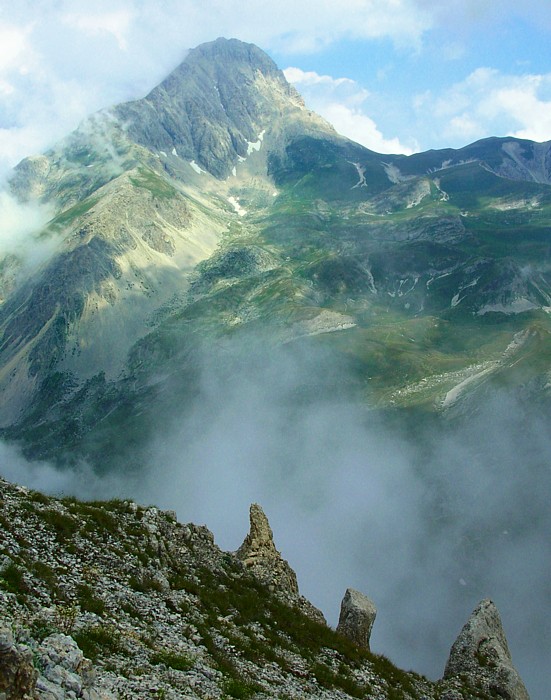
Take a moment to look around. You stand at roughly 1,460 metres above sea level, which makes this one of the highest fortresses in Italy. To one side, the land falls away into deep valleys. To the other, the ground opens toward the high plateau of Campo Imperatore, a long, treeless upland. The whole area now lies inside the Gran Sasso and Monti della Laga National Park. On a clear day you can see for many kilometres in almost every direction... and that view is the reason the castle exists.
The story begins with a single tower. Historians generally place the first watchtower here around the tenth or eleventh century. It was a lookout, not a palace. From this ridge a guard could watch the valleys below and the routes across the mountains. He could also send signals by fire or smoke to other towers in the region. A message could cross a whole landscape faster than any rider on horseback.
Over the following centuries, the single tower grew into a true fortress. Builders added a ring of walls around the central keep, the strong inner tower at the heart of the castle. At the corners they placed four round towers. Look at their shape. Round towers were harder to break with siege weapons than square ones, and defenders could shoot along the walls from them. Much of this work dates to the thirteenth and fourteenth centuries.
Now look closely at the stone itself. The walls are built from the same pale local limestone as the ridge, so the castle and the rock almost blend together. The builders used the mountain as part of the defence. In places, the walls sit directly on the bedrock. Notice too how small the entrance is. In the Middle Ages, entry was by a wooden ramp or drawbridge that defenders could remove. An attacker would face a sheer wall with no easy way in.
Here is a detail many visitors miss. This castle was never just about war. It also protected a working economy, and that economy ran on sheep. For centuries, enormous flocks grazed the summer pastures of Campo Imperatore. In autumn, shepherds drove them south along ancient droving tracks, called tratturi, toward the warmer plains of Puglia. This seasonal movement is known as transhumance. Wool from these flocks brought real wealth to the mountain villages.
That wealth attracted powerful owners. Over the centuries, control of Calascio and the surrounding lands passed between several noble families. In the later sixteenth century, the area came under the Medici of Florence, the same banking dynasty famous for their art and politics. It can be surprising to find a Florentine name in such a remote place. But wool and pasture land were serious business, and these mountains were worth owning.
Then came the earth itself. In 1703, a powerful earthquake struck this part of the Apennines. The castle was badly damaged, and the village below suffered too. The fortress was never fully rebuilt as a working stronghold. Over the following generations, people slowly left. Many moved down to the larger village of Calascio below, or emigrated much further. By the twentieth century, the old hilltop settlement was largely empty.
As you walked up, you passed through that small hamlet beneath the castle. Look again at its stone houses on the way back down. Many have been carefully restored in recent decades. Some now host visitors in a model sometimes called a scattered hotel, where rooms are spread across different old houses rather than one building. This approach keeps the original buildings in use. It also brings people back into lanes that once stood almost silent.
Now turn your attention a short walk away from the castle, to the small, many-sided church nearby. This is the Church of Santa Maria della Pietà. Its plan is octagonal, which means it has eight sides, and it dates from around the late sixteenth or seventeenth century. Locals tell a story about it. According to one popular tale, villagers fought and defeated a band of brigands on this hillside, and they built the church to give thanks. Treat it as legend rather than documented history.
You may feel that you have seen this place before. If so, there is a good reason. Filmmakers have come here for decades because the ridge looks like a medieval world with no modern buildings in sight. Scenes for the fantasy film Ladyhawke, from 1985, were shot at the castle. The Name of the Rose, released the following year, also used the area. Later, the George Clooney film The American was filmed in villages nearby. The landscape plays the main character.
As you explore the ruins, watch your footing. The ground inside is uneven, and there are few barriers along the edges. The weather also changes quickly at this height. A warm valley morning can become a cold, windy afternoon up here, and fog can roll in and hide the view in minutes. That change is part of the experience. One moment the castle stands sharp against the blue sky, and the next it fades into grey.
Before you leave, stand still for one more moment. Feel the wind again, the same wind the guards felt in their tower a thousand years ago. Look out toward the plateau, where sheep may still be grazing far below. Then look back at the pale walls, the round towers, and the small octagonal church on the slope. As you walk down the path, turn around once or twice. Watch how the castle seems to grow back into the mountain behind you.
Key facts
What to look for
Practical tips
Common questions
Is there a free audio guide to Castle of Rocca Calascio?
Yes — the Lokali app narrates Castle of Rocca Calascio free of charge in 50+ languages. The guide runs about 7 minutes, covers the history, what to look for on site and practical tips, and works offline once downloaded.
Where is Castle of Rocca Calascio?
Castle of Rocca Calascio is in Calascio, Italy, at 42.3289, 13.6889. Tap the map link on this page for directions from where you are.
What is Castle of Rocca Calascio known for?
Sits at roughly 1,460 metres above sea level. First watchtower dates to around the tenth or eleventh century.
What should you look for at Castle of Rocca Calascio?
Four round towers at the corners of the walls. Walls built directly onto the bare limestone bedrock. The small raised entrance once reached by a removable ramp.
What should you know before visiting Castle of Rocca Calascio?
Bring a windproof layer, even on warm summer days. Wear sturdy shoes for the uneven limestone path.
When is the best time to visit Castle of Rocca Calascio?
Come early morning or late afternoon for softer light.
On the map
Opens directions to Castle of Rocca Calascio from your location.
More to see near Castle of Rocca Calascio

Hear Castle of Rocca Calascio in your language
The full story, narrated, in 50+ languages. Download it before you go and it plays offline, at your own pace, with no ticket and no tour group.