
Photo: PaestumPaestum · CC BY 4.0 · Wikimedia Commons
Alba Fucens is an ancient town. It is near Massa d'Albe, Italy. Founded as a Roman colony around the late fourth century BCE. The free Lokali audio guide runs 6 minutes.
✓ Published October 2026 · how we write these guides
Visitor facts
| Lokali audio guide | 6 min · free |
|---|---|
| Type | Archaeological Site |
| Location | Massa d'Albe, Italy |
| Coordinates | 42.0791, 13.4115 |
| Official website | albafucens.info |
| Languages | 50+, in the Lokali app |
The story
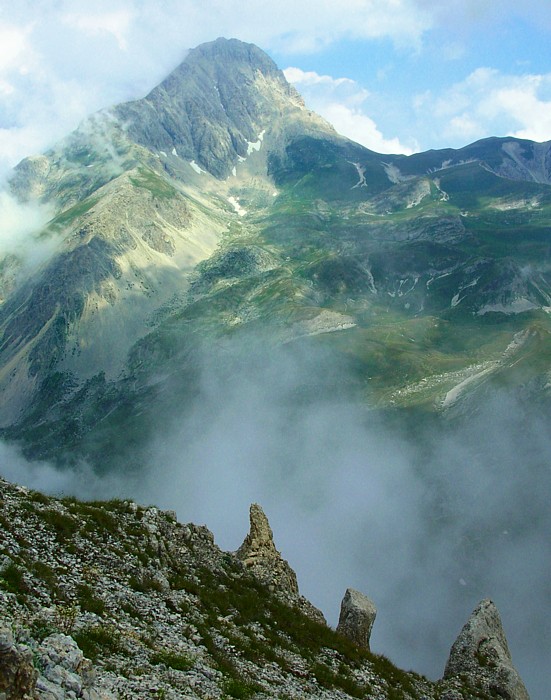
Listen first. Wind comes down from the slopes of Monte Velino and moves through the grass between grey stones. Somewhere a sheep bell rings. Underfoot, the paving is uneven and worn smooth. These are the slabs of a Roman street, and you are standing inside a city that was laid out more than two thousand years ago. Around you, the mountains of Abruzzo rise on almost every side, pale and quiet.
This is Alba Fucens. Rome founded it as a colony at the very end of the fourth century before Christ. The Roman historian Livy says that thousands of settlers were sent here. Their task was simple and hard. They had to hold a high basin in the central Apennines, the mountain chain that runs down the spine of Italy. This land belonged to the Aequi, a local people who had fought Rome for generations.
The position was chosen with great care. Alba Fucens sits on a raised plateau between three hills. From here, the settlers could watch the routes that crossed the mountains toward the Adriatic coast. Later, a great Roman road called the Via Valeria ran right through the town. If you follow the main street with your eyes, you are tracing the line that soldiers, merchants and mule trains once walked.
Now look toward the edges of the site. The town is ringed by walls built from huge, irregular blocks of limestone. The stones are not cut into neat rectangles. Instead, each one is shaped to lock against its neighbours, with no mortar at all. This style is called polygonal masonry, and it is one of the oldest building techniques in central Italy. The circuit runs for roughly three kilometres, and long sections still stand.
Here is something many visitors miss. Alba Fucens was more than a frontier town. It was also a prison for kings. Rome sent defeated foreign rulers here, far from the sea and far from any friendly army. Ancient writers record that Syphax, a king of Numidia in North Africa, was held here. So was Perseus, the last king of Macedon. Imagine a royal captive, used to palaces, looking out at these same cold peaks.
At the heart of the town lies the forum, the open public square of any Roman city. Around it you can still trace the plan of a basilica, a large hall used for law courts and business. Nearby are the remains of a covered market and of public baths. The walls are low now, often only knee height. But the layout is clear. You can walk from shop to hall to bath and feel the daily routine of the place.
Look for the long colonnaded street lined with stumps of pillars. Behind the columns were rows of small shops. Some still show their stone thresholds, with grooves where wooden shutters once slid into place each night. Close by is a sanctuary of Hercules, the hero and god of strength. Excavators found a large marble statue of Hercules there. The original is now kept in a museum, but the sacred enclosure remains where it stood.
Now turn to the hill called San Nicola. Cut into its slope is an amphitheatre, the oval arena where crowds watched games and gladiator fights. An inscription records that it was paid for by the will of Naevius Sutorius Macro. He was a powerful commander of the imperial guard under the emperor Tiberius, and he came from this town. A local boy who rose to the centre of Roman power left his hometown a stage for its festivals.
On another hill stands the church of San Pietro. It is built directly on top of a Roman temple, generally identified as a temple of Apollo. You can see ancient columns reused inside the medieval structure. The church holds a carved pulpit and a choir screen decorated with Cosmatesque work. That means fine inlays of coloured marble and stone pieces set into geometric patterns, a craft typical of medieval central Italy.
The church has its own story of survival. In 1915, a powerful earthquake struck the Avezzano area and destroyed the old hilltop village of Albe. San Pietro was badly damaged too. In the decades after the Second World War, it was carefully rebuilt, using its original stones wherever possible. The modern village moved lower down the slope. So the ruins of the medieval settlement now sit beside the ruins of the Roman one.
Much of what you see was uncovered fairly recently. For centuries, the Roman town lay under fields and pasture. Systematic excavation began after the Second World War, led by Belgian archaeologists working with Italian authorities. Their digs brought the streets, the forum and the amphitheatre back to the surface. That is a second surprise for many visitors. A city this old has been visible in this form for less than a century.
The landscape has changed as well. Below you, to the south, stretches the wide, flat plain of the Fucino. This was once a large lake, the Fucine Lake. The Romans tried to drain it through a long tunnel under the emperor Claudius. The lake was finally drained in the nineteenth century, and today the old lakebed is farmland. When the settlers first arrived, they would have looked down on water instead of fields.
Before you leave, stand still for a moment near the forum. Look at the walls, then the hills, then the peaks above them. The stones under your feet carried carts, prisoners, priests and traders. Now they carry you. As you walk back toward the village, notice how the grass grows between the paving slabs, and how quiet this mountain town has become.
Key facts
What to look for
Practical tips
Common questions
Is there a free audio guide to Alba Fucens?
Yes — the Lokali app narrates Alba Fucens free of charge in 50+ languages. The guide runs about 6 minutes, covers the history, what to look for on site and practical tips, and works offline once downloaded.
Where is Alba Fucens?
Alba Fucens is near Massa d'Albe, Italy, at 42.0791, 13.4115. Tap the map link on this page for directions from where you are.
What is Alba Fucens known for?
Founded as a Roman colony around the late fourth century BCE. Defensive walls run roughly three kilometres around the town.
What should you look for at Alba Fucens?
Huge interlocking polygonal blocks in the town walls. Shop thresholds with grooves for sliding wooden shutters. Reused Roman columns inside the church of San Pietro.
What should you know before visiting Alba Fucens?
Wear sturdy shoes for the uneven Roman paving stones. Bring a layer; mountain wind can feel cold here.
When is the best time to visit Alba Fucens?
Visit in morning light when the Velino slopes are clearest.
On the map
Opens directions to Alba Fucens from your location.
More to see near Alba Fucens


Hear Alba Fucens in your language
The full story, narrated, in 50+ languages. Download it before you go and it plays offline, at your own pace, with no ticket and no tour group.