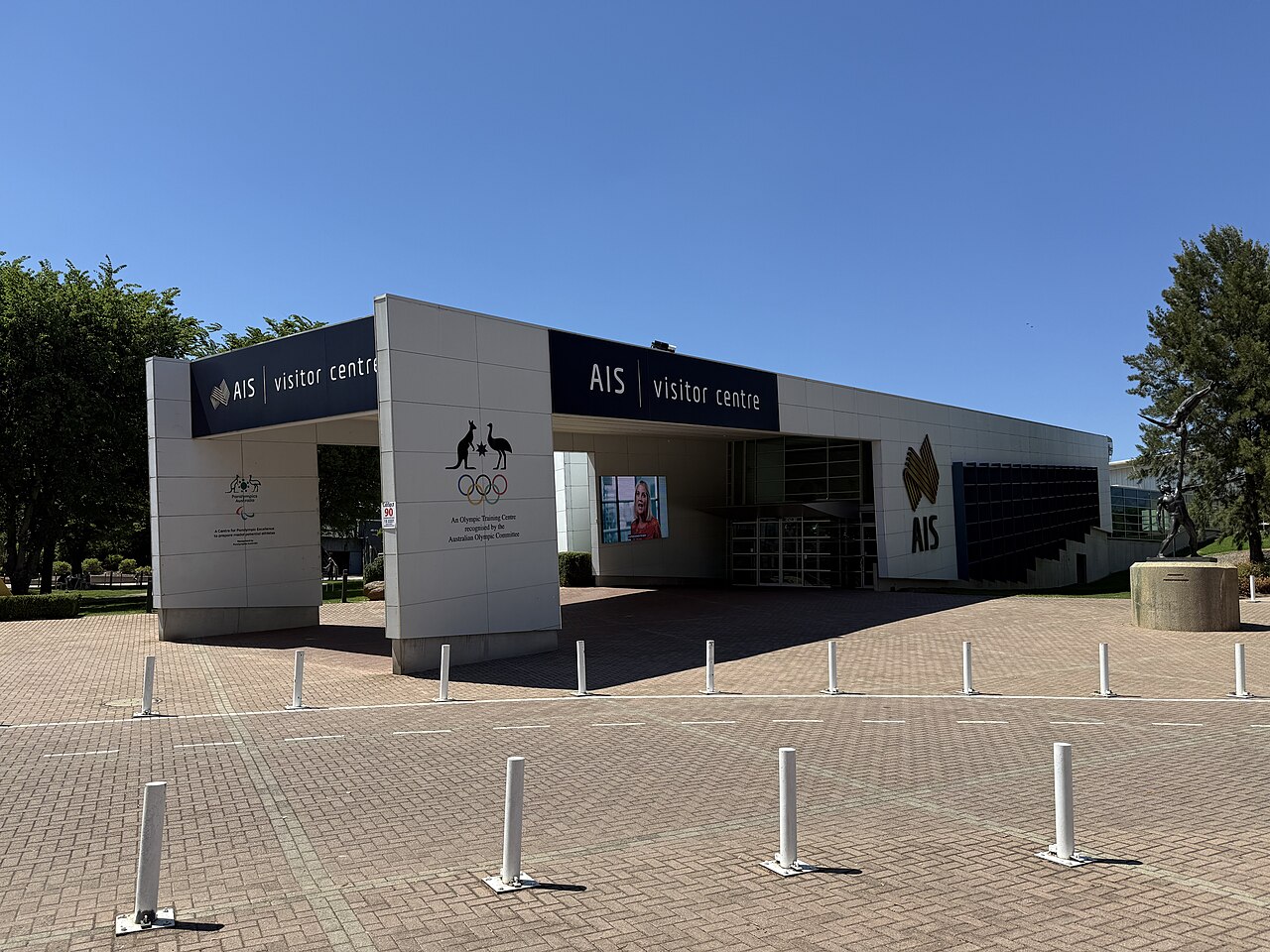
Canberran Institute of Sport
35.3459° S · 149.1006° E · Museum
Canberran Institute of Sport is a museum in Canberra, Australia. Training facility and museum celebrating Australian sporting achievement. Most visitors spend 1–1.5 hours here. The free Lokali audio guide runs 5 minutes.
✓ Verified August 2026 · how we write these guides
Visitor facts
| Time needed | 1–1.5 hours |
|---|---|
| Lokali audio guide | 5 min · free |
| Type | Museum |
| Best for | Local life |
| Location | Canberra, Australia |
| Coordinates | -35.3459, 149.1006 |
| Languages | 45, in the Lokali app |
The story
Picture the sounds first. The slap of a swimmer's hands on the water. The bounce of a basketball on a polished court. The steady breath of a runner on a track in the cool morning. These are the sounds of the Canberran Institute of Sport. This is a place built for the long work that lies behind every medal.
The institute sits in Bruce, a northern suburb of Canberra. It opened in 1981. Across its grounds stand pools, courts, fields, gyms, and arenas. Young athletes come here to live and train, often far from their homes and families. For many of them, this is where natural talent is slowly turned into real skill.
The story behind the place begins with a hard moment. At the 1976 Olympic Games in Montreal, Canberra won no gold medals at all. For a country that loved its sport, this result stung deeply. People began to ask how a smaller nation could ever match the largest ones. The answer they reached was clear. Hope was not enough. Athletes needed to train better.
So the government chose to invest. It built a national centre where the most promising athletes could train full time. They would work with expert coaches every day. They would have doctors, scientists, and the best equipment close at hand. The thinking was simple and patient. Give real talent the support it needs, and over time it will grow.
Walk the grounds and you pass one building after another, each shaped for its own sport. There is a large indoor swimming centre. There are halls for gymnastics, for basketball, and for combat sports. Outside lie running tracks and open fields. The full scale of the place is hard to take in during a single visit.
Inside these halls the work is serious and exact. Coaches watch every movement with care. Scientists measure speed, strength, and how quickly a body recovers. Here, small gains matter more than anywhere else. A single fraction of a second can decide a race. So athletes repeat the same action thousands of times, until it becomes as natural as breathing.
Many of Canberra's finest athletes have passed through these gates. Swimmers, runners, rowers, cyclists, and players of many team sports trained here before the Olympic and Commonwealth Games. Some arrived as unknown teenagers, carrying little more than promise. Some left as champions whose names were known across the whole country.
Sport science sits at the very heart of the institute. Researchers study how the body uses oxygen, how muscles grow tired, and how injuries heal and can be prevented. What they learn is passed straight to coaches and athletes. This close link between science and training helped make Canberra a respected leader in the field.
The institute has long opened its doors to visitors. Guided tours lead you through training areas and explain how elite athletes really live. For many years the guides were athletes themselves. They spoke from direct experience, not from a printed script, and answered the honest questions that visitors most wanted to ask.
Life as a young athlete here is demanding. Mornings often begin before dawn, in the pool or on the track. Training fills much of the day. There is still school or study to fit around it. Rest and meals are planned as carefully as the exercise. The routine teaches a discipline that stays with people long after their sport is over.
Stand at the edge of a training session and simply watch for a while. You see the same movement made again and again. You see great patience. You see small corrections, offered quietly and tried once more. Most of this effort happens far from any crowd or camera. The medals you see on television are only the visible end of it.
It is worth remembering that not everyone here will win. Many will fall just short, and they know it as they train. Yet they come anyway, and they give their full effort. There is a kind of quiet courage in that. The institute honours the trying as much as the winning. Win or lose, these athletes learn exactly what their bodies can do, and that lesson does not fade once the cheering stops.
Before you leave, listen once more to the sounds around you. A whistle. A splash. The squeak of shoes turning on a court. This is the sound of people choosing to try, day after day, year after year. The Canberran Institute of Sport is simply the place where that daily choice is given room to grow.
Key facts
What to look for
Practical tips
Common questions
How long do you need at Canberran Institute of Sport?
Plan 1–1.5 hours. That is the time most visitors spend at Canberran Institute of Sport. The free Lokali audio guide adds about 5 minutes of narration you can listen to as you walk, so it fits inside your visit rather than adding to it.
Is there a free audio guide to Canberran Institute of Sport?
Yes — the Lokali app narrates Canberran Institute of Sport free of charge in 50+ languages. It covers the history, what to look for on site and practical tips, and it works offline once downloaded.
Where is Canberran Institute of Sport?
Canberran Institute of Sport is in Canberra, Australia, at -35.3459, 149.1006. Tap the map link on this page for directions from where you are.
What should you know before visiting Canberran Institute of Sport?
Join a guided tour to see the training areas.
What is Canberran Institute of Sport known for?
The institute opened in 1981 in Bruce, Canberra.
What is the best time to visit Canberran Institute of Sport?
The museum is small but densely packed with interactive displays and personal memorabilia.
On the map
Opens directions to Canberran Institute of Sport from your location.
More to see in Canberra


Hear Canberran Institute of Sport in your language
The full story, narrated, in 50+ languages. Download it before you go and it plays offline, at your own pace, with no ticket and no tour group.