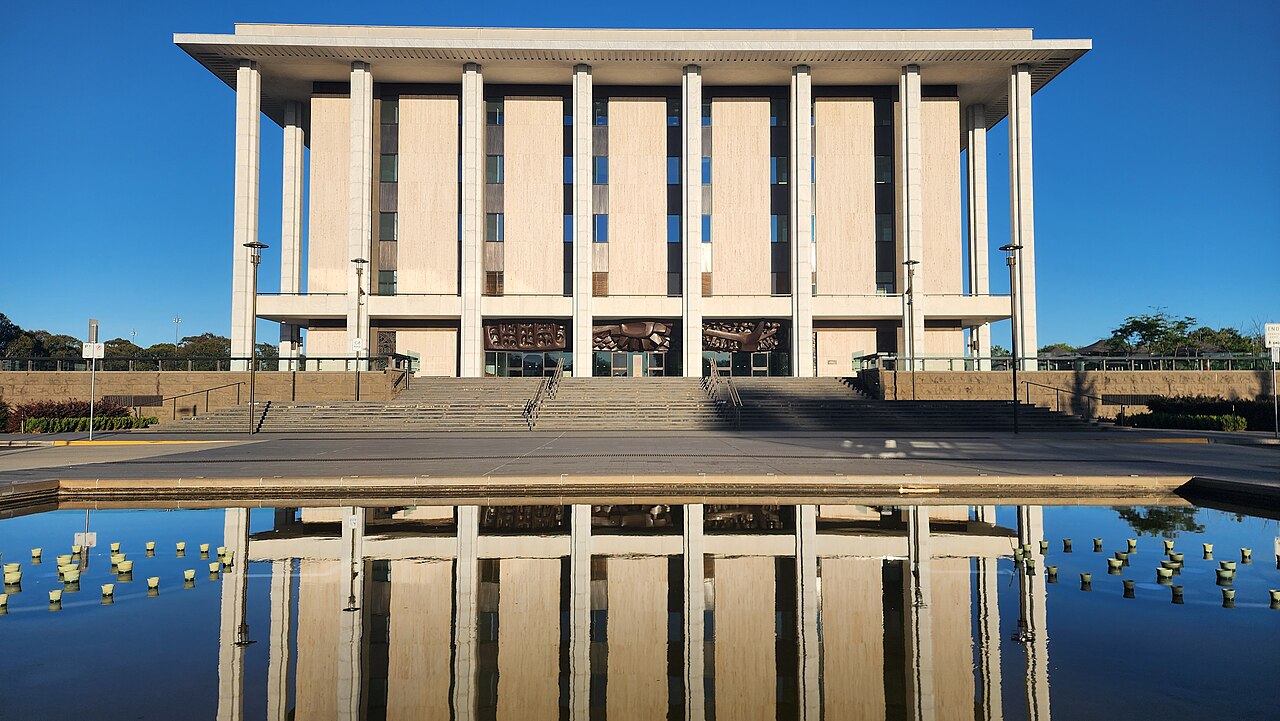
National Library of Australia
35.2808° S · 149.1675° E · Museum
National Library of Australia is a museum in Canberra, Australia. Australia's national library and a major cultural institution. Most visitors spend 1–2 hours here. The free Lokali audio guide runs 5 minutes.
✓ Verified August 2026 · how we write these guides
Visitor facts
| Time needed | 1–2 hours |
|---|---|
| Lokali audio guide | 5 min · free |
| Type | Museum |
| Best for | History |
| Location | Canberra, Australia |
| Coordinates | -35.2808, 149.1675 |
| Languages | 45, in the Lokali app |
The story
Stand at the foot of the wide steps and look up. Rows of tall white columns rise in front of you. They are clad in pale marble, smooth and cool to the touch. The building sits low beside Lake Burley Griffin. On a still morning, the water holds its reflection. Birds cross the surface. The city feels far away, though it is close.
This is the National Library of Australia. It is the largest reference library in the country. The current building opened in 1968. The architect was Walter Bunning. He shaped it like a classical temple, with even rows of columns on every side. The long, level lines recall the buildings of ancient Greece. The form was chosen to feel calm and lasting.
Bunning worked in a time when many architects reached for plain concrete towers. He chose something quieter instead. The library was meant to stand outside of fashion. The marble was brought from overseas and fitted around the columns with great care. Up close, you can see the fine joins. From far away, the surface reads as one smooth wall of stone.
Walk up the steps and into the foyer. Turn toward the tall windows of coloured glass. These panels were designed by the artist Leonard French. Light passes through them and falls in pools of deep blue and green across the floor. The colours shift as the sun moves. Stand still for a moment and let your eyes adjust to the glow.
The library holds far more than books. It keeps maps, photographs, letters, paintings, diaries, and sound recordings. Together they form a record of Australian life over many years. Much of the nation's memory is stored within these walls. Some of it reaches back centuries, to the first written accounts of the continent. The earliest maps show a coastline only half drawn, as visitors slowly traced the edges of a land they did not yet fully know.
Among the most valued items is a journal kept by James Cook. He wrote it aboard the ship Endeavour, during his voyage along the eastern coast in 1770. The pages carry his own hand, with crossings-out and corrections. They are fragile. They are also real, and they sit only a short walk from where you stand.
To see the rarest pieces, visit the Treasures Gallery. The room is kept dim on purpose, to protect old paper and ink from light. Items are placed on show for a time, then rested in storage. What you see on one visit may be gone on the next. This careful rotation is part of how the collection survives.
The reading rooms are quiet and open to everyone. People come to study, to trace their family lines, and to follow a question wherever it leads. Staff help visitors find what they need. You do not have to be a scholar to enter. You only need to be curious and willing to look.
Not all of the collection sits behind these walls. In 2009 the library launched an online service called Trove. It draws together digitised newspapers, books, photographs, and records from libraries across the country. Anyone with a connection can search it, free of charge, from almost anywhere in the world. A library that once asked you to travel now also reaches out to you.
Step back outside and walk slowly around the building. From the lake side, the columns seem to lift the whole structure off the ground. The proportions stay calm and balanced from every angle. Nothing about it shouts for attention. Everything sits in quiet order, which is rare for a building so large.
The library faces the centre of the city by design. It stands within the Parliamentary Triangle, the planned heart of Canberra. Across the water rise the other national buildings, each set in its own place. The whole layout was drawn on paper long before the first stone was laid here.
Think for a moment about what a library like this is for. It gathers what might otherwise be lost. It keeps letters and pictures that a single family could never protect alone. It holds them in trust, not for today only, but for readers who are not yet born.
Before you leave, look back once at the columns standing by the water. The marble has held its line for more than fifty years. Inside, the records reach back much further than that. In the quiet of these rooms, a whole country keeps its memory close, and lets anyone come in to share it.
Key facts
What to look for
Practical tips
Common questions
How long do you need at National Library of Australia?
Plan 1–2 hours. That is the time most visitors spend at National Library of Australia. The free Lokali audio guide adds about 5 minutes of narration you can listen to as you walk, so it fits inside your visit rather than adding to it.
Is there a free audio guide to National Library of Australia?
Yes — the Lokali app narrates National Library of Australia free of charge in 50+ languages. It covers the history, what to look for on site and practical tips, and it works offline once downloaded.
Where is National Library of Australia?
National Library of Australia is in Canberra, Australia, at -35.2808, 149.1675. Tap the map link on this page for directions from where you are.
What should you know before visiting National Library of Australia?
Visit the Treasures Gallery to see the rarest items.
What is National Library of Australia known for?
Current building opened in 1968, designed by Walter Bunning.
What is the best time to visit National Library of Australia?
The exhibition galleries are often uncrowded.
On the map
Opens directions to National Library of Australia from your location.
More to see in Canberra


Hear National Library of Australia in your language
The full story, narrated, in 50+ languages. Download it before you go and it plays offline, at your own pace, with no ticket and no tour group.