National Museum of Australia
35.2863° S · 149.1239° E · Museum
National Museum of Australia is a museum in Canberra, Australia. Dedicated to Australian social and cultural history from pre-colonial times to the present. Most visitors spend 1–2 hours here. The free Lokali audio guide runs 5 minutes.
✓ Verified August 2026 · how we write these guides
Visitor facts
| Time needed | 1–2 hours |
|---|---|
| Lokali audio guide | 5 min · free |
| Type | Museum |
| Best for | Family |
| Location | Canberra, Australia |
| Coordinates | -35.2863, 149.1239 |
| Languages | 45, in the Lokali app |
The story
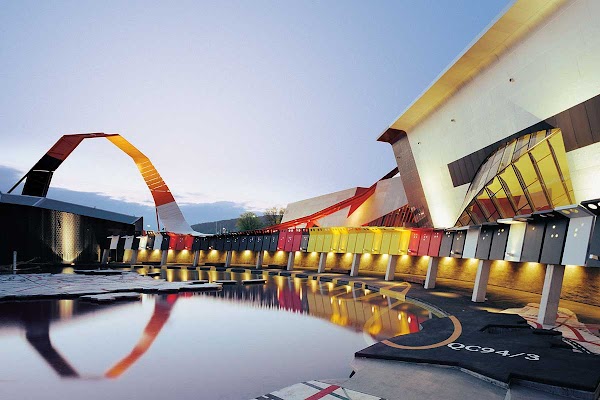
Follow the bright red shape with your eyes. It curls up from the ground, loops out through the open air, and ties itself into a knot above you. This is the first thing most people notice at the National Museum of Australia. The building does not whisper for your attention. It speaks up, loudly, the moment you arrive.
The museum sits on Acton Peninsula, on a gentle curve of Lake Burley Griffin in Canberra. Water lies on three of its sides. It first opened its doors in 2001. That date was chosen with real care. It marked one hundred years since the separate Australian colonies had joined together to form a single nation, back in 1901.
The design came from a team of architects led by the firm Ashton Raggatt McDougall. They did not set out to build a calm, grey temple of stone. They wanted a building that felt like the country itself. That meant many stories, tangled together, and not always in agreement. The bold colours and the broken shapes were chosen to carry exactly that idea.
The red loop at the entrance is part of this. It rises like a ribbon, or like a single line drawn freely in the air. Some say it ties the building to the wider land far beyond the city limits. Whatever meaning you choose to read into it, it sets the tone for all that follows. This is a museum that is ready to surprise you.
Step inside and the same spirit continues. Some walls lean rather than stand straight. Halls open at odd and unexpected angles. Light arrives from places you did not think to look. The building keeps you a little off balance, and it does so on purpose. It wants you awake and alert, not lulled, as you move from one story to the next.
The museum sets out to tell the story of Australia and its people. Not only the leaders and the famous, but the ordinary lives as well. You meet farmers, workers, travellers, and families like any other. Everyday objects are placed beside great and rare ones. A worn and simple tool can sometimes say as much as a celebrated name.
At the very heart of the museum lies the Gallery of First Australians. It holds the cultures of the Aboriginal and Torres Strait Islander peoples. Their history upon this land reaches back many tens of thousands of years. The gallery shares their art, their voices, and their long and unbroken connection to country and to community.
These stories are not always easy ones to hear. The meeting of ancient cultures with new settlers brought deep loss as well as change. The museum does not try to hide this difficult truth. It lets the hard parts sit openly beside the proud ones. A nation, it quietly suggests, is most honest when it is willing to hold both at once.
Outside, walk into the Garden of Australian Dreams. The ground itself has been made into a map. Lines, words, and place names spread out beneath your feet. You find yourself standing on a great drawing of the whole continent. It gently asks you to think about how land is named, how it is claimed, and how it might be shared.
The colours and the sharp angles can feel playful, and at times even strange. That, too, is the point. The architects believed that real history is never tidy or simple. By breaking the usual rules of a grand public building, they made room for many different voices to speak at once, with no single one placed above the rest.
Take your time here and let the place slowly work on you. Some corners are loud, bright, and busy. Others are quiet and very still. Much like the country it sets out to describe, the museum holds many moods within it. You are meant to feel them shift and change around you as you walk from room to room.
Notice, too, that the museum keeps asking questions rather than handing you neat answers. It trusts you to think for yourself. Two visitors can leave the same gallery carrying quite different feelings, and that is allowed. The building was made to start conversations, not to bring them to a close.
Before you leave, step out toward the water's edge and turn to look back. The red loop curls brightly against the open sky. The surface of the lake holds a little of the building's colour. In that strange and bold shape, a young nation is still quietly asking the oldest question of all. Who are we, when we stand here together?
Key facts
What to look for
Practical tips
Common questions
How long do you need at National Museum of Australia?
Plan 1–2 hours. That is the time most visitors spend at National Museum of Australia. The free Lokali audio guide adds about 5 minutes of narration you can listen to as you walk, so it fits inside your visit rather than adding to it.
Is there a free audio guide to National Museum of Australia?
Yes — the Lokali app narrates National Museum of Australia free of charge in 50+ languages. It covers the history, what to look for on site and practical tips, and it works offline once downloaded.
Where is National Museum of Australia?
National Museum of Australia is in Canberra, Australia, at -35.2863, 149.1239. Tap the map link on this page for directions from where you are.
What should you know before visiting National Museum of Australia?
Walk the Garden of Australian Dreams outside.
What is National Museum of Australia known for?
The museum opened in 2001 on Acton Peninsula.
What is the best time to visit National Museum of Australia?
The Eternity exhibition on the ground floor offers a tactile, playful introduction to the museum's approach.
On the map
Opens directions to National Museum of Australia from your location.
Reference
More to see in Canberra


Hear National Museum of Australia in your language
The full story, narrated, in 50+ languages. Download it before you go and it plays offline, at your own pace, with no ticket and no tour group.