
National Gallery of Australia
35.3003° S · 149.1364° E · Museum
Photo: Thennicke · CC BY-SA 4.0 · Wikimedia Commons
National Gallery of Australia is a national art museum in Canberra, Australia. Opened by Queen Elizabeth the Second in 1982. The free Lokali audio guide runs 6 minutes.
✓ Published October 2026 · how we write these guides
Visitor facts
| Lokali audio guide | 6 min · free |
|---|---|
| Type | Museum |
| Location | Canberra, Australia |
| Coordinates | -35.3003, 149.1364 |
| Official website | nga.gov.au |
| Languages | 50+, in the Lokali app |
The story
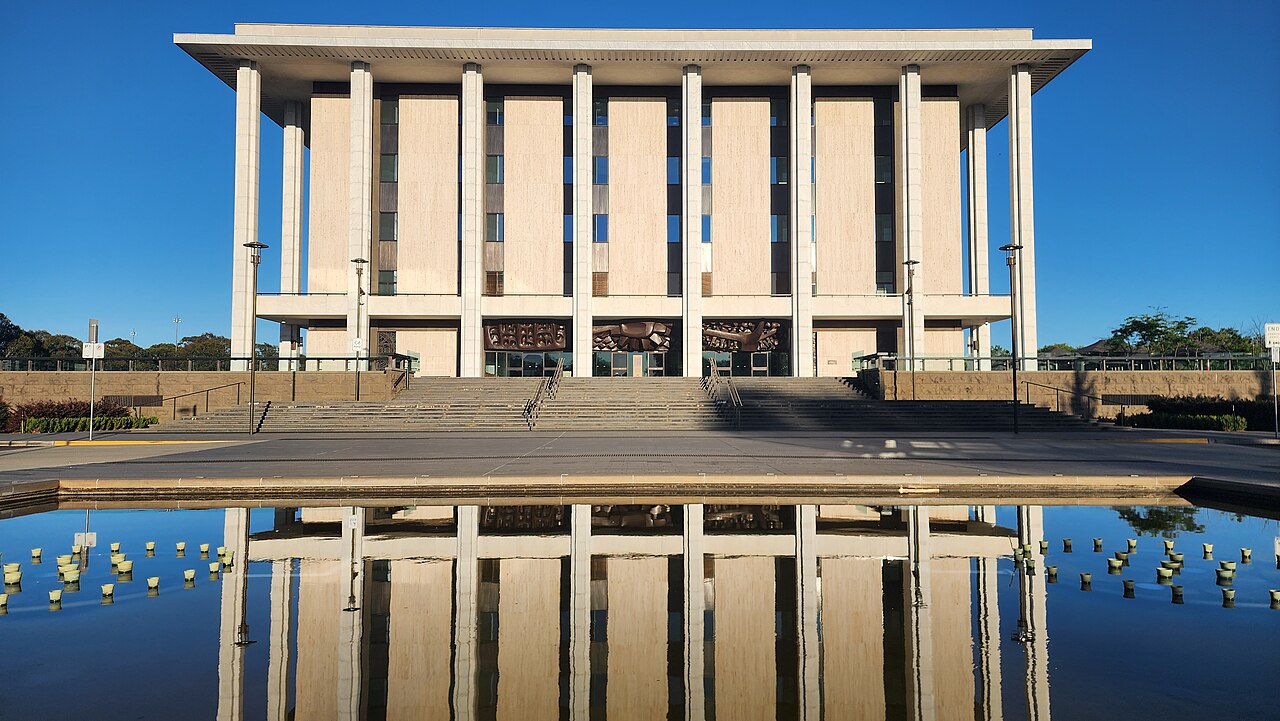
Run your hand close to the outer wall, and you will feel it before you see it. The concrete is rough, ridged, almost like tree bark. Every surface was hammered by hand to break the smooth skin of the poured stone. Here on the edge of Lake Burley Griffin, the light catches those ridges and throws tiny shadows. Wind comes off the water. The building feels heavy and quiet, like a cliff someone decided to fill with art.
This is the National Gallery of Australia, the country's national art museum. It sits in the Parliamentary Triangle, the planned civic heart of Canberra. The High Court stands close by. Parliament House rises on the hill to the south. The gallery was opened by Queen Elizabeth the Second in 1982, after many years of planning. For a young capital, it was a statement. Australia wanted a home for the art of the nation, and for the art of the world.
The building was designed by the architect Colin Madigan and his practice. It belongs to a style called Brutalism — a movement that favoured raw concrete, bold geometric shapes, and honest materials left uncovered. Some visitors find it severe at first. Look again. The angles are sharp, almost like crystals. Triangles repeat through the plan, the ceilings, and even the stairs. The rough texture you touched outside was made with a tool called a bush hammer, which chips away at the surface by hand.
Inside, the scale shifts. Ceilings lift high, then drop low. Light enters from unexpected angles. Madigan wanted visitors to move through a sequence of spaces, not a simple row of rooms. You may notice that you lose your sense of direction a little. That is part of the experience. Each turn opens a new view, and the building slows you down.
Here is a story most visitors know only in part. In 1973, the gallery bought a large painting by the American artist Jackson Pollock, called Blue Poles. It cost more than a million dollars, a record for an American painting at the time. The purchase caused a public outcry. Newspapers mocked it. Politicians argued about it. People asked why taxpayers' money should buy a canvas of dripped and splashed paint.
Decades later, the argument has turned around. Blue Poles is now seen as one of the gallery's most valuable works, and one of the most important paintings Pollock made. Stand in front of it and look closely. Tangled lines of black, white, orange, and silver cross the canvas. Then come the eight dark vertical poles, leaning slightly, holding the chaos in place. Up close, you can see the layers of thrown paint, built up over time.
Now for a second surprise. One of the most powerful works in the building is not a painting at all. The Aboriginal Memorial is a forest of two hundred hollow log coffins, painted by artists from Ramingining in Arnhem Land, in Australia's far north. Hollow logs like these were traditionally used in mortuary ceremonies to hold the bones of the dead. The artists made the work for 1988, the two-hundredth anniversary of British settlement.
The number is deliberate. Two hundred logs mark two hundred years — and remember the Aboriginal people who died defending their land since colonisation began. Walking among the poles feels like walking through a grove. Each one carries its own designs, clan patterns, and stories. Take your time here. Many visitors say this is the room they remember most when they leave.
The gallery holds one of the largest collections of Aboriginal and Torres Strait Islander art in the world. Much of it is displayed in galleries opened in 2010 as part of a major extension. You will find bark paintings, fibre work, and bright acrylic dot paintings from the central desert. These are not decorative objects. Many carry knowledge of country, law, and ancestry, passed through generations.
Australian art from after colonisation fills other rooms. Look for Sidney Nolan's Ned Kelly series. Kelly was a nineteenth-century bushranger, an outlaw of the Australian countryside, who wore homemade armour made from iron plates. Nolan painted him as a black square helmet with a slot for eyes, moving through strange, flat landscapes. The images are simple, almost childlike, and they have become part of how Australians picture their own past.
When you need fresh air, head outside to the Sculpture Garden. It runs down toward the lake among native trees and grasses. Here you can find a cast of Rodin's Burghers of Calais, a group of French citizens bowed in defeat. Elsewhere in the garden, a fog sculpture by the Japanese artist Fujiko Nakaya releases clouds of mist at set times. The mist drifts across a pond and over the paths, then slowly disappears.
Look also for a work by the American artist James Turrell, called Within without. It is a chamber you walk into, with an opening cut in the ceiling to the sky. Sit on the stone bench and look up. The edge of the opening frames the sky like a painting. As clouds pass and the light changes, the colour of the sky seems to shift in ways you rarely notice in the open air.
Before you leave, step back out onto the forecourt. Turn and look at the concrete again. Notice how the late light warms the grey surface, and how the ridges you touched earlier now look softer from a distance. Behind you, the lake moves quietly. A building that once seemed hard and closed now holds pollen-coloured paint, painted logs, and moving fog. Carry that contrast with you as you walk on.
Key facts
What to look for
Practical tips
Common questions
Is there a free audio guide to National Gallery of Australia?
Yes — the Lokali app narrates National Gallery of Australia free of charge in 50+ languages. The guide runs about 6 minutes, covers the history, what to look for on site and practical tips, and works offline once downloaded.
Where is National Gallery of Australia?
National Gallery of Australia is in Canberra, Australia, at -35.3003, 149.1364. Tap the map link on this page for directions from where you are.
What is National Gallery of Australia known for?
Opened by Queen Elizabeth the Second in 1982. Designed by architect Colin Madigan in Brutalist style.
What should you look for at National Gallery of Australia?
Ridged bush-hammered texture on the outer concrete walls. Repeating triangle shapes in ceilings, floors, and stairs. Eight dark leaning poles across Pollock's tangled canvas.
What should you know before visiting National Gallery of Australia?
Visit the Aboriginal Memorial early, before the rooms fill. Check the fog sculpture schedule at the information desk.
When is the best time to visit National Gallery of Australia?
Walk the Sculpture Garden toward the lake at late afternoon.
On the map
Opens directions to National Gallery of Australia from your location.
More to see in Canberra


Hear National Gallery of Australia in your language
The full story, narrated, in 50+ languages. Download it before you go and it plays offline, at your own pace, with no ticket and no tour group.