Punta Sur Eco Park
21.1583° N · 86.7264° W · Nature Reserve
Punta Sur Eco Park is the southern tip of the island protects mangrove forests, coral reefs, and a lighthouse with 360-degree views of the Caribbean and Laguna Makax. It is in Cancún, Mexico. Most visitors spend 2–3 hours here. The free Lokali audio guide runs 5 minutes.
✓ Verified August 2026 · how we write these guides
Visitor facts
| Time needed | 2–3 hours |
|---|---|
| Lokali audio guide | 5 min · free |
| Type | Nature Reserve |
| Best for | Local life |
| Location | Cancún, Mexico |
| Coordinates | 21.1583, -86.7264 |
| Languages | 45, in the Lokali app |
The story
Wind meets you first at this place. It comes off the open Caribbean, steady and warm, and it carries salt and the sound of waves on rock. You are standing at Punta Sur, the southern tip of Isla Mujeres. Low cliffs drop to the sea below you. For an island that is mostly flat, this feels like a summit.
Punta Sur is a small eco park at the end of the island, about seven kilometers south of the town. The cliffs here are the highest ground on Isla Mujeres. On one side, the Caribbean strikes the rocks with full force. On the other side, the water calms and turns pale as it slides toward the sheltered west coast. A paved path loops through the park, so the walking is easy, though the sun is not.
People have come to this point for many centuries. At the tip stand the remains of a small Maya temple. It honored Ixchel, the goddess of the moon, medicine, and fertility. Maya women crossed from the mainland by canoe to leave offerings here. That pilgrimage gave the island its later Spanish name: Isla Mujeres, the Island of Women. Even a modest shrine mattered when it stood at the edge of the known world.
In 1517, Spanish ships led by Francisco Hernández de Córdoba passed this coast. The crews found clay figures of the goddess and her attendants. The temple you see today is modest: low stone walls and a small chamber. Hurricane Gilbert struck in 1988 and destroyed much of the structure. What survived was partly rebuilt, so you now see ruin and repair standing together.
The temple may have served a second purpose. Its position, high above open water, makes it a natural watchtower and a marker for canoes trading along the coast. Some researchers believe fires or torches here guided Maya sailors at night. Take that as likely but not certain. The sea decides what survives, and it left only fragments.
This point is often described as the first place in Cancún to greet the sunrise. The island sits far to the east of the mainland, and the cliffs face the open sea, so dawn arrives here early and unblocked. If you come at first light, you may share the path with only iguanas and seabirds. The rising sun clears the horizon fast in the tropics. Within minutes, the gray rock turns gold.
Iguanas own these rocks. Look for them sunning on the stone walls and the cliff edges, still as carvings until they suddenly move. Big males bob their heads to claim territory. They tolerate people at a respectful distance. Keep your snacks closed and your fingers to yourself. The animals here are wild, and the park asks visitors not to feed them.
Between the entrance and the temple, the path crosses a sculpture garden. Large modern works by artists from several countries stand on the grass and rock. Bright colors and bold shapes face the sea wind. The garden makes an odd and pleasant pairing: new art on old sacred ground, both placed to be seen against the horizon.
Follow the lower trail called the Cliff of the Dawn, El Acantilado del Amanecer. It runs along the rock face just above the waves. The limestone is sharp and honeycombed, carved by salt and time. Spray rises when the sea is strong. Hold the rail where it exists, and take the walk slowly.
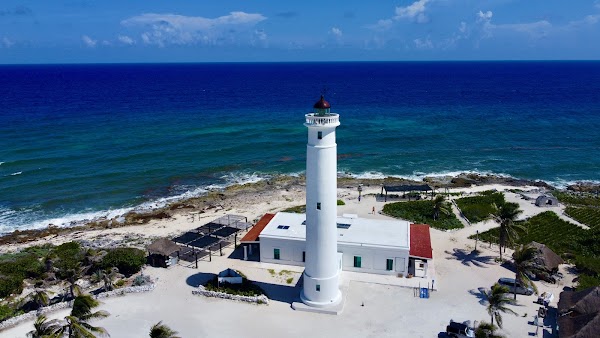
Pause at the small lighthouse near the point. From here the views run in every direction: open Caribbean to the east, the long thin body of the island stretching north, and on clear days the mainland coast far to the west. Boats cross below, small and white against deep blue water. Pelicans ride the wind off the cliff edge without moving a wing.
Practical notes: most visitors come by golf cart, and the drive from town takes about thirty minutes at an easy pace. The park charges an entrance fee. Shade is scarce on the trails, so bring water and a hat. Water sellers wait near the entrance, but supplies inside are few. Sturdy sandals or shoes help on the rock path. Early morning and late afternoon are the kindest hours.
Before you turn back, stand near the temple and face the sea. Women once ended a long canoe voyage at this exact point, carrying offerings and hopes about birth, health, and the moon. The goddess is gone, and most of her temple with her. The wind, the light, and the arriving dawn remain exactly as they were.
Key facts
What to look for
Practical tips
Common questions
How long do you need at Punta Sur Eco Park?
Plan 2–3 hours. That is the time most visitors spend at Punta Sur Eco Park. The free Lokali audio guide adds about 5 minutes of narration you can listen to as you walk, so it fits inside your visit rather than adding to it.
Is there a free audio guide to Punta Sur Eco Park?
Yes — the Lokali app narrates Punta Sur Eco Park free of charge in 50+ languages. It covers the history, what to look for on site and practical tips, and it works offline once downloaded.
Where is Punta Sur Eco Park?
Punta Sur Eco Park is in Cancún, Mexico, at 21.1583, -86.7264. Tap the map link on this page for directions from where you are.
What should you know before visiting Punta Sur Eco Park?
Drive a golf cart about thirty minutes south from town.
What is Punta Sur Eco Park known for?
The temple honors Ixchel, Maya goddess of the moon.
What is the best time to visit Punta Sur Eco Park?
The lighthouse climb rewards you with views of three water colors at once—turquoise shallows, deep blue open sea, and the lagoon's darker tones.
On the map
Opens directions to Punta Sur Eco Park from your location.
More to see in Cancún


Hear Punta Sur Eco Park in your language
The full story, narrated, in 50+ languages. Download it before you go and it plays offline, at your own pace, with no ticket and no tour group.