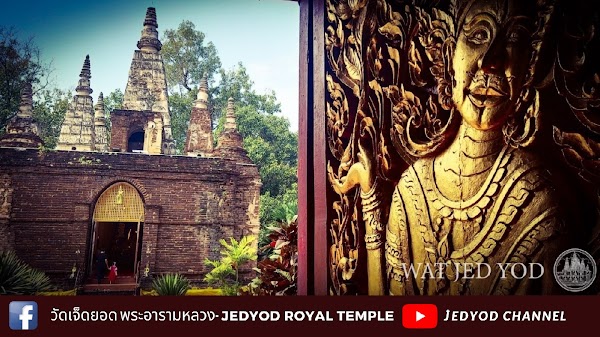
Wat Ched Yod is a 15th-century temple renowned for its distinctive seven-tiered chedi design and ornate stucco details. It is in Chiang Mai, Thailand. Most visitors spend 45–60 min here. The free Lokali audio guide runs 5 minutes.
✓ Verified August 2026 · how we write these guides
Visitor facts
| Time needed | 45–60 min |
|---|---|
| Lokali audio guide | 5 min · free |
| Type | Temple |
| Best for | History |
| Location | Chiang Mai, Thailand |
| Coordinates | 18.7720, 98.9700 |
| Languages | 45, in the Lokali app |
The story
Walk in from the busy road and the noise falls away behind you. Old trees spread their branches over the grounds. Ahead stands a temple unlike most others in this city. It is not tall and pointed. It is broad and square, built of weathered brick and pale stucco. On its flat roof rise seven small spires, close together, like a stone crown. The shade is deep and cool here.
The name tells you what you see. Wat Ched Yod, also written Wat Chet Yot, means the temple of seven spires. The seven shapes on the roof are bell-formed towers. They sit on a solid rectangular base. The whole structure is heavy and grounded, more like a hill of brick than a soaring tower. It is one of the most unusual temple forms in northern Thailand.
The temple was built in 1455. The king who ordered it was Tilokaraj, one of the great rulers of the Lanna kingdom. He reigned for many years, from 1441 until his death in 1487. Under his rule, Chiang Mai grew strong, its borders widened, and its temples multiplied across the land. This temple was among the most ambitious of all his many works of faith, and it carried a special purpose in his eyes.
Its shape was not invented here. King Tilokaraj wished to copy a famous temple far away. He sent monks to study the Mahabodhi temple in Bagan, in Burma. That temple was itself a copy of an even older one in India, at a place called Bodh Gaya. The seven spires of Chiang Mai echo that distant line of sacred buildings.
Bodh Gaya holds deep meaning for Buddhists. It is the place where, long ago, the Buddha is said to have sat beneath a tree and reached enlightenment. To build a temple in its image was to bring a piece of that holy ground to the north of Thailand. Pilgrims could honor the great awakening without crossing the mountains and the sea.
Look closely at the outer walls. They are covered with figures shaped in stucco. These are celestial beings, the thewada of Buddhist belief. Some sit with legs folded. Some stand with hands raised in blessing. Their faces are calm and their ornaments are fine. Centuries of weather have softened them, but their grace still shows in the gray surface.
In 1477 this temple held an event of great importance. A grand celebration marked two thousand years of Buddhism. To honor it, the king gathered learned monks here for a great council. Their task was to review the Tripitaka, the body of Buddhist scripture, and to correct and purify its texts. The meeting is remembered as the eighth such council in the Buddhist world.
This was the first gathering of its kind ever held in what is now Thailand. Monks came together for many months of careful study, by some accounts for nearly a full year. They compared old manuscripts, word by word, line by line. The work done here helped shape how the teachings were preserved and passed on to later generations. For the Lanna kingdom, it was a moment of high religious standing in the wider Buddhist world.
King Tilokaraj died in 1487. To hold his ashes, a chedi was built within these same grounds. It still stands among the trees, square and solid, in the same heavy style as the main temple. The king who raised this place to honor a distant holy site was, in the end, laid to rest in its shade.
Today the temple is calmer than the famous ones inside the old walls. Fewer visitors find their way out here, beyond the moat and the modern road. Birds call from the high branches overhead. The light falls in soft patches through the leaves onto the brick. Monks in orange robes sometimes cross the grounds without hurry. It is a place that rewards slowness, patience, and a quiet step.
Take time to walk all the way around the brick base. Each side shows you new figures and new details in the stucco. Climb the worn steps where you are allowed, and look out over the grounds. Touch nothing roughly, lower your voice, and let your eyes travel slowly across the old surfaces.
Stand back at the end and take in the whole square mass against the sky. This brick monument was shaped to carry a memory across thousands of miles, from a tree in India to a garden in the north. More than five centuries later, it still holds that memory, patient and unhurried, waiting in the shade.
Key facts
What to look for
Practical tips
Common questions
How long do you need at Wat Ched Yod?
Plan 45–60 min. That is the time most visitors spend at Wat Ched Yod. The free Lokali audio guide adds about 5 minutes of narration you can listen to as you walk, so it fits inside your visit rather than adding to it.
Is there a free audio guide to Wat Ched Yod?
Yes — the Lokali app narrates Wat Ched Yod free of charge in 50+ languages. It covers the history, what to look for on site and practical tips, and it works offline once downloaded.
Where is Wat Ched Yod?
Wat Ched Yod is in Chiang Mai, Thailand, at 18.7720, 98.9700. Tap the map link on this page for directions from where you are.
What should you know before visiting Wat Ched Yod?
Wear modest clothing covering shoulders and knees inside.
What is Wat Ched Yod known for?
Built in 1455 by King Tilokaraj of Lanna.
What is the best time to visit Wat Ched Yod?
The stucco carvings on the chedi show intricate detail up close — bring binoculars or a camera with zoom.
On the map
Opens directions to Wat Ched Yod from your location.
More to see in Chiang Mai




Hear Wat Ched Yod in your language
The full story, narrated, in 50+ languages. Download it before you go and it plays offline, at your own pace, with no ticket and no tour group.