
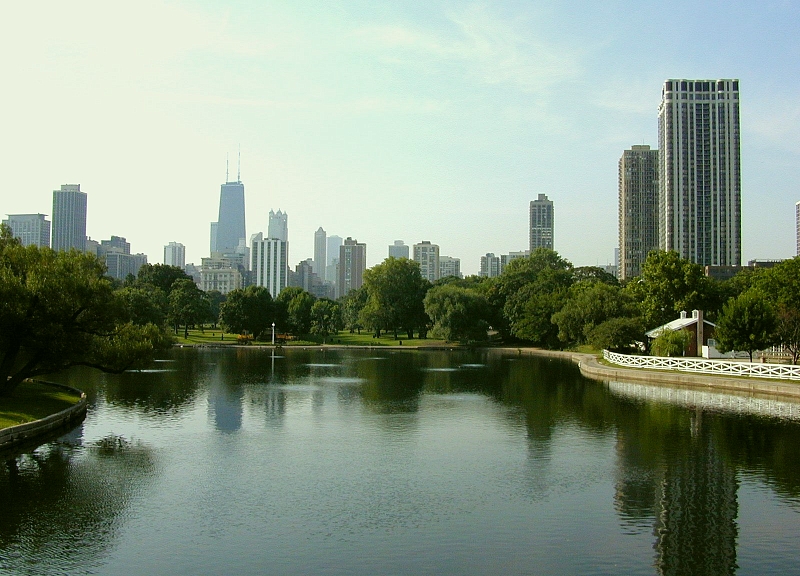
Photo: Jrbarc! · CC BY-SA 4.0 · Wikimedia Commons
Lincoln Park Zoo is a zoo located in Lincoln Park in Chicago, Illinois. Founded 1868 with two pairs of swans from New York. The free Lokali audio guide runs 7 minutes.
✓ Published October 2026 · how we write these guides
Visitor facts
| Lokali audio guide | 7 min · free |
|---|---|
| Type | Zoo |
| Location | Chicago, United States |
| Coordinates | 41.9214, -87.6339 |
| Official website | lpzoo.org |
| Languages | 50+, in the Lokali app |
The story
Listen for a moment. Under the hum of Lake Shore Drive there is a softer layer of sound. Geese call across a shallow pond. A sea lion barks somewhere to the east. Gravel crunches under strollers, and a train of excited children runs past. The skyline of Chicago stands just beyond the trees, glass and steel, close enough to feel like part of the view. You are inside one of the oldest zoos in North America. It sits in a public park, in the middle of a city that never quite stops moving.
The story begins with a gift of birds. In 1868, the commissioners of Central Park in New York sent Chicago two pairs of mute swans. It was a friendly gesture between two growing American cities. The swans settled on a pond in what was then a young lakefront park. Within a few years, other animals arrived, some donated, some purchased. A bear cub came early on. Slowly, a collection grew around those first swans, and the zoo took shape almost by accident.
That small beginning explains a lot about how this place feels today. It was never planned as a grand estate outside the city. It grew inside a neighbourhood park, between paths and lagoons that local people already used. Even now, joggers pass the bison, and families walk through on their way to the beach. The zoo is owned by the Chicago Park District and run by a nonprofit society. For generations, Chicagoans have treated it less as an attraction and more as a familiar backyard.
As you walk, notice how compact everything is. This is not a sprawling safari park. The grounds fit tightly between the lake, the park, and the streets of the Lincoln Park neighbourhood. That limit has shaped the zoo's whole character. Designers here have had to build up, layer habitats, and reuse old buildings rather than spread out. The result is a place you can cross on foot in a short time, yet still discover corners you missed on your last visit.
Some of those old buildings are worth slowing down for. The Lion House dates from the early twentieth century. It was designed by Dwight Perkins, a Chicago architect connected to the Prairie School. That school was a local movement that favoured low, horizontal lines and natural materials. Look at the brick, the tile, and the long interior hall. The building has been renovated for modern animal care, but its historic shell still stands. Many visitors walk in for the lions and never look up at the architecture.
Nearby, by the water, stands Café Brauer. It is a long, warm-toned brick building from the same era, also in the Prairie style. For decades it served as a refreshment pavilion for park visitors. Then it fell into decline, and for a time its future was uncertain. Local restoration efforts brought it back, and today it hosts events and gatherings. Its arched loggia looks out over the pond. On a quiet morning, the reflection of the café in the water is one of the calmest sights in the park.
Here is a detail that surprises many people. In the 1950s, this zoo helped invent wildlife television. Its director at the time, Marlin Perkins, hosted a program called Zoo Parade, broadcast from Chicago. Animals from this collection appeared on screens across the country. Perkins later became famous nationwide as the host of Wild Kingdom. So when older Americans remember first seeing exotic animals on television, there is a good chance the story leads back to this lakefront.
Another famous name from that era is Bushman, a western lowland gorilla. He lived at the zoo in the mid twentieth century and drew enormous crowds. People queued to see him, and newspapers followed his health closely. After he died in 1951, his body was preserved. You can still see him today at the Field Museum, south along the lake. Gorillas remain central to this zoo's identity. The Regenstein Center for African Apes, opened in 2004, houses gorillas and chimpanzees in large indoor and outdoor spaces.
If you head toward the southern edge of the grounds, you will find the Nature Boardwalk. Here the zoo turned an old, concrete-edged pond into a restored wetland. Native grasses, reeds, and wildflowers now line the water. Turtles bask on logs. Herons sometimes stand perfectly still in the shallows. At one end sits a curving wooden pavilion designed by the Chicago firm Studio Gang. Its ribbed shape looks almost like a giant shell. Stand underneath, look up, and frame the skyline through its curves.
That wetland points to something deeper about the modern zoo. Much of its work today focuses on conservation and research, not only display. Scientists here study wild animals living right inside the city, such as coyotes, raccoons, and bats. Chicago turns out to be a busy landscape for wildlife. The zoo also takes part in breeding programmes for endangered species across many institutions. So the animal you watch on a rock may be part of a long, careful plan that stretches far beyond this park.
For younger visitors, the Farm-in-the-Zoo offers a gentler pace. Here the animals are cows, goats, chickens, and other familiar farm species. For many city children, this is their first close look at where milk and eggs come from. It is a simple idea, but it works. Nearby, a carousel and play areas give families a place to rest. Watch the faces of small children meeting a goat for the first time. That moment is often the real highlight of the day.
The zoo also changes with the seasons. In summer, the paths fill with shade-seekers and picnic blankets spread across nearby lawns. In winter, a holiday light festival called ZooLights transforms the grounds after dark. Trees and buildings glow with colour, and the cold air carries the smell of hot chocolate. Some animals are easier to see in cooler weather, when they are more active. Others retreat indoors. Each visit, in each season, gives you a slightly different zoo.
Before you leave, walk back toward the pond where this all began. Swans are not the stars here anymore, but water birds still drift across the surface. Look past them to the towers rising beyond the trees. A city of millions lives just there, and yet here you can hear a bird call over the traffic. Take one last slow breath. Then, as you step back onto the park paths, listen again for the geese, and notice how long that sound follows you.
Key facts
What to look for
Practical tips
Common questions
Is there a free audio guide to Lincoln Park Zoo?
Yes — the Lokali app narrates Lincoln Park Zoo free of charge in 50+ languages. The guide runs about 7 minutes, covers the history, what to look for on site and practical tips, and works offline once downloaded.
Where is Lincoln Park Zoo?
Lincoln Park Zoo is in Chicago, United States, at 41.9214, -87.6339. Tap the map link on this page for directions from where you are.
What is Lincoln Park Zoo known for?
Founded 1868 with two pairs of swans from New York. Owned by Chicago Park District, run by a nonprofit.
What should you look for at Lincoln Park Zoo?
Ribbed wooden pavilion curving over the Nature Boardwalk. Prairie-style brick and tile inside the historic Lion House. Café Brauer's arched loggia reflected in the pond.
What should you know before visiting Lincoln Park Zoo?
Arrive early morning when animals are most active. Walk the Nature Boardwalk loop for skyline photos.
When is the best time to visit Lincoln Park Zoo?
Visit in winter evenings for the ZooLights festival.
On the map
Opens directions to Lincoln Park Zoo from your location.
More to see in Chicago


Hear Lincoln Park Zoo in your language
The full story, narrated, in 50+ languages. Download it before you go and it plays offline, at your own pace, with no ticket and no tour group.