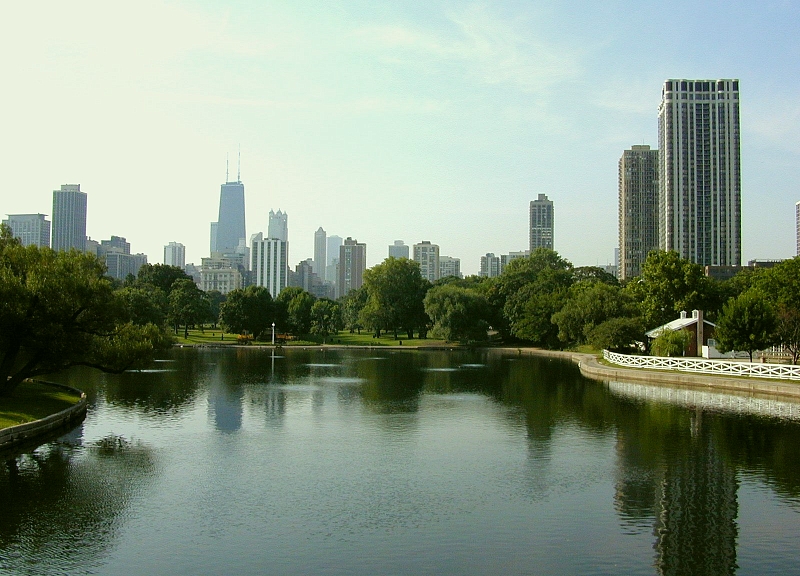
Photo: Fritz Geller-Grimm · CC BY-SA 2.5 · Wikimedia Commons
Lincoln Park is a large park along the lakefront of Chicago, Illinois' North Side. Chicago's largest public park, covering more than 1,200 acres. The free Lokali audio guide runs 7 minutes.
✓ Published October 2026 · how we write these guides
Visitor facts
| Lokali audio guide | 7 min · free |
|---|---|
| Type | Park |
| Location | Chicago, United States |
| Coordinates | 41.9400, -87.6350 |
| Official website | chicagoparkdistrict.com |
| Languages | 50+, in the Lokali app |
The story
Listen for a moment. Behind the rustle of leaves, there is a low and steady hum. That is Lake Shore Drive, carrying traffic along the water. Closer in, you may hear joggers on the gravel, a dog's tags jingling, and gulls calling over the harbour. The air carries a cool, faintly mineral smell from Lake Michigan. You are standing in Chicago's largest public park, a long green band that follows the shoreline for miles.
Lincoln Park covers more than 1,200 acres. It runs north from the edge of downtown, through several neighbourhoods, almost to the city's far North Side. It is not one single space. It is a chain of lagoons, lawns, beaches, harbours, gardens and paths. Each stretch has its own character. On a summer weekend, one meadow is full of picnics while the next is nearly empty. Many Chicagoans have a favourite corner, and they will defend it.
Here is the first thing most visitors miss. The southern part of this park was once a graveyard. In the nineteenth century, this land was Chicago's City Cemetery. Thousands of people were buried here, close to the lake that supplied the city's drinking water. As Chicago grew, doctors and reformers worried about disease. Cholera outbreaks had already struck the young city, and the burial ground sat uncomfortably near homes and water.
So the city decided to move the dead and make a park for the living. Over the following years, many graves were relocated to new cemeteries further from the centre. But the work was never fully completed. Historical accounts describe remains turning up during later construction and digging in this area. When you walk the lawns near the southern end, you are walking over ground with a long and complicated past.
One reminder of that past still stands in plain sight. Near the Chicago History Museum, look for a heavy stone tomb surrounded by grass and trees. This is the Couch Tomb, the burial vault of a family from the city's early hotel trade. It is one of the few structures left from the old cemetery. Nobody fully agrees on why it was never moved. It remains a quiet, solid block in the middle of a recreation ground, and many people pass it without a second look.
The park first carried a different name. It took the name Lincoln Park in 1865, shortly after the assassination of President Abraham Lincoln. Lincoln had deep ties to Illinois, and the renaming honoured him in the state that sent him to Washington. Not far from the history museum, you can find a bronze statue of Lincoln by the sculptor Augustus Saint-Gaudens. He stands beside a chair, head slightly bowed, as if he has just risen to speak. It is one of the most admired portraits of him anywhere in the country.
Head a little north, and the sounds change. You may hear the bark of sea lions or the call of a bird you cannot place. This is Lincoln Park Zoo, one of the oldest zoos in the United States. According to the zoo's own history, it began in the late 1860s with a gift of a pair of swans from New York's Central Park. From that modest start, it grew into the collection you see today, set right inside the park rather than behind a distant gate.
The zoo's setting is part of its charm. Old brick animal houses sit beside newer habitats of glass and steel. Families stroll in from the surrounding streets, many of them regulars rather than tourists. Next to the zoo is a small farm area designed for children, where city kids can see cows and other farm animals up close. It is a reminder that this park serves people who live here, not only visitors passing through.
Now look for a glint of glass among the trees. That is the Lincoln Park Conservatory, a Victorian-era greenhouse from the late nineteenth century. Inside, the air is warm and heavy with the smell of damp soil. Palms reach toward the curved panes, ferns crowd the paths, and orchids bloom in bright colours. In the depth of a Chicago winter, when the lake wind cuts through your coat, people come here simply to stand in the warmth and green light.
Close by is one of the park's quietest places, the Alfred Caldwell Lily Pool. Caldwell was a landscape architect who worked in the Prairie style, an American approach that tries to echo the flat, open landscapes of the Midwest. Here, layered limestone ledges frame a still pond. Native plants soften the edges, and a simple wooden shelter looks over the water. The design feels natural, but every stone was placed with care. Many locals come here to read, sketch, or simply sit without speaking.
Notice how the park meets the lake. Much of the shoreline you see is not natural. Over many decades, the city added fill to push the land outward into Lake Michigan. That work created space for beaches, harbours, and the long lakefront trail. Today, cyclists and runners share that trail with people walking slowly to watch the waves. On windy days, the water turns grey and rough, and spray rises over the concrete edges.
The park is also full of smaller details that reward a slow walk. Statues of writers, generals and scientists stand at the ends of paths. A pond near the nature museum reflects tall buildings across the trees. Benches carry small plaques left by families in memory of someone they loved. Each one is a personal story, placed quietly in a public space. Read a few as you pass, and the park starts to feel less like a map and more like a neighbourhood.
One more surprise is the view itself. From certain points along the lagoons, you can see the city's skyline rising directly behind the trees. Few cities place this much open green so close to so many towers. The contrast is the point. Chicago's leaders long argued that the lakefront should stay open to the public, and this park is one result of that long debate. You are standing in the space that argument protected.
So before you move on, pause where you are. Feel the ground under your feet, whether it is grass, gravel or old stone. Look toward the water, then back toward the city. Listen again for the traffic, the birds, the wind in the branches. This place has been a cemetery, a memorial and a playground. Today, for a few minutes, it is simply yours.
Key facts
What to look for
Practical tips
Common questions
Is there a free audio guide to Lincoln Park?
Yes — the Lokali app narrates Lincoln Park free of charge in 50+ languages. The guide runs about 7 minutes, covers the history, what to look for on site and practical tips, and works offline once downloaded.
Where is Lincoln Park?
Lincoln Park is in Chicago, United States, at 41.9400, -87.6350. Tap the map link on this page for directions from where you are.
What is Lincoln Park known for?
Chicago's largest public park, covering more than 1,200 acres. Southern section was originally the City Cemetery.
What should you look for at Lincoln Park?
The stone Couch Tomb near the Chicago History Museum. Saint-Gaudens' standing Lincoln, rising beside his chair. Layered limestone ledges around the Alfred Caldwell Lily Pool.
What should you know before visiting Lincoln Park?
Visit the Conservatory on cold days for warm, green relief. Walk the lakefront trail early morning to avoid crowds.
When is the best time to visit Lincoln Park?
Walk the lakefront trail early morning to avoid crowds.
On the map
Opens directions to Lincoln Park from your location.
More to see in Chicago


Hear Lincoln Park in your language
The full story, narrated, in 50+ languages. Download it before you go and it plays offline, at your own pace, with no ticket and no tour group.