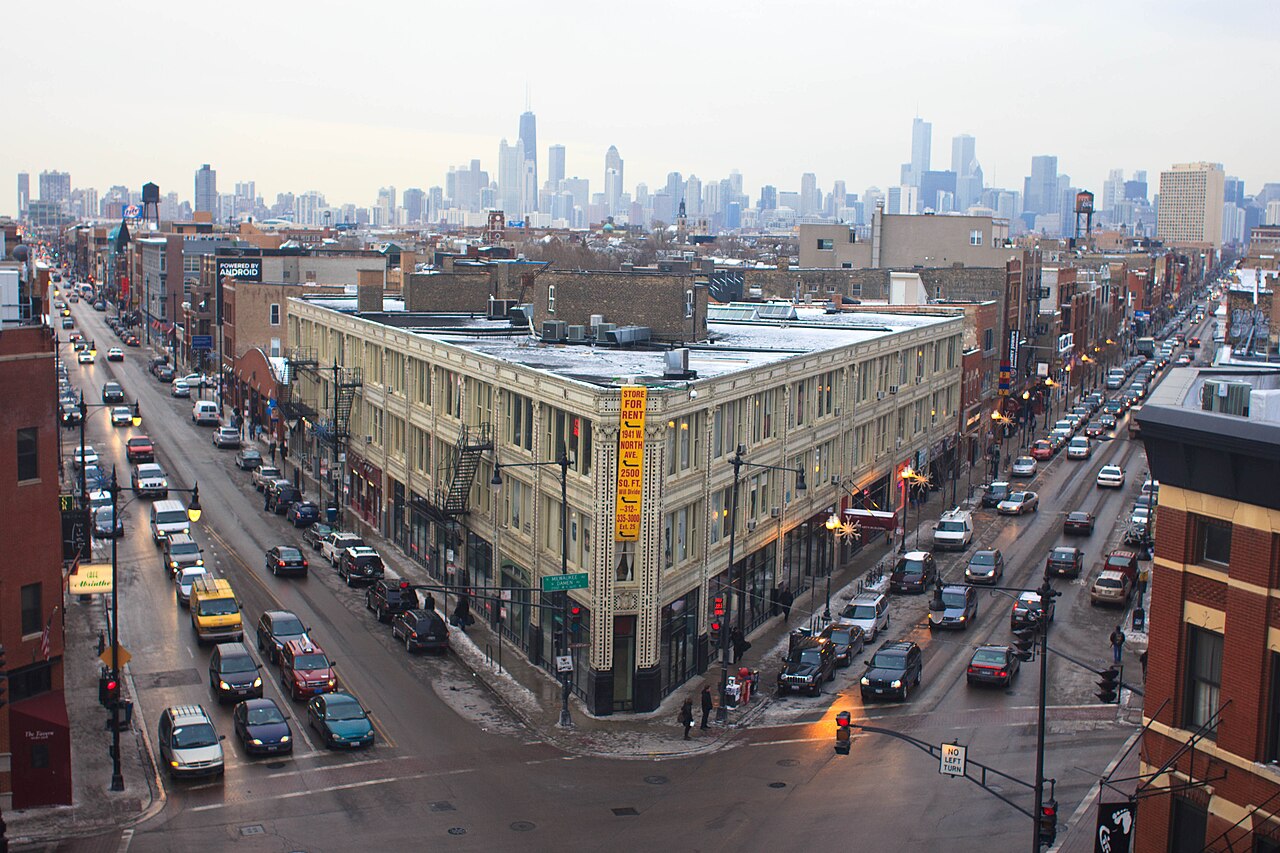
Wicker Park is a bohemian neighborhood northwest of downtown known for street art, vintage shops, independent cafes, and a young creative community. It is in Chicago, United States. Most visitors spend 2–3 hours here. The free Lokali audio guide runs 5 minutes.
✓ Verified August 2026 · how we write these guides
Visitor facts
| Time needed | 2–3 hours |
|---|---|
| Lokali audio guide | 5 min · free |
| Type | Neighborhood |
| Best for | Local life |
| Location | Chicago, United States |
| Coordinates | 41.9081, -87.6776 |
| Languages | 45, in the Lokali app |
The story
Stand at the six-way crossing where Milwaukee, Damen, and North Avenues meet. Traffic weaves in from six directions at once. Coffee drifts out of cafe doorways. Somewhere a guitar plays inside a record shop. Cyclists thread between buses. This is Wicker Park, a Chicago neighborhood that shares its name with the small green square at its heart, two blocks south of where you stand.
The park came first. In 1870, two brothers, Charles and Joel Wicker, bought land out here along Milwaukee Avenue, a plank road that angled northwest from the young city. They divided their purchase into house lots. Then they set aside about four acres as a public park. It was clever business. A home facing a park sells for more, and the brothers knew it.
One year later, their timing turned lucky. In 1871, the Great Chicago Fire burned the center of the city to the ground. Around one hundred thousand people lost their homes. Many moved northwest, past the edge of the burned zone, onto solid ground where they could build again. Wicker Park began to fill.
German and Scandinavian merchants built large houses near the park. Brewers did especially well here. Along Hoyne Avenue and Pierce Avenue they raised mansions with towers, carved stone, and stained glass. People called it Beer Baron Row. Many of those houses still stand, and their details reward a slow, unhurried walk.
Polish families arrived in the following decades, in very large numbers. Milwaukee Avenue became the spine of Polish Chicago, lined with churches, savings banks, and meeting halls. For a time, Chicago held one of the largest Polish populations of any city in the world outside Poland, and much of that life ran along this street.
The neighborhood also produced hard, honest literature. The novelist Nelson Algren lived on Evergreen Avenue, a short walk from the park. He wrote about the area's card players, night workers, and dreamers. His novel The Man with the Golden Arm won the first National Book Award for fiction in 1950. Algren compared loving Chicago to loving a woman with a broken nose. Imperfect, he meant, but real.
The middle of the twentieth century brought decline. Families moved to the suburbs. Buildings emptied, and rents fell. Then, in the 1980s, artists noticed those same low rents and big old spaces. Studios and galleries opened. The triangular Flat Iron Arts Building, right at the main crossing, filled with painters and printmakers. It still holds working studios today, and on some evenings the doors open for art walks.
In the 1990s, music took over. Small clubs booked loud young bands, and Wicker Park became a center of American alternative rock. The Double Door club stood at the main intersection for more than twenty years. In 1997, the Rolling Stones played a surprise show there, in a room built for a few hundred people. Fans still talk about that night.
By 2000, the wider world had noticed. Film crews shot movie scenes along Milwaukee Avenue, and in 2001 a reality television series moved its cameras into a loft right at the six-way crossing. Longtime residents rolled their eyes. The neighborhood had become a brand.
Through all of this, the park itself stayed calm. Today it holds gardens, an ornamental fountain, a playground, and a small fieldhouse. Dogs get their own fenced run. On summer Sundays, a farmers market fills the paths with produce stands and fresh bread. Neighbors cross paths here the way they have for a century and a half.
The blocks around the park repay wandering. Milwaukee Avenue carries record shops, bookstores, and murals. A few blocks north, an old elevated freight line has become the 606 trail, where you can walk above the rooftops and look down into back gardens. The Blue Line's Damen stop drops you at the heart of it all.
Change has a price, and Wicker Park knows it. Rising rents pushed out many of the artists and working families who gave the area its character. Some moved a few miles northwest along the same avenue, repeating an old Chicago pattern. That tension is part of the story too. Neighborhoods keep negotiating between what they were and what they are becoming.
So find a bench near the fountain. Watch the mix pass by: skaters, strollers, old-timers, newcomers. The Wicker brothers set this ground aside to help sell house lots. It became something better than a sales pitch. A small green room in a loud city, holding a hundred and fifty years of arrivals, with space still open on the bench.
Key facts
What to look for
Practical tips
Common questions
How long do you need at Wicker Park?
Plan 2–3 hours. That is the time most visitors spend at Wicker Park. The free Lokali audio guide adds about 5 minutes of narration you can listen to as you walk, so it fits inside your visit rather than adding to it.
Is there a free audio guide to Wicker Park?
Yes — the Lokali app narrates Wicker Park free of charge in 50+ languages. It covers the history, what to look for on site and practical tips, and it works offline once downloaded.
Where is Wicker Park?
Wicker Park is in Chicago, United States, at 41.9081, -87.6776. Tap the map link on this page for directions from where you are.
What should you know before visiting Wicker Park?
Take the Blue Line to Damen for the main crossing.
What is Wicker Park known for?
Brothers Charles and Joel Wicker donated the park land in 1870.
What is the best time to visit Wicker Park?
Wicker Park avenue and Division Street have the densest concentration of murals and galleries.
On the map
Opens directions to Wicker Park from your location.
More to see in Chicago


Hear Wicker Park in your language
The full story, narrated, in 50+ languages. Download it before you go and it plays offline, at your own pace, with no ticket and no tour group.