
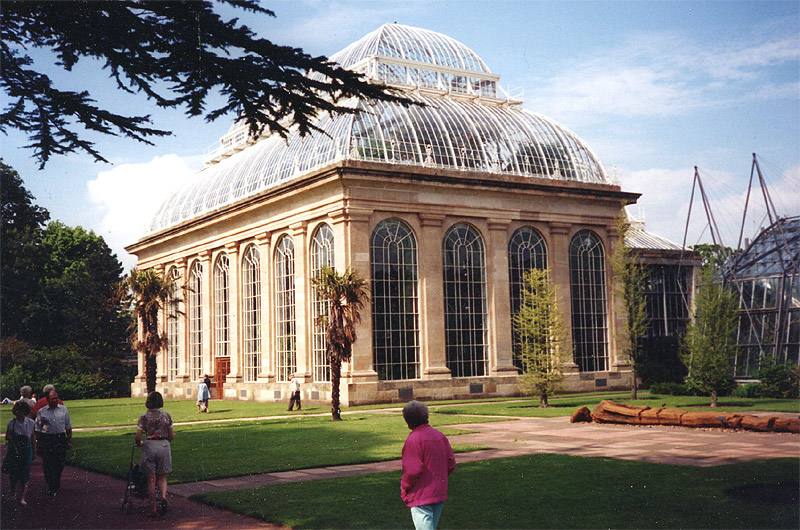
Photo: billfromesm · CC BY 2.0 · Wikimedia Commons
Edinburgh Zoo is a zoo in Edinburgh, Scotland, UK. Edinburgh Zoo opened to the public in 1913. The free Lokali audio guide runs 7 minutes.
✓ Published October 2026 · how we write these guides
Visitor facts
| Lokali audio guide | 7 min · free |
|---|---|
| Type | Zoo |
| Location | Edinburgh, United Kingdom |
| Coordinates | 55.9425, -3.2700 |
| Official website | edinburghzoo.org.uk |
| Languages | 50+, in the Lokali app |
The story
Listen for a moment. Beneath the traffic on Corstorphine Road there is a second layer of sound: the squeal of a gibbon, the chatter of birds, and somewhere uphill, a strange honking call. The paths under your feet already tilt upward. This zoo does not sit on flat ground. It climbs a hillside on the western edge of Scotland's capital, and almost every visit here starts the same way, with a gentle uphill walk.
The ground explains much of the zoo's character. The site lies on the lower slopes of Corstorphine Hill, a wooded ridge a few kilometres west of the city centre. Enclosures are tucked into terraces and hollows, linked by winding paths and steps. You will rarely see the whole zoo at once. Instead it opens up in pieces: a stand of trees, a rocky ledge, a pool, then another bend. The hill turns a day here into a slow discovery.
The story begins with one determined man. Thomas Gillespie was an Edinburgh lawyer with a passion for animals. In 1909 he helped found the Royal Zoological Society of Scotland, a charity that still runs the zoo today. Gillespie had a modern idea for his time. He admired the work of Carl Hagenbeck, a German animal dealer who built enclosures without bars, using ditches and moats instead. Gillespie wanted animals shown in open spaces, closer to their natural settings.
The zoo opened to the public in 1913. Picture Edinburgh just before the First World War: a city of stone tenements, coal smoke and tramlines. A zoo on a green hillside, built around open enclosures, was a bold project. It was also a gamble. The society had to raise money, find animals and keep them alive through hard Scottish winters. More than a century later, the hillside is still home to animals from almost every continent.
Here is the first surprise. Edinburgh became famous for penguins almost from the beginning. In the zoo's opening years, king penguins arrived from the South Atlantic, carried north on ships connected to a Scottish whaling company based in the city's port of Leith. Not long after, in 1919, a king penguin chick hatched here. It is widely recorded as the first penguin ever to hatch outside the Southern Hemisphere. A cold, windy city in the north turned out to suit these birds well.
That link to penguins produced one of the zoo's best-known traditions — and it began by accident. The story goes that in 1951, a keeper left a gate open, and a group of penguins wandered out and followed him along the path. Visitors loved it. The Penguin Parade grew from that moment. Over the years it became a gentle walk outside the enclosure, and the penguins are never forced to join. Some days only a few curious birds waddle out. Other days, none at all.
Now for the second surprise. One of the penguins here holds a military knighthood. In 1972, the Norwegian King's Guard adopted a king penguin at Edinburgh Zoo as its mascot. The bird was named Nils Olav. When one penguin dies, the name and the rank pass to a successor. In 2008, Sir Nils Olav was formally knighted in a ceremony here, with Norwegian soldiers standing in full parade uniform. He has received further promotions since. A bronze statue of him stands in the zoo.
From penguins, it is worth thinking about the bigger picture. The Royal Zoological Society of Scotland is a conservation charity, not a commercial business. It also runs the Highland Wildlife Park in the Cairngorms, where animals from cold climates live in a wilder landscape. Here in Edinburgh, many of the animals take part in breeding programmes shared with zoos across Europe. The aim is to keep healthy populations of threatened species, and in some cases to support projects in the wild.
For more than a decade, the most famous residents here were two giant pandas, Tian Tian and Yang Guang. They arrived from China in 2011, on a long-term loan, and they were the only giant pandas in the United Kingdom at the time. Crowds came for years to watch them eat bamboo and sleep in the sun. At the end of 2023, the pair returned to China. Their departure marked the end of a chapter that many Edinburgh families remember well.
Another corner of the zoo looks closely at our nearest relatives. The Budongo Trail is home to a group of chimpanzees. It opened in 2008 and is named after a forest in Uganda where chimpanzees are studied in the wild. The building is more than a display. Scientists from Scottish universities use it to study how chimpanzees think, communicate and solve problems. If you stand quietly near the glass, you may see them groom each other, argue, or simply watch you back.
As you walk higher, pay attention to the views. The upper slopes of the hill look out across the rooftops of western Edinburgh, and on a clear day the land opens toward the hills beyond the city. The air feels cooler up here, and the wind is often stronger. Rain can sweep in quickly and leave again just as fast. On a grey morning, mist sits low among the trees, and the calls of the animals carry a long way.
It also helps to remember what kind of place this is. The zoo is a working site, so animals are not always on show. Some enclosures are large, with plenty of places to hide. A tiger may sleep out of sight, or a tapir may stay in its house on a cold day. Patience pays off here. Early in the day, and around feeding times, animals are often more active. Slow down, and the zoo rewards you.
Before you move on, stop for a moment wherever you are standing. Look at the slope of the ground, the old trees, the paths that bend out of sight. This hillside has carried a century of visitors — children holding parents' hands, keepers on early rounds, penguins with no plans at all. Listen again for those layered sounds: birds, wind, voices, and the city just beyond the fence. Then take the next path, and see what the hill shows you.
Key facts
What to look for
Practical tips
Common questions
Is there a free audio guide to Edinburgh Zoo?
Yes — the Lokali app narrates Edinburgh Zoo free of charge in 50+ languages. The guide runs about 7 minutes, covers the history, what to look for on site and practical tips, and works offline once downloaded.
Where is Edinburgh Zoo?
Edinburgh Zoo is in Edinburgh, United Kingdom, at 55.9425, -3.2700. Tap the map link on this page for directions from where you are.
What is Edinburgh Zoo known for?
Edinburgh Zoo opened to the public in 1913. Founded by lawyer Thomas Gillespie and a zoological society.
What should you look for at Edinburgh Zoo?
The bronze statue of Sir Nils Olav the penguin. Terraced enclosures cut into the slope of Corstorphine Hill. Views across western Edinburgh from the upper paths.
What should you know before visiting Edinburgh Zoo?
Wear comfortable shoes for steep paths across the hillside. Arrive early when many animals are most active.
When is the best time to visit Edinburgh Zoo?
Arrive early when many animals are most active.
On the map
Opens directions to Edinburgh Zoo from your location.
More to see in Edinburgh


Hear Edinburgh Zoo in your language
The full story, narrated, in 50+ languages. Download it before you go and it plays offline, at your own pace, with no ticket and no tour group.