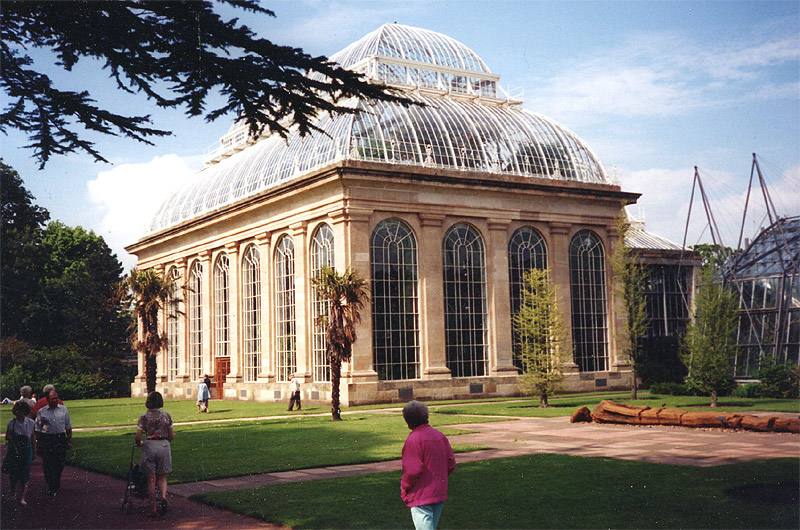
Royal Botanic Garden Edinburgh
55.9651° N · 3.2085° W · Botanical Garden
Photo: Steve nova at English Wikipedia. · CC BY-SA 3.0 · Wikimedia Commons
Royal Botanic Garden Edinburgh is a botanical garden in Edinburgh, Scotland, UK. Founded in 1670 as a physic garden near Holyrood. The free Lokali audio guide runs 7 minutes.
✓ Published October 2026 · how we write these guides
Visitor facts
| Lokali audio guide | 7 min · free |
|---|---|
| Type | Botanical Garden |
| Location | Edinburgh, United Kingdom |
| Coordinates | 55.9651, -3.2085 |
| Official website | rbge.org.uk |
| Languages | 50+, in the Lokali app |
The story
Listen for a moment. Under the traffic of the city there is another sound here: gravel crunching underfoot, wind moving through tall conifers, and blackbirds calling from the shrubs. The air smells of cut grass and damp bark. It is cooler under the trees, and it feels further from the city centre than it really is. This is the Royal Botanic Garden Edinburgh, a few minutes' walk north of the New Town. Its story began long before these lawns were laid.
The garden started in 1670, but not on this spot. Two Edinburgh physicians, Robert Sibbald and Andrew Balfour, set up a small physic garden near Holyrood Abbey. A physic garden grew plants for medicine, so doctors and students could learn which leaf or root might heal and which might kill. It was a practical teaching tool, about the size of a tennis court. That makes Edinburgh's garden the second oldest botanic garden in Britain, after the one in Oxford.
The city grew, and the garden had to move with it. In the eighteenth century it shifted to a larger site off Leith Walk. Then, in the 1820s, it came here to Inverleith, to open ground on what was then the edge of town. Here is a detail most visitors miss. The gardeners did not want to start again with saplings. So they moved mature trees across Edinburgh, roots and soil intact, on a transplanting machine designed by the curator, William McNab. Some of those trees were already decades old.
As you walk, notice how the garden is shaped. It is not flat. The ground rises gently from the eastern entrances towards a ridge, and the paths wind rather than run straight. This was deliberate. Each turn shows you a new group of plants and a new view. The whole site covers about seventy acres, a little under thirty hectares. That is enough space to lose the sound of the street completely if you walk towards the centre.
Along Inverleith Row, the eastern edge of the garden, you may have passed a huge beech hedge. It is taller than a house and runs for a long stretch beside the pavement. Gardeners have trimmed it for more than a century, and keeping it in shape is a serious job that needs ladders and lifting platforms. In autumn the leaves turn copper. In winter many of the dead leaves stay on the branches, so the hedge keeps its colour when other trees are bare.
Now look towards the glasshouses. The tall Temperate Palm House dates from the 1850s. It is often described as the tallest traditional palm house in Britain, with stone walls below and glass above. Victorian engineers built houses like this to show off plants that empire and trade had brought back from warmer climates. In recent years these glasshouses have been closed for a major restoration programme, so check what is open on the day you visit.
The Rock Garden is one of the best places to slow down. Water trickles between boulders, and small alpine plants grow in the cracks and gravel. Many of them come from high mountains, where summers are short and winds are hard. In spring and early summer, tiny flowers in blue, white and yellow open close to the ground. Bend down and look closely. Some of these plants are no bigger than your thumbnail, yet they survive conditions that would kill a garden rose.
Here is the second surprise. Much of what grows on the higher slopes comes from the mountains of western China and the Himalaya. In the early twentieth century, plant hunters travelled there to collect seeds, and the Scottish collector George Forrest became especially known for rhododendrons from Yunnan province. Edinburgh's cool, wet climate suits many of these plants well. That is why the garden has such a large collection of rhododendrons. In late spring the slopes fill with pink, red, purple and cream flowers.
The garden is also a working scientific institution, not only a park. Behind the scenes is a herbarium, a library of pressed and dried plants. It holds around three million specimens collected from all over the world over several centuries. Botanists use them to identify species, track changes in plant life and study plants that may now be rare in the wild. The work done here supports conservation projects far beyond Scotland.
Edinburgh is not the only home of this institution. It is one of four gardens under the same organisation. Benmore lies in the hills of Argyll in the west, Logan sits near the coast in the far southwest, and Dawyck is in the Scottish Borders. Each one has a different climate, so each can grow different plants. Some species that struggle in Edinburgh thrive in the milder air at Logan, which is warmed by the sea.
Climb up towards Inverleith House, the elegant eighteenth century mansion near the top of the slope. It was once the home of the garden's Regius Keeper, the title given to its director. Later it was used to show art exhibitions. The real reward is on the lawn beside it. Turn south and you will see the skyline of Edinburgh laid out across the city: church spires, rooftops and, on the horizon, the castle on its rock. On a clear day this is one of the finest views in the city.
Near the western entrance you will find the John Hope Gateway, a modern building of timber and glass. It is named after John Hope, an eighteenth century professor who ran the garden and taught botany to generations of students. The building holds information about the garden, a shop and a place to eat. It stands in clear contrast to the Victorian glasshouses, and it shows how the garden has kept changing over more than three centuries.
Before you leave, stop somewhere quiet. Perhaps choose a bench under one of the older trees, or a spot by the pond where ducks move slowly through the reeds. Look around at the different shades of green, the shape of the bark, the light coming through the leaves. Some of these trees were planted by people who lived two hundred years ago. As you walk back towards the gate, listen for the moment when the traffic sound returns. Edinburgh is right there, but you carry a little of this calm with you.
Key facts
What to look for
Practical tips
Common questions
Is there a free audio guide to Royal Botanic Garden Edinburgh?
Yes — the Lokali app narrates Royal Botanic Garden Edinburgh free of charge in 50+ languages. The guide runs about 7 minutes, covers the history, what to look for on site and practical tips, and works offline once downloaded.
Where is Royal Botanic Garden Edinburgh?
Royal Botanic Garden Edinburgh is in Edinburgh, United Kingdom, at 55.9651, -3.2085. Tap the map link on this page for directions from where you are.
What is Royal Botanic Garden Edinburgh known for?
Founded in 1670 as a physic garden near Holyrood. Moved to its present Inverleith site in the 1820s.
What should you look for at Royal Botanic Garden Edinburgh?
The towering beech hedge running along Inverleith Row. Tiny alpine flowers growing between Rock Garden boulders. Edinburgh Castle on the skyline from Inverleith House.
What should you know before visiting Royal Botanic Garden Edinburgh?
Visit in late spring for the rhododendrons in flower. Check which glasshouses are open before planning your route.
When is the best time to visit Royal Botanic Garden Edinburgh?
Visit in late spring for the rhododendrons in flower.
On the map
Opens directions to Royal Botanic Garden Edinburgh from your location.
More to see in Edinburgh


Hear Royal Botanic Garden Edinburgh in your language
The full story, narrated, in 50+ languages. Download it before you go and it plays offline, at your own pace, with no ticket and no tour group.