
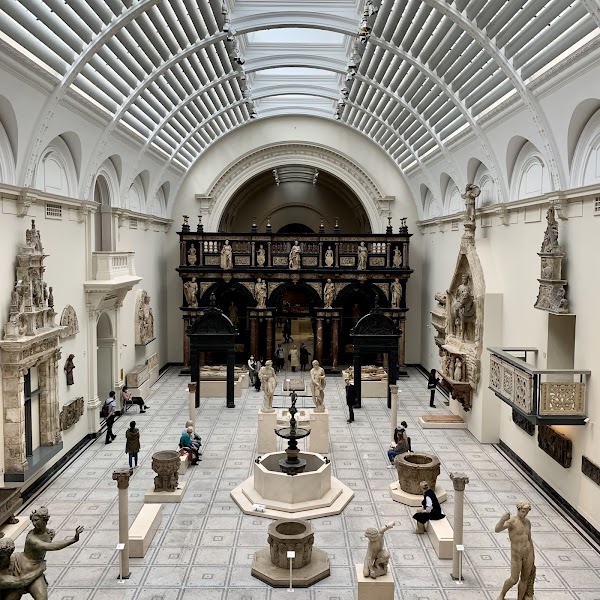
Photo: Shadowssettle · CC BY-SA 4.0 · Wikimedia Commons
Science Museum is a science museum in London, United Kingdom. It is in Westminster, United Kingdom. Grew from the proceeds of the 1851 Great Exhibition. The free Lokali audio guide runs 6 minutes.
✓ Published October 2026 · how we write these guides
Visitor facts
| Lokali audio guide | 6 min · free |
|---|---|
| Type | Museum |
| Location | Westminster, United Kingdom |
| Coordinates | 51.4975, -0.1747 |
| Official website | sciencemuseum.org.uk |
| Languages | 50+, in the Lokali app |
The story
Listen for a moment. Under the high ceiling of the entrance halls, the sound is a soft mix of footsteps, school groups, and the low hum of machines that were built to move the world. The air smells faintly of polished metal and old oil. Light falls across brass, iron, and painted steel. This is the Science Museum, on Exhibition Road in South Kensington, and the first thing many visitors notice is the scale of the engines.
The museum's story begins with the Great Exhibition of 1851. That event filled a vast glass hall in nearby Hyde Park with the newest inventions of the industrial age. Its profits helped buy land in this part of London. Over the following decades, a cluster of museums, colleges, and learned societies grew here. Some Londoners still call this district by an old nickname, Albertopolis, after Prince Albert, who pushed hard for the exhibition.
At first, science and art shared one institution, the South Kensington Museum. Paintings and sculpture sat alongside machines and models. Over time the collections grew too large to live together. In the early twentieth century they separated. The art went to what became the Victoria and Albert Museum, just up the road. The machines, instruments, and inventions became the Science Museum. The building you are in now took shape in the 1920s, with later galleries added since.
On the ground floor, the Energy Hall is a good place to start. Here, great steam engines stand in rows. Their wheels, rods, and pistons once drove mills and factories across Britain. Look at the size of the flywheels, and imagine the noise and heat when they ran. These were not polite machines. They were the power source of the industrial revolution, the period when Britain moved from hand work to factory production.
Nearby, a gallery called Making the Modern World lines up objects from across the last few centuries. One of them is Puffing Billy, among the oldest surviving steam locomotives in the world. It was built to haul coal wagons, not passengers. Its shape looks almost clumsy today — tall chimney, exposed cylinders, wooden frame. Yet engines like this one opened the way for the railways that later crossed whole continents.
In the same space hangs a small, scorched capsule. This is the command module from Apollo 10, a NASA mission that flew to the Moon in 1969 as a dress rehearsal for the first landing. The crew nicknamed it Charlie Brown, after the cartoon character. Stand close and look at the heat shield. Its rough, burnt surface shows the friction of re-entry into the Earth's atmosphere at enormous speed.
Here is a detail many visitors walk past. The museum holds a reconstruction of James Watt's workshop. Watt was the Scottish engineer whose improvements to the steam engine changed industry. When he died, his attic workshop was sealed and left almost untouched. Much later, its entire contents were moved here. Tools, drawers, half-finished projects... it feels less like an exhibit and more like a room the owner has just stepped out of.
Upstairs, the story of computing has its own surprise. In the nineteenth century, the mathematician Charles Babbage designed a mechanical calculating machine called the Difference Engine. He never completed it in his lifetime. In 1991, the museum built one from his original drawings — and it worked. Thousands of precise metal parts turn together to calculate tables of numbers. And yes, the museum also keeps part of Babbage's brain. It was preserved after his death.
The Flight gallery changes the mood. Aircraft hang from the ceiling, and the room feels open and airy. Among them is the Vickers Vimy flown by John Alcock and Arthur Brown, who made the first non-stop flight across the Atlantic in 1919. Their aircraft looks fragile today, all fabric and struts. Nearby is the small biplane of Amy Johnson, the British pilot who flew solo from England to Australia.
The museum is not only about the past. Galleries on medicine trace how people have tried to heal the body, from ancient charms to modern surgery. Another space looks at information and communication — from telegraph cables to radio and the internet. The interactive gallery called Wonderlab lets visitors test forces, light, and sound with their own hands. It is popular with families, so expect lively noise in that part of the building.
Step outside for a moment and look along Exhibition Road. The Natural History Museum stands on one side, with its pale terracotta walls. The Victoria and Albert Museum is a short walk north. Behind the Science Museum, the buildings of Imperial College London, one of the city's leading science universities, continue the area's link between research and public learning. The street itself was redesigned in recent years so that pedestrians and traffic share one level surface.
One quiet idea runs through all of these rooms. Most of the objects here were once ordinary working tools. A steam engine was a factory machine. A locomotive pulled coal. A computer part sat inside an office. The museum shows how everyday technology slowly becomes history. It is worth asking which objects in your own pocket or home might one day sit behind glass in a gallery like this.
Before you leave, pause near one of the large machines again. Look at the rivets, the worn paint, the marks left by hands that oiled and repaired them. Listen to the voices around you — children asking how things work, adults reading labels aloud. That curiosity is the real engine of this place. As you walk back out onto Exhibition Road, notice how much of the modern city around you runs on ideas first tested in rooms like these.
Key facts
What to look for
Practical tips
Common questions
Is there a free audio guide to Science Museum?
Yes — the Lokali app narrates Science Museum free of charge in 50+ languages. The guide runs about 6 minutes, covers the history, what to look for on site and practical tips, and works offline once downloaded.
Where is Science Museum?
Science Museum is in Westminster, United Kingdom, at 51.4975, -0.1747. Tap the map link on this page for directions from where you are.
What is Science Museum known for?
Grew from the proceeds of the 1851 Great Exhibition. Science collections split from the art collections last century.
What should you look for at Science Museum?
Scorched heat shield on the Apollo 10 capsule. Exposed cylinders and tall chimney on Puffing Billy. Cluttered drawers inside James Watt's reconstructed workshop.
What should you know before visiting Science Museum?
Start in the Energy Hall on the ground floor. Book Wonderlab separately if you are visiting with children.
When is the best time to visit Science Museum?
Arrive early on weekdays to avoid school group crowds.
On the map
Opens directions to Science Museum from your location.
More to see in Westminster



Hear Science Museum in your language
The full story, narrated, in 50+ languages. Download it before you go and it plays offline, at your own pace, with no ticket and no tour group.