
Natural History Museum, London
51.4961° N · 0.1761° W · Museum
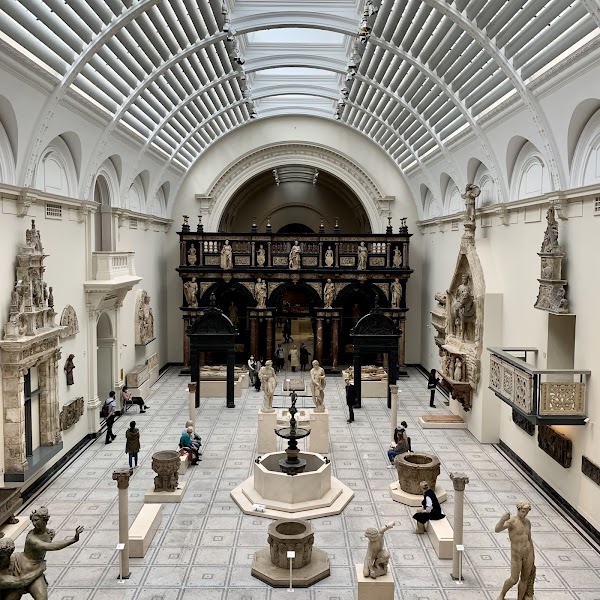
Photo: Christine Matthews · CC BY-SA 2.0 · Wikimedia Commons
Natural History Museum, London is a museum in London, England, UK. The museum building opened to the public in 1881. The free Lokali audio guide runs 8 minutes.
✓ Published October 2026 · how we write these guides
Visitor facts
| Lokali audio guide | 8 min · free |
|---|---|
| Type | Museum |
| Location | London, United Kingdom |
| Coordinates | 51.4961, -0.1761 |
| Official website | nhm.ac.uk |
| Languages | 50+, in the Lokali app |
The story
Stand still for a moment on the front steps and put your hand against the wall. It is not stone. It is terracotta, baked clay in pale honey and soft blue-grey, cool and slightly grainy under your fingers. Above you, rows of arches climb toward two tall towers. And if you look closely at the surface, it is crawling with life. Monkeys, fish, birds and lizards are moulded into the walls. This building was designed to tell you what is inside before you even reach the door.
Welcome to the Natural History Museum, on Cromwell Road in South Kensington. The building opened to the public in 1881. For most of the century before that, Britain's natural history specimens lived inside the British Museum in Bloomsbury. The collection simply outgrew its home. Fossils, minerals and stuffed animals competed for space with ancient sculpture and old manuscripts. Something had to change, and one determined man pushed hardest for it.
That man was Richard Owen, a brilliant and famously combative anatomist. Owen is the scientist who gave us the word dinosaur. He argued that the nation's animals, plants and rocks deserved a building of their own — a cathedral to nature, open to ordinary people. Many politicians thought the idea was too expensive. Owen kept pressing for years. In the end he won, and the museum you see is, in large part, the result of his persistence.
The architect was Alfred Waterhouse, a Manchester man who also designed Manchester Town Hall. He worked in a Romanesque style, meaning rounded arches and heavy, solid forms borrowed from European churches built about a thousand years ago. His choice of terracotta was practical, not only decorative. Victorian London was thick with coal smoke. Terracotta has a hard, glazed surface, so soot could be washed away more easily than from soft stone. The building was made to survive the city's dirty air.
Now here is the first detail most visitors miss. The animal carvings follow a plan. On the western side of the building, the terracotta shows living species, creatures that still exist today. On the eastern side, the carvings show extinct species, animals known only from fossils. Owen wanted the building itself to work as a lesson. As you walk around the outside later, see if you can tell which side you are on just by looking at the walls.
Step through the main doors and you enter Hintze Hall, the great central space. The scale changes all at once. The ceiling rises high above you, and sound moves differently here. Voices soften and float. Children's footsteps echo off the floor. Light falls from above through the roof, and the whole hall feels less like a gallery and more like the nave of a church. That comparison was intentional. Waterhouse and Owen wanted visitors to feel wonder here, not just curiosity.
Look up. Hanging above the hall is the skeleton of a blue whale, the largest animal that has ever lived on Earth. She is called Hope. She is a female who was stranded in Wexford Harbour, in Ireland, in 1891, and the museum acquired her skeleton soon after. For much of the twentieth century she was displayed in the mammal galleries. In 2017 she was lifted into this hall and suspended in a diving pose, as if she were plunging toward the floor. She measures roughly twenty-five metres from end to end.
Hope replaced a famous predecessor. For decades this hall belonged to Dippy, a full-size cast of a Diplodocus skeleton. Dippy was a copy, not real bone. The original fossil was found in the United States, and the industrialist Andrew Carnegie gave a cast to the museum in the early twentieth century. Generations of Londoners grew up seeing that long-necked dinosaur as they walked in. When Dippy left the hall, many people were genuinely upset. The museum chose the whale to carry a message about conservation, and about a species that humans once hunted close to extinction.
Here is a second detail worth your attention. Raise your eyes past the whale to the ceiling itself. It is divided into many painted panels, more than a hundred of them. Each one shows a plant. Some are botanical illustrations of trees, flowers and crops from around the world. It is easy to walk the length of this hall without ever noticing them. Even the roof of this building was designed to teach. Then look along the arches at the sides of the hall, where small terracotta monkeys climb upward.
At the top of the grand staircase, a seated marble figure looks out over the hall. That is Charles Darwin, whose theory of evolution by natural selection changed how we understand all the life in this building. His statue has moved around over the years and returned to this place on the stairs in 2008. There is a quiet irony here. Richard Owen, the man who fought for this museum, was one of Darwin's sharpest critics. The two men disagreed bitterly. Today the building honours both.
From here the museum branches into separate worlds. Many visitors head straight for the dinosaur gallery, with its raised walkway and its moving model of a Tyrannosaurus rex. Others go east into the Earth galleries, which once belonged to a separate geological museum. There, a long escalator carries you up through a large sculpted globe, into displays about volcanoes, earthquakes and the rocks beneath our feet. Toward the back, the modern Darwin Centre houses research collections behind glass, where you can sometimes see scientists at work.
This is the part of the museum most visitors never think about. What you see on display is only a small fraction of what the institution holds. The collections run to around eighty million specimens. They include insects pinned in drawers, birds collected on long voyages, meteorites from space, and jars of animals preserved in alcohol. Scientists from around the world come here to study them. The museum is a public attraction, yes — but it is also a working laboratory, and the research never stops.
Outside, the grounds change with the seasons. On the eastern side there is a wildlife garden, a small patch of planted habitat where birds, bees and insects live in the middle of the city. In winter, an ice rink often appears on the lawn in front of the museum, and the terracotta walls glow behind the skaters at dusk. Exhibition Road runs along one side, linking this building to its neighbours, the Science Museum and the Victoria and Albert Museum.
Before you move on, take one last look at the front of the building. Notice how the towers frame the entrance, and how the pale clay changes colour as the light moves across it. Somewhere on these walls, a carved fish or a stone lizard is looking back at you. The people who built this place wanted every surface to make you curious about the natural world. As you walk away, listen to the traffic, and to the birds in the trees... and remember that they belong to the same story told inside.
Key facts
What to look for
Practical tips
Common questions
Is there a free audio guide to Natural History Museum, London?
Yes — the Lokali app narrates Natural History Museum, London free of charge in 50+ languages. The guide runs about 8 minutes, covers the history, what to look for on site and practical tips, and works offline once downloaded.
Where is Natural History Museum, London?
Natural History Museum, London is in London, United Kingdom, at 51.4961, -0.1761. Tap the map link on this page for directions from where you are.
What is Natural History Museum, London known for?
The museum building opened to the public in 1881. Architect Alfred Waterhouse also designed Manchester Town Hall.
What should you look for at Natural History Museum, London?
Living species carved on the west, extinct ones on the east. Painted plant panels covering the Hintze Hall ceiling. Small terracotta monkeys climbing the arches inside the hall.
What should you know before visiting Natural History Museum, London?
Arrive early on a weekday to avoid the longest queues. Try the Exhibition Road entrance when the main queue is long.
When is the best time to visit Natural History Museum, London?
Head to the dinosaur gallery first before crowds build.
On the map
Opens directions to Natural History Museum, London from your location.
More to see in London



Hear Natural History Museum, London in your language
The full story, narrated, in 50+ languages. Download it before you go and it plays offline, at your own pace, with no ticket and no tour group.