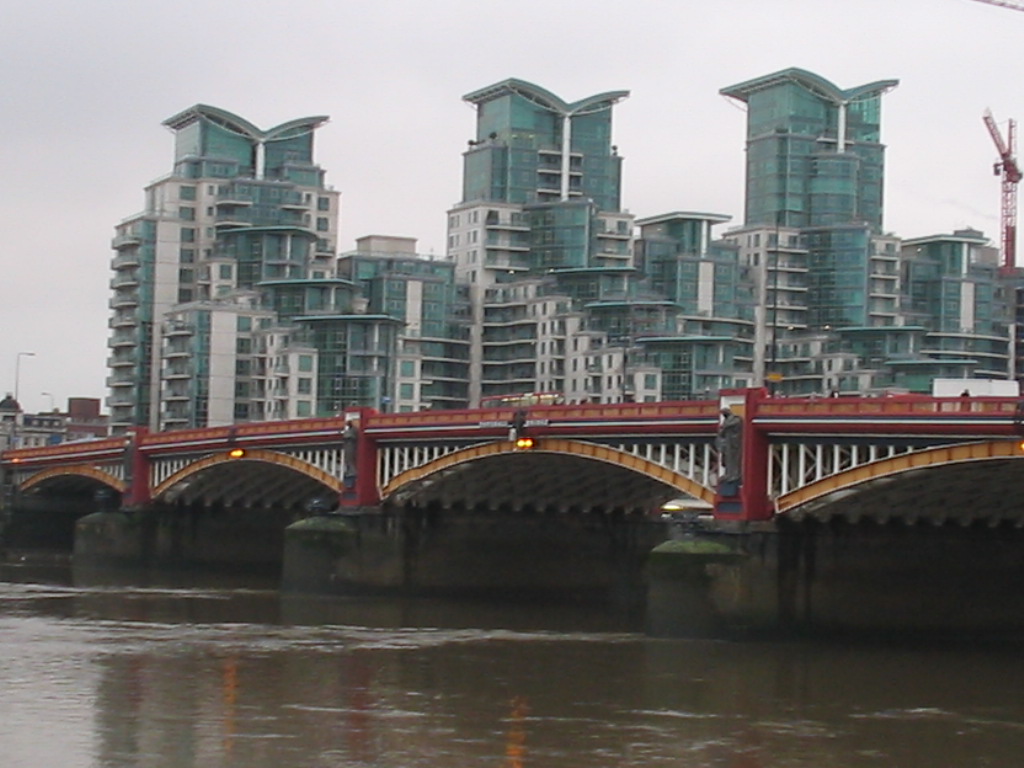
Photo: Michiel1972 at Dutch Wikipedia · CC BY-SA 3.0 · Wikimedia Commons
Vauxhall Bridge is an arch bridge in central London. It is in Westminster, United Kingdom. Current steel arch bridge opened in 1906. The free Lokali audio guide runs 7 minutes.
✓ Published October 2026 · how we write these guides
Visitor facts
| Lokali audio guide | 7 min · free |
|---|---|
| Type | Bridge |
| Location | Westminster, United Kingdom |
| Coordinates | 51.4875, -0.1269 |
| Languages | 50+, in the Lokali app |
The story
Stand at the parapet for a moment and listen. Buses pass close behind you with a low, steady hum. Below, the Thames slaps against stone piers, brown and restless, carrying the smell of mud and salt from the estuary. The railing is cool under your hand and painted a deep red. Look upstream and downstream and you will see a river that has carried London's traffic for two thousand years. This is Vauxhall Bridge, and it holds one of the river's best surprises. You cannot see it from where you are standing.
First, a sense of where you are. The bridge crosses the Thames between Pimlico on the north bank, in the City of Westminster, and Vauxhall on the south bank, in Lambeth. It is a working bridge, not a ceremonial one. Commuters, cyclists and delivery vans cross it all day. It carries a main road into central London. Most people who use it never stop. That is part of its character. It is a piece of serious engineering that hides its decoration in an unusual place.
The bridge you are standing on is the second one on this site. It opened in 1906, early in the twentieth century. Before it, an iron bridge stood here from 1816. That first crossing was originally called Regent Bridge, after the Prince Regent, the future King George the Fourth. It is often described as the first iron bridge across the Thames in London. Iron was still a bold material for river crossings at the time. Within a few decades, though, the old structure was struggling.
The Thames is hard on bridges. Its tides are strong, and its riverbed shifts. The piers of the first bridge sat close together, and they obstructed boats and the flow of water. By the late nineteenth century, engineers decided that repair was not enough. A temporary crossing was built while the old bridge came down. Work on its replacement then took several years. Building in a tidal river is slow, careful work, because builders can only reach the riverbed at certain hours.
The new bridge used steel arches set on granite piers. Count the spans from the bank and you will find five of them. The engineering was led first by Sir Alexander Binnie, and the work was completed under Maurice Fitzmaurice. The result is wider and stronger than the iron bridge before it. Here is a small fact many visitors miss. Vauxhall Bridge was the first Thames bridge in London built to carry trams. Electric trams once rattled over the deck where buses run today.
Now for the hidden part. On the piers below you stand eight large bronze statues. They are female figures, each one taller than a person. You cannot see them from the bridge deck, because they face out along the river. They were designed to be seen from the water and the banks. Many Londoners cross this bridge for years without knowing the statues exist. To find them, walk down to the riverside path on either bank and look back at the piers.
The statues were made by two sculptors, Alfred Drury and Frederick Pomeroy. Each figure stands for an art, science or civic idea. On one side you will find Agriculture, Architecture, Engineering and Pottery. On the other side stand Science, Fine Arts, Local Government and Education. Look closely and each woman holds an object that hints at her subject. One carries a small model of a building. Another holds tools. Together they show what Edwardian Londoners valued — industry, learning and good government.
That word Edwardian is useful here. It refers to the reign of King Edward the Seventh, in the first decade of the twentieth century. It was a confident period for London. The city was the centre of a large empire, and public works were often decorated with allegory. Allegory means using a figure, like a woman holding a book, to stand for an idea, like Education. On most bridges this decoration sits on top for everyone to see. Here it was placed low, close to the water.
Turn now to the south bank. The large, pale building with green glass and stepped terraces is the headquarters of the Secret Intelligence Service, often called MI6. It was designed by the architect Terry Farrell and completed in the 1990s. Some people say it looks like a ziggurat, a stepped temple from ancient Mesopotamia. Others compare it to a giant machine. It has appeared in several James Bond films. It is a strange neighbour for a quiet working bridge.
Now look down at the shore below that building at low tide. Here is the second surprise, and it is far older than anything else in view. On the foreshore near Vauxhall, archaeologists found the remains of ancient timber posts. They date to the prehistoric period, thousands of years before London existed. They are among the oldest structures ever found in the city. Nobody knows their exact purpose. Some researchers think they marked a sacred place where a smaller river once met the Thames.
The name Vauxhall has its own story. It comes from a medieval landowner, and over the centuries the name stayed with the district. In the eighteenth century, Vauxhall was famous for its pleasure gardens. Londoners came across the river to walk under lanterns, listen to music and watch fireworks. Before any bridge stood here, many visitors arrived by boat. The gardens closed in the nineteenth century, but the district kept its name. Today the area around the bridge is a mix of offices, housing and busy road junctions.
On the north side, the streets of Pimlico run away from the river in neat terraces of cream stucco. Stucco is a smooth plaster coating on brick. Just downstream along Millbank stands Tate Britain, the national gallery of British art. Upstream you can see newer towers rising at Nine Elms and Battersea. From the middle of the bridge, the river shows London's layers clearly. Old and new sit side by side, all held together by the moving water.
Before you go, look once more at the red railings and the long curve of the steel arches. Feel the slight movement as a heavy bus passes. Hundreds of people will cross this spot in the next hour, and few will know what stands beneath their feet. Now you do. As you walk off the bridge, take the stairs to the river path. Turn back, look at the piers, and find the bronze women watching the Thames.
Key facts
What to look for
Practical tips
Common questions
Is there a free audio guide to Vauxhall Bridge?
Yes — the Lokali app narrates Vauxhall Bridge free of charge in 50+ languages. The guide runs about 7 minutes, covers the history, what to look for on site and practical tips, and works offline once downloaded.
Where is Vauxhall Bridge?
Vauxhall Bridge is in Westminster, United Kingdom, at 51.4875, -0.1269. Tap the map link on this page for directions from where you are.
What is Vauxhall Bridge known for?
Current steel arch bridge opened in 1906. First bridge on this site opened in 1816.
What should you look for at Vauxhall Bridge?
Bronze female figures standing on the piers below. Deep red paint on the bridge railings. Five steel arch spans crossing the Thames.
What should you know before visiting Vauxhall Bridge?
Walk down to the riverside path to see the statues. Visit at low tide to view the Vauxhall foreshore.
On the map
Opens directions to Vauxhall Bridge from your location.
More to see in Westminster



Hear Vauxhall Bridge in your language
The full story, narrated, in 50+ languages. Download it before you go and it plays offline, at your own pace, with no ticket and no tour group.