
Cristo de la Concordia
17.3843° S · 66.1350° W · Monument
Photo: Jimmy Gilles · CC BY-SA 3.0 · Wikimedia Commons
Cristo de la Concordia is a colossal statue of Jesus, tourist attraction, and pilgrimage site in Cochabamba in Bolivia. The statue itself stands about thirty-four metres tall. The free Lokali audio guide runs 6 minutes.
✓ Published October 2026 · how we write these guides
Visitor facts
| Lokali audio guide | 6 min · free |
|---|---|
| Type | Monument |
| Location | Cochabamba, Bolivia |
| Coordinates | -17.3843, -66.1350 |
| Languages | 50+, in the Lokali app |
The story
Feel the air first. Up here, high above the Cochabamba valley, it is thin, dry and clean, and it moves across the hilltop in soft, steady gusts. Below you, a wide plain of rooftops runs out toward the mountains, a patchwork of terracotta, grey concrete and green. Above you, a white figure stands with its arms held open. This is Cristo de la Concordia, the Christ of Concord, and you are standing at its feet.
The statue rises from the summit of San Pedro hill, on the eastern edge of the city. From almost anywhere in Cochabamba, you can look up and find it. Locals use it as a compass. Lost in the market streets? Look for the Christ, and you know where east is. That simple, everyday role matters. Long before it became a destination, the figure became a landmark in the most practical sense of the word.
Now, the number that surprises most visitors. The figure itself is about thirty-four metres tall, and it stands on a pedestal of roughly six metres more. That makes it taller than the famous Christ the Redeemer in Rio de Janeiro. For years, this Bolivian Christ was described as the largest statue of Jesus in the world. Today a few newer statues elsewhere are taller, but it is still among the largest on Earth.
The comparison with Rio is not an accident. The design clearly follows the Brazilian model — the long robe, the calm face, the arms stretched wide. But the people of Cochabamba wanted something of their own. Construction began in the late 1980s, and the statue was completed in 1994. It was built mainly from reinforced concrete, and its pale surface catches the strong Andean sun throughout the day.
Why this name, Concordia? The word means harmony, or agreement between people. The open arms are meant to hold the whole valley in one gesture. In a country with many languages, many peoples and a long history of political tension, that message carries weight. The statue is a religious image, yes. But for many residents it also expresses a wish — that the city below might live in peace.
Take a moment to look at the arms. They span more than thirty metres from fingertip to fingertip, almost as wide as the statue is tall. Stand directly beneath one hand and look up. The scale changes completely. From the city, the figure looks graceful and small. Up close, the folds of the robe become deep channels, and the hands become heavy slabs of concrete against the sky.
There are two ways to reach this summit. Many visitors ride the cable car, which climbs the slope in a few quiet minutes. The cabins swing gently, and the city slowly spreads out beneath your feet. Others choose the long stairway that zigzags up the hillside. It is a real climb — well over a thousand steps — and at this altitude, every flight asks something of your lungs.
Cochabamba sits at roughly 2,500 metres above sea level. That is high, though gentler than La Paz. Bolivians often call this the city of eternal spring, because the climate stays mild for most of the year. Even so, the sun up here is fierce. The light is bright and hard, and shadows are sharp. Many visitors forget this, and walk down with sunburned faces.
Locals add a word of caution about the stairway. Walk it in daylight, ideally in a group, and stay aware on quieter stretches. On weekends the steps fill with families, joggers and pilgrims, and the mood is friendly. On empty weekdays, the cable car is the easier and more relaxed choice. Either way, the reward at the top is the same wide view.
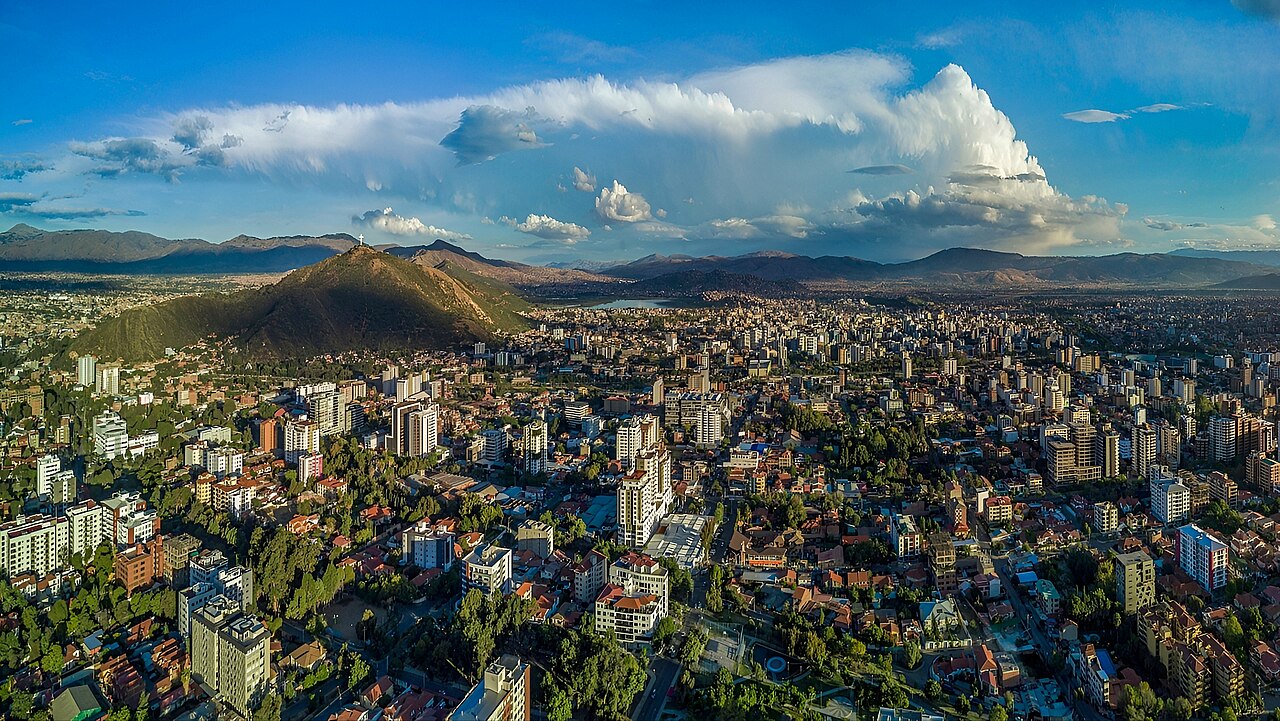
Turn away from the statue now and face the valley. To the north, a long wall of mountains rises above the city. This is the Cordillera del Tunari, and on clear days its ridges look close enough to touch. Below, you can trace the grid of central Cochabamba, its avenues lined with trees. Further out, the farmland of the valley fades into a soft haze.
This valley has fed Bolivia for centuries. Its fertile soil produced maize and other crops, and Cochabamba became known for its food. If you have eaten in the city, you have already tasted that tradition — generous plates, strong flavours, and the corn drink called chicha. Looking down from here, you can see why. Fields and orchards still push in among the newer neighbourhoods at the edges.
The hilltop itself is part of the experience. Around the base you will often find small stalls selling drinks, snacks and souvenirs. Children run between the benches. Couples lean on the railings, taking photos with the city behind them. On some days, visitors have been able to climb a narrow stairway inside the statue itself, to small openings near the arms. Ask on site whether it is open during your visit.
As evening comes, the light shifts. The white concrete turns warm gold, then pink, then grey. Lights begin to appear across the valley, one neighbourhood at a time. The statue is lit at night, and from the city it seems to float above the dark hill. Many residents say this is the hour when the figure feels most like a guardian rather than a monument.
Before you leave, stand still for a moment. Feel the wind again, the same steady wind you noticed when you arrived. Look down at the city of more than half a million people, carrying on below these open arms. When you are back in the streets, glance up now and then. The Christ will still be there, pale against the hill — quietly showing you the way east.
Key facts
What to look for
Practical tips
Common questions
Is there a free audio guide to Cristo de la Concordia?
Yes — the Lokali app narrates Cristo de la Concordia free of charge in 50+ languages. The guide runs about 6 minutes, covers the history, what to look for on site and practical tips, and works offline once downloaded.
Where is Cristo de la Concordia?
Cristo de la Concordia is in Cochabamba, Bolivia, at -17.3843, -66.1350. Tap the map link on this page for directions from where you are.
What is Cristo de la Concordia known for?
The statue itself stands about thirty-four metres tall. Completed in 1994 after construction began in the late 1980s.
What should you look for at Cristo de la Concordia?
Deep folds in the concrete robe seen from below. The outstretched hands framed against the open sky. The Tunari mountain range rising north of the city.
What should you know before visiting Cristo de la Concordia?
Take the cable car if you want to save energy. Climb the stairway only in daylight, preferably with others.
When is the best time to visit Cristo de la Concordia?
Stay for sunset to watch the valley lights appear.
On the map
Opens directions to Cristo de la Concordia from your location.
More to see in Cochabamba

Hear Cristo de la Concordia in your language
The full story, narrated, in 50+ languages. Download it before you go and it plays offline, at your own pace, with no ticket and no tour group.