
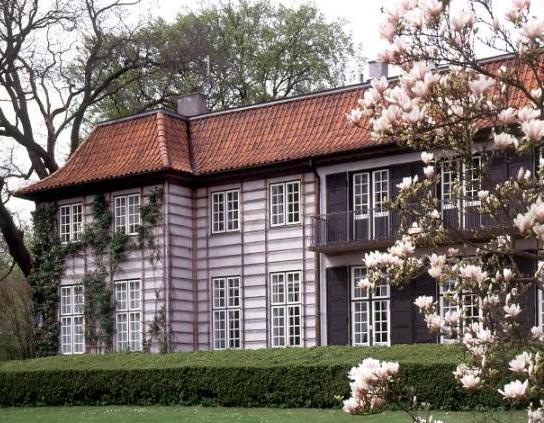
Charlottenlund Palace
55.7503° N · 12.5806° E · Palace
Photo: Jesper Hertel · CC BY-SA 3.0 · Wikimedia Commons
Charlottenlund Palace is a palace in Copenhagen. Named after Princess Charlotte Amalie, daughter of Frederick the Fourth. The free Lokali audio guide runs 6 minutes.
✓ Published October 2026 · how we write these guides
Visitor facts
| Lokali audio guide | 6 min · free |
|---|---|
| Type | Palace |
| Location | Copenhagen, Denmark |
| Coordinates | 55.7503, 12.5806 |
| Official website | slks.dk |
| Languages | 50+, in the Lokali app |
The story
Listen first. Gravel shifts under your shoes. Somewhere behind the trees, a gull calls over the water. On a breezy day, the air smells faintly of salt, because the Øresund, the narrow strait between Denmark and Sweden, lies just beyond the road. In front of you, a pale building rises from a wide lawn. Its walls are white, and a green copper dome sits on top. This is Charlottenlund Palace, a former royal summer house on the coast just north of central Copenhagen.
The name tells part of the story. Charlottenlund means, roughly, Charlotte's grove. It honours Princess Charlotte Amalie, a daughter of King Frederick the Fourth. She had a residence here in the early eighteenth century, and her name stayed with the place long after she was gone. Many Danish royal estates carry names like this. A park, a forest, or a house became tied to one person, and that person's name outlived them by centuries.
Why build here at all? Look around and the answer becomes clear. This stretch of coast was close enough to the capital for an easy carriage ride. It was also far enough away to feel like the countryside. There were beech woods, open meadows, and cool sea air in summer. For the Danish court, the land north of Copenhagen became a string of retreats. Royal families moved between them as the seasons changed.
The building you see today is not the original eighteenth-century house. In the late nineteenth century, the palace was rebuilt for Crown Prince Frederick, who later became King Frederick the Eighth, and his wife, Louise. The architects gave it the look it has now. Notice the tall windows, the symmetrical front, and the dome, which shows an influence from French and Renaissance design. It was a fashionable choice for the time. It made a modest summer house look grand and modern.
Here is a detail many visitors miss. For decades, this was a family home in the most ordinary sense. Children grew up here. The royal couple spent long summers on these lawns. After her husband died, Louise continued to live at Charlottenlund, and she stayed here for the rest of her life. When you picture a palace, you may imagine ceremonies and guards. This one was more about quiet afternoons, letters, and walks under the trees.
After the royal era ended, the palace took on a very different job. For many years in the twentieth century, it housed Danish fisheries research. Scientists studied fish stocks, currents, and the life of the surrounding seas. That is the second surprise. A building made for royal summers became a working laboratory for marine science. Its location, a few minutes from the water, suddenly made practical sense in a new way.
That link to the sea runs through this whole neighbourhood. For a long time, Denmark's national aquarium stood nearby in Charlottenlund, before it moved to a new building elsewhere in the Copenhagen area. Just along the coast is Charlottenlund Fort, an old coastal defence work that once guarded the approach to the capital. Fishing, science, and defence all shaped this shoreline, alongside the leisure of the court.
The interior of the palace is generally not open to the public as a museum. That is worth knowing before you arrive. The real experience here is outside. The palace garden is a public park, and it belongs to everyone. On warm days, local families spread blankets on the grass. Dogs run along the paths. Joggers pass by, barely looking up at the dome. The palace works as a calm backdrop to everyday Danish life.
Take a slow walk through the garden. Its layout has changed over the centuries. Earlier royal gardens in Denmark often followed strict formal lines, with straight paths and clipped hedges. Later tastes favoured a softer, more natural style, with curving walks, open lawns, and groups of old trees. As you move, watch how the views open and close. One moment the palace fills your view. The next, it disappears behind a wall of leaves.
Next to the garden lies Charlottenlund Forest, a stretch of woodland with tall beech trees. The beech is Denmark's national tree, and Danes feel a deep attachment to it. In spring, the new leaves are a bright, almost glowing green. In autumn, they turn copper and gold, and the ground becomes thick and soft underfoot. If you have time, follow one of the forest paths for a few minutes. The noise of the road fades quickly.
Now turn toward the sea. The beach at Charlottenlund is only a short walk away. On clear days, you can look across the water toward the Swedish coast. In summer, Copenhageners come here to swim, even when the water feels cold to visitors. In winter, some hardy swimmers still go in. Sea bathing is a strong local habit, and it says a lot about how people here live with their coastline.
It helps to see Charlottenlund as part of a larger picture. North of Copenhagen, the coast holds a chain of parks, villas, forests, and royal estates. Each one tells a small piece of Danish history. Charlottenlund is not the largest or the most famous of them. But it shows something real: how a royal retreat slowly became a public place, shared by scientists, walkers, swimmers, and neighbours.
Before you leave, stand for a moment on the lawn and look back at the building. See how the white walls change colour as clouds pass over. Notice the green of the dome against the sky, and the tall windows that once looked out on royal summers. Listen again for the gravel, the gulls, and perhaps a child laughing somewhere in the garden. The palace has had many lives. Right now, for a few quiet minutes, it is part of yours.
Key facts
What to look for
Practical tips
Common questions
Is there a free audio guide to Charlottenlund Palace?
Yes — the Lokali app narrates Charlottenlund Palace free of charge in 50+ languages. The guide runs about 6 minutes, covers the history, what to look for on site and practical tips, and works offline once downloaded.
Where is Charlottenlund Palace?
Charlottenlund Palace is in Copenhagen, Denmark, at 55.7503, 12.5806. Tap the map link on this page for directions from where you are.
What is Charlottenlund Palace known for?
Named after Princess Charlotte Amalie, daughter of Frederick the Fourth. Rebuilt in the late nineteenth century for Crown Prince Frederick.
What should you look for at Charlottenlund Palace?
The green copper dome rising above the white facade. Symmetrical rows of tall windows across the palace front. Curving garden paths framing changing views of the palace.
What should you know before visiting Charlottenlund Palace?
Plan for the gardens, since the interior is generally closed. Bring a blanket for a picnic on the palace lawn.
When is the best time to visit Charlottenlund Palace?
Come in autumn for copper-coloured beech leaves in the forest.
On the map
Opens directions to Charlottenlund Palace from your location.
More to see in Copenhagen



Hear Charlottenlund Palace in your language
The full story, narrated, in 50+ languages. Download it before you go and it plays offline, at your own pace, with no ticket and no tour group.