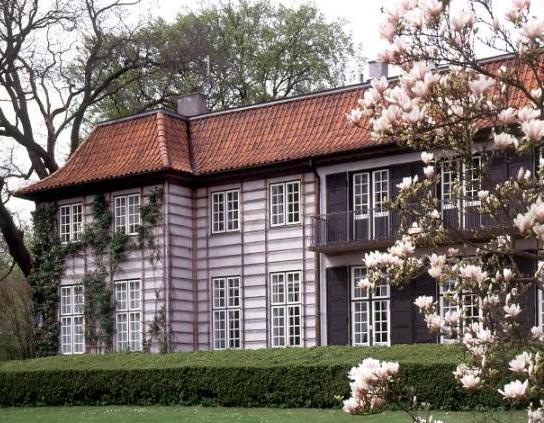
Photo: Nafred at da.wikipedia · Public domain · Wikimedia Commons
Ordrupgaard is a state-owned art museum in Denmark. Founded by insurance businessman Wilhelm Hansen and wife Henny. The free Lokali audio guide runs 6 minutes.
✓ Published October 2026 · how we write these guides
Visitor facts
| Lokali audio guide | 6 min · free |
|---|---|
| Type | Museum |
| Location | Gentofte, Denmark |
| Coordinates | 55.7669, 12.5633 |
| Official website | museumordrupgaard.dk |
| Languages | 50+, in the Lokali app |
The story
Listen for a moment. Gravel crunches underfoot, and somewhere behind the hedges a blackbird is calling. The air out here, north of Copenhagen, smells of cut grass and damp leaves. In front of you stands a pale manor house with a steep tiled roof. It looks like the country home of a wealthy family, and that is what it was. Today it is Ordrupgaard, one of the most personal art museums in Scandinavia.
The story begins with a couple, Wilhelm and Henny Hansen. Wilhelm made his fortune in insurance in the early twentieth century. He and Henny wanted a home in the leafy suburbs of Gentofte, away from the city centre. They had the house built during the years of the First World War. From the start, they planned it as a place to live with art. It was also a place to share that art.
And what art it was. Wilhelm Hansen began collecting with real ambition. At first he bought Danish paintings, especially works from the Danish Golden Age. That name refers to the early nineteenth century, when Danish painters produced clear, calm landscapes and quiet portraits. Then his eye turned south, to France. Within only a few years he gathered paintings by the Impressionists and the artists who came after them.
Here is the first surprise. This was not a private treasure locked away. Soon after the house was finished, the Hansens opened their gallery to the public on certain days. Visitors could walk through a private home and stand in front of paintings by Manet, Monet, Renoir and Degas. In the Denmark of that time, this was very unusual. Few people in the country had ever seen French modern painting up close.
The second surprise is a story of loss. In the early 1920s, Denmark went through a serious banking crisis. Wilhelm Hansen was hit hard by it. To protect his finances, he sold a large part of his French collection. Works left for collections in other countries, and some of those pictures now hang in famous museums abroad. Yet the Hansens kept a strong core, and they kept collecting in later years.
Wilhelm died in the 1930s. Henny lived on in the house for many more years. When she died, the house, the park and the collection passed to the Danish state, as the couple had wished. In the early 1950s Ordrupgaard opened as a state museum. So when you walk through the old rooms, remember this. You are walking through a home that became public because two people decided it should.
Inside the manor, look at the scale of the rooms. They are generous, but not palatial. The paintings hang at a human height, and you can stand close. The French works include names you will know from postcards: Monet, Pissarro, Sisley, Cézanne. Look for Gauguin too. His paintings here are among the treasures of the collection. Their strong colours stand out against the calm northern light that falls through the windows.
The Danish Golden Age paintings deserve your time as well. Many visitors walk past them on the way to the French rooms. That is a mistake. Look for the precise skies, the pale green fields, the soft evening light on water. These painters worked in a small country with flat land and wide horizons. Their pictures feel quiet and exact. Next to the French brushwork, they show two very different ways of looking at the world.
Now step toward the modern wing, and the mood changes completely. In 2005, a new extension opened, designed by the architect Zaha Hadid. She was known for buildings that seem to flow rather than stand. Here she used dark concrete and large panels of glass. The walls curve and lean. The building does not copy the old manor. Instead, it bends around it, like a dark shadow beside a pale house.
Take a moment inside that wing. Notice how the floor, walls and ceiling seem to run into one another. There are very few right angles. Through the glass you see the trees of the park, so the garden becomes part of the room. This was one of Hadid's early completed buildings in Scandinavia. For many visitors it is the first time they see her ideas at a human scale.
More recently, the museum grew again. In the early 2020s, a large new gallery opened, designed by the Norwegian studio Snøhetta. Much of it sits below ground, so it does not crowd the old house or the park. From above, you mainly see grass, paths and light openings. This gave the museum space for its permanent collection and for larger exhibitions, while the garden stayed open and green.
Before you leave, walk out into the park. Among the trees stands a low, simple house. This was the home of Finn Juhl, one of the leading Danish furniture designers of the twentieth century. He designed the house himself in the 1940s, and he lived there for many years. Today it belongs to the museum. Inside you can see his chairs, his colours and his sense of order in daily life.
So stand still for a final moment on the lawn. Behind you is a manor house from the First World War era. To one side is a dark, curving wing from the twenty-first century. Somewhere under your feet is a gallery you cannot see. And in the trees, a designer's quiet home. As you walk back along the gravel, listen again for that blackbird. It has been singing here through all of it.
Key facts
What to look for
Practical tips
Common questions
Is there a free audio guide to Ordrupgaard?
Yes — the Lokali app narrates Ordrupgaard free of charge in 50+ languages. The guide runs about 6 minutes, covers the history, what to look for on site and practical tips, and works offline once downloaded.
Where is Ordrupgaard?
Ordrupgaard is near Gentofte, Denmark, at 55.7669, 12.5633. Tap the map link on this page for directions from where you are.
What is Ordrupgaard known for?
Founded by insurance businessman Wilhelm Hansen and wife Henny. Manor house built during the First World War years.
What should you look for at Ordrupgaard?
Steep tiled roof of the original pale manor house. Dark curving concrete walls of Zaha Hadid's wing. Gauguin's strong colours against the calm northern window light.
What should you know before visiting Ordrupgaard?
Visit the Danish Golden Age rooms before the French ones. Allow extra time to walk the park to Finn Juhl's house.
On the map
Opens directions to Ordrupgaard from your location.
More to see near Ordrupgaard


Hear Ordrupgaard in your language
The full story, narrated, in 50+ languages. Download it before you go and it plays offline, at your own pace, with no ticket and no tour group.