
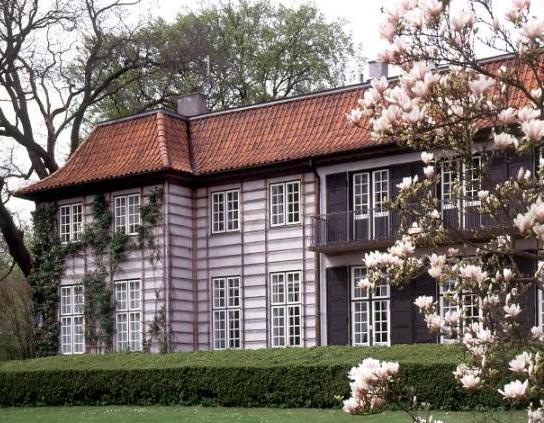
Photo: No machine-readable author provided. Heje assumed (based on copyright claims). · CC BY-SA 3.0 · Wikimedia Commons
Bernstorff Palace is a historic 18th century palace now managed as a hotel in Copenhagen, Denmark. Built for statesman Johan Hartvig Ernst Bernstorff. The free Lokali audio guide runs 6 minutes.
✓ Published October 2026 · how we write these guides
Visitor facts
| Lokali audio guide | 6 min · free |
|---|---|
| Type | Chateau |
| Location | Gentofte, Denmark |
| Coordinates | 55.7584, 12.5524 |
| Official website | bernstorffslot.dk |
| Languages | 50+, in the Lokali app |
The story
Listen for a moment. Gravel crunches underfoot, old trees move in the wind, and somewhere a crow complains from a high branch. The city of Copenhagen is only a short ride away, but here the air feels slower. In front of you stands a low, pale manor house with clean lines and calm proportions. It does not shout for attention. That quiet confidence is exactly the point. Welcome to Bernstorff Palace, in Gentofte, just north of the Danish capital.
The house takes its name from Johan Hartvig Ernst Bernstorff. He was born in Germany, yet he became one of the most powerful statesmen in Denmark in the eighteenth century. He served as foreign minister and guided Danish policy through a dangerous era of European wars. Denmark stayed largely at peace during his time in office. That was no small achievement. A man in his position needed a country seat close to court, and this is the place he chose.
The palace was built in the second half of the eighteenth century, in the 1750s and 1760s. Bernstorff hired a French architect, Nicolas-Henri Jardin, who worked in Denmark at that time. Look at the facade and notice what is missing. There is very little swirling ornament. There are no heavy flourishes. Instead you see balance, symmetry, and restraint. This style is called Neoclassicism, a movement that looked back to the calm order of ancient Greek and Roman buildings.
Here is the first surprise. Bernstorff Palace is counted among the earliest Neoclassical buildings in Denmark. When it went up, much of Europe still loved the playful curves of the Rococo, the decorative style that came just before. This house pointed toward the future. So the simple lines you see today were, in their own moment, quite modern. A visitor in the eighteenth century might have found it fresh, even a little daring.
Now think about the land around you. In Bernstorff's time, most Danish farmers lived under heavy obligations to their landlords. They worked the lord's fields and had little control over their own lives. On this estate, Bernstorff tried something different. He reorganised the land and gave his tenant farmers more independence over their own farms. His reforms here became an early model for the wider agricultural reforms that later changed the Danish countryside.
The farmers did not forget it. Not far from the palace stands a stone monument known as the Bernstorff Column. Local peasants raised it in thanks for the reforms on the estate. It is a rare thing — a monument paid for by ordinary farmers to honour a nobleman. If you have time, it is worth seeking out. It turns the story of this quiet house into a story about how a whole society began to shift.
Later, the palace passed into royal hands. In the nineteenth century it became the beloved summer home of King Christian the Ninth and Queen Louise. Their family life here was famously warm and informal by royal standards. The children ran through these gardens, and the house filled with guests every summer. That family would soon reach far beyond Denmark, in a way few people expected.
Here is the second surprise. Christian the Ninth is often called the father-in-law of Europe. One of his daughters, Alexandra, became Queen of the United Kingdom. Another, Dagmar, became Empress of Russia. One son became King of Greece. In the summers, these royal relatives came back to Denmark to gather together. So the rooms behind these modest walls once held a family whose members ruled across a large part of the continent.
Imagine those summers for a moment. A Russian empress and a British queen, both sisters, walking these paths like ordinary siblings home for the holidays. Grandchildren from several royal houses played together on the lawns. For a few weeks each year, the politics of Europe seemed to pause here. Then the guests returned to their courts, their palaces, and their very different lives. The house kept its calm either way.
Take a slow look at the building itself. The main house is not huge, and that surprises many visitors who expect a royal palace to be grand. Its scale is human. Notice the regular rhythm of the windows, the proportions of the central section, and the way the roofline stays simple. Every element seems placed with care. This is architecture that wants you to feel order and ease, rather than awe.
Then turn toward the park. The grounds are wide and green, with mature trees, open lawns, and walking paths. The park is open to the public, and on a fine day you will see local families, dog walkers, and runners passing through. Listen to the leaves and the birds. In autumn the ground turns gold and brown. In spring the light comes through fresh green branches and the whole place feels newly washed.
In recent times, the palace has taken on a new role. It now works as a hotel and conference venue, so the rooms where royalty once gathered can host meetings, dinners, and overnight guests. This keeps the old house alive and in use. Buildings like this survive best when people still walk through them, open their doors, and light their rooms. The gardens, meanwhile, remain a shared space for everyone in the neighbourhood.
Before you leave, stand still for one more moment. Look at the pale walls, the tall windows, and the trees that frame them. This house began as the retreat of a careful diplomat. It became a place where farmers found new freedom, and later a summer home for a family that spread across Europe. Now it is simply a quiet house in a green park. As you walk away, listen to the gravel under your feet once more.
Key facts
What to look for
Practical tips
Common questions
Is there a free audio guide to Bernstorff Palace?
Yes — the Lokali app narrates Bernstorff Palace free of charge in 50+ languages. The guide runs about 6 minutes, covers the history, what to look for on site and practical tips, and works offline once downloaded.
Where is Bernstorff Palace?
Bernstorff Palace is near Gentofte, Denmark, at 55.7584, 12.5524. Tap the map link on this page for directions from where you are.
What is Bernstorff Palace known for?
Built for statesman Johan Hartvig Ernst Bernstorff. Designed by French architect Nicolas-Henri Jardin.
What should you look for at Bernstorff Palace?
The symmetrical rhythm of the tall front windows. The simple, unadorned roofline of the main house. Mature old trees framing views of the facade.
What should you know before visiting Bernstorff Palace?
Walk the public park paths around the palace. Seek out the Bernstorff Column raised by local farmers.
When is the best time to visit Bernstorff Palace?
Visit in autumn for golden leaves across the lawns.
On the map
Opens directions to Bernstorff Palace from your location.
More to see near Bernstorff Palace


Hear Bernstorff Palace in your language
The full story, narrated, in 50+ languages. Download it before you go and it plays offline, at your own pace, with no ticket and no tour group.