
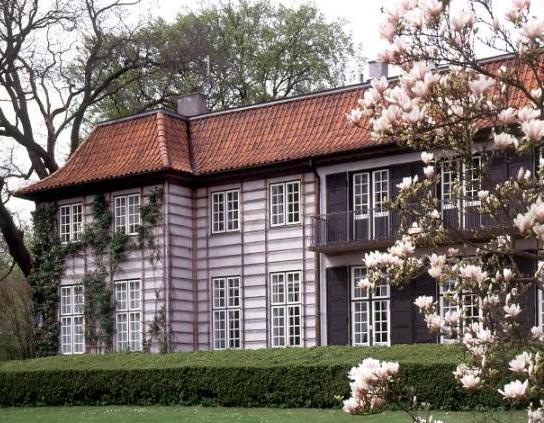
Photo: Danmark2011 · CC BY-SA 3.0 · Wikimedia Commons
Sorgenfri Palace is a palace in Denmark. Sorgenfri means free of sorrow in Danish. The free Lokali audio guide runs 6 minutes.
✓ Published October 2026 · how we write these guides
Visitor facts
| Lokali audio guide | 6 min · free |
|---|---|
| Type | Palace |
| Location | Frederiksberg, Denmark |
| Coordinates | 55.7788, 12.4969 |
| Languages | 50+, in the Lokali app |
The story
Listen first. Water moves somewhere close by, low and steady, running through reeds and under old trees. The gravel shifts under your feet. Through the branches, you can see a long, pale building with tall windows and a calm roofline. Nothing about it shouts. That quiet is the whole point of this place. Before we go further, a small note on direction. Sorgenfri Palace is often grouped with Frederiksberg, and both sit among the royal country houses around Copenhagen. Sorgenfri itself stands further north, near Kongens Lyngby, beside a small river called the Mølleå. If you came out from the city, you followed the same road that kings and courtiers once took to escape the capital.
Start with the name. In Danish, Sorgenfri means something close to free of sorrow, or without care. If that sounds familiar, there is a reason. Across Europe in the eighteenth century, royals and nobles gave their country retreats names like this. The best known is Sanssouci, in Potsdam, which carries the same meaning in French. The idea was simple. The city was for duty. A house like this was for rest.
The story begins in the early eighteenth century. At first, this was a private country house built for a nobleman, not a royal residence. Wealthy families liked this landscape north of Copenhagen. It had woods, water, and hunting grounds, but it was still close enough to reach the court. Before long, the crown took an interest, and the property passed into royal hands.
In the mid-eighteenth century, the house was rebuilt for the royal family. The architect Lauritz de Thurah is associated with this work. He was one of the leading Danish architects of his time, and his name appears on several royal projects of that era. Over the following decades the building changed again. Later remodelling gave it the restrained, classical face you see today, with clean lines rather than heavy decoration.
Take a moment with the facade. Look at the regular rhythm of the windows, the light-coloured walls, and the low, even proportions. This is a building designed for balance more than display. Compare it in your mind with the grand baroque palaces of the same century. Those were built to impress visitors. Sorgenfri was built for the people living inside it. The style is quieter, and almost domestic.
Now turn toward the water. The Mølleå, whose name means Mill River, runs past the grounds. For centuries this small river powered mills along its banks. It ground grain, made paper, and supported early industry in the area. So while royals rested here, working people were busy just downstream. Today the river is calm, but it was once one of the most hard-working stretches of water in Denmark.
Here is something many visitors do not know. During the Second World War, Denmark was occupied by Germany. In late August 1943, relations between Danish authorities and the occupying forces broke down. King Christian the Tenth was staying at Sorgenfri at that time. German troops took control, and for a period the elderly king was kept here under guard. This peaceful country house, named for freedom from sorrow, became a place of confinement.
Think about that contrast as you stand here. The gardens around you look exactly as a retreat should look... soft lawns, old trees, the sound of water. Yet for a king who had become a symbol of quiet resistance to many Danes, these walls held a very different meaning. History often leaves its sharpest marks on the gentlest places.
After the war, Sorgenfri remained in royal use. Members of the Danish royal family have lived here across the twentieth century, and it has served as a home rather than a showpiece. For this reason, the palace interior is generally not open to the public. Please respect the private areas and any signs or barriers. The building still belongs to the Danish state, and it is cared for by the national agency for palaces and cultural properties.
The good news is the park. The palace gardens are open to walk through, and they are the best way to experience this place. Paths follow the river and wind between large trees. The design is closer to the English landscape style, which means curving routes and open views, rather than strict geometric beds. Romantic garden design like this became popular in Denmark from the late eighteenth century onward.
As you walk, notice how the garden frames the palace. From some points, the building appears suddenly between trees. From others, it disappears completely. This was intentional. Landscape gardeners of that era liked surprise and slow discovery. They wanted a walk to feel like a sequence of scenes. Small garden buildings and bridges add to that effect, so keep looking around corners as you go.
The light here changes the mood quickly. On a grey day, the palace looks cool and serious against dark trees. In low afternoon sun, the walls turn warm and the river shines. In autumn, fallen leaves cover the paths and the smell of damp earth rises from the ground. If you have time, come back in a different season. It will feel like a different place.
Before you leave, stand still for one last moment. Listen again for the river. Look at the long, calm front of the palace and the tall windows that once looked out at kings and children, war and peace. Free of sorrow... the name was always a wish more than a promise. As you walk back along the path, notice how the city noise stays far away, exactly as the builders intended.
Key facts
What to look for
Practical tips
Common questions
Is there a free audio guide to Sorgenfri Palace?
Yes — the Lokali app narrates Sorgenfri Palace free of charge in 50+ languages. The guide runs about 6 minutes, covers the history, what to look for on site and practical tips, and works offline once downloaded.
Where is Sorgenfri Palace?
Sorgenfri Palace is near Frederiksberg, Denmark, at 55.7788, 12.4969. Tap the map link on this page for directions from where you are.
What is Sorgenfri Palace known for?
Sorgenfri means free of sorrow in Danish. Began as a nobleman's house in early eighteenth century.
What should you look for at Sorgenfri Palace?
The even rhythm of the tall front windows. The Mølleå river running beside the grounds. Curving English-style paths between large old trees.
What should you know before visiting Sorgenfri Palace?
Plan to explore the park rather than the interior. Follow the riverside path for the most varied views.
On the map
Opens directions to Sorgenfri Palace from your location.
More to see near Sorgenfri Palace



Hear Sorgenfri Palace in your language
The full story, narrated, in 50+ languages. Download it before you go and it plays offline, at your own pace, with no ticket and no tour group.