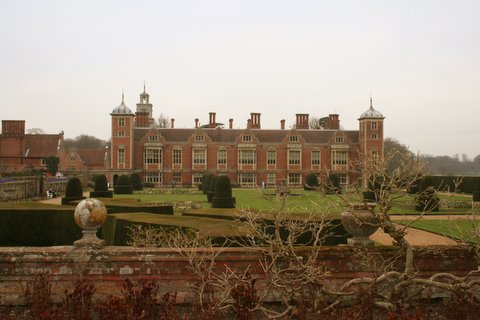
Photo: The original uploader was Tobybuk at English Wikipedia. · Public domain · Wikimedia Commons
Blickling Hall is a country house in Norfolk, England, UK. Built from around 1616 for Sir Henry Hobart. The free Lokali audio guide runs 6 minutes.
✓ Published October 2026 · how we write these guides
Visitor facts
| Lokali audio guide | 6 min · free |
|---|---|
| Type | Museum |
| Location | Cromer, United Kingdom |
| Coordinates | 52.8117, 1.2317 |
| Official website | nationaltrust.org.uk |
| Languages | 50+, in the Lokali app |
The story
Listen first to the gravel under your feet. It crunches softly as you walk forward, and ahead of you a long red-brick front rises behind two dark walls of clipped yew. The hedges run on either side of the approach like the sides of a corridor. They pull your eye straight to the house. Up close, the brick looks warm even on a grey Norfolk day, and the windows catch whatever light the sky allows.
You are a short drive inland from Cromer, near the market town of Aylsham. The sea is close, but the land here feels very different. It is flat and green, with wide fields, old trees and quiet lanes. This is the estate of Blickling Hall, one of the great Jacobean houses of England. Jacobean means the style of the reign of King James the First, in the early seventeenth century.
The house in front of you was begun around 1616 for Sir Henry Hobart. He was a lawyer who rose to become Lord Chief Justice, one of the most powerful legal posts in the country. His architect was Robert Lyminge, who had recently worked on Hatfield House in Hertfordshire. You can see the family likeness. Look at the curved, stepped gables, the corner turrets and the central clock tower. Together they give the front a confident, almost theatrical outline.
But Hobart did not build on empty ground. An older house stood here before him, and that earlier house belonged to the Boleyn family. Yes — the family of Anne Boleyn, the second wife of King Henry the Eighth. Some historians believe Anne may have been born at Blickling in the early sixteenth century. Others favour Hever Castle in Kent. Nobody knows for certain, and that uncertainty is part of the story here.
The Boleyn link has given Blickling its most famous legend. Locals say that on the anniversary of Anne's execution, a coach arrives at the house in the night. It is pulled by headless horses, driven by a headless coachman, and Anne sits inside with her own head in her lap. It is folklore, of course. Still, on a misty evening, with the yews in shadow, the tale is easy to imagine.
Now step closer to the entrance. Notice the moat, which is dry, and the bridge that crosses it. The house is built around two courtyards, so it feels larger inside than the front suggests. Watch for the black bull carved in stone near the approach. The bull comes from the Hobart family crest, and it appears in several places around the estate. Once you notice it, you start to see it everywhere.
Inside, one room surprises almost every visitor. This is the Long Gallery, which runs for well over a hundred feet along the east side of the house. Look up. The ceiling is covered in elaborate Jacobean plasterwork, with panels showing emblems, figures and patterns. Long galleries were built for walking indoors in bad weather, and for showing off. This one does both very well.
The Long Gallery is also a library. Its shelves hold a collection of many thousands of books, and it is one of the most important historic libraries cared for by the National Trust. Much of it was gathered in the eighteenth century. Among the books are rare early printed works and manuscripts. Even if you cannot read the titles, the rows of old leather spines give the room a quiet, scholarly weight.
In the eighteenth century, the house passed to the Earls of Buckinghamshire. The second Earl served as British ambassador to the court of Catherine the Great in Russia. He came home with gifts, and one of them hangs here today: a large tapestry showing Peter the Great on horseback. It is a striking thing to find in a Norfolk country house. It shows how far a family's ambitions could travel.
The second Earl also left a mark on the park. Out among the trees stands a stone pyramid. It is his mausoleum, built in the late eighteenth century and designed by Joseph Bonomi. A pyramid in the English countryside may seem strange, but at that time ancient Egypt and Rome were fashionable among wealthy collectors. The walk to it takes you through open parkland, far from the formal gardens.
The twentieth century brought the last private owner, Philip Kerr, the eleventh Marquess of Lothian. He was a diplomat and became British ambassador to the United States. He died in 1940, early in the Second World War. In his will, he left Blickling to the National Trust. It was the first great house to pass to the Trust under its new scheme to save country houses, and that decision helped shape how Britain protects its heritage.
During the war, the house had another role. A Royal Air Force base stood nearby, and Blickling was used to house officers. Today a small exhibition remembers the airmen who lived here. Then think about the gardens. In the 1930s, the garden designer Norah Lindsay replanted the formal beds east of the house. Her deep borders of soft colour still shape the garden you can walk through today.
When you leave, pause once more on the gravel between the yew hedges. Turn back and look at the house as a whole. You are looking at four hundred years of change — a lawyer's ambition, an ambassador's souvenirs, a marquess's gift, and the legend of a queen. Listen to the rooks in the trees and the quiet of the park. Then walk slowly. The red brick stays in view for a long time.
Key facts
What to look for
Practical tips
Common questions
Is there a free audio guide to Blickling Hall?
Yes — the Lokali app narrates Blickling Hall free of charge in 50+ languages. The guide runs about 6 minutes, covers the history, what to look for on site and practical tips, and works offline once downloaded.
Where is Blickling Hall?
Blickling Hall is near Cromer, United Kingdom, at 52.8117, 1.2317. Tap the map link on this page for directions from where you are.
What is Blickling Hall known for?
Built from around 1616 for Sir Henry Hobart. Architect Robert Lyminge also worked on Hatfield House.
What should you look for at Blickling Hall?
Stone bulls from the Hobart family crest. Plasterwork ceiling of the Long Gallery. Peter the Great tapestry from the Russian embassy.
What should you know before visiting Blickling Hall?
Allow time to walk out to the pyramid mausoleum. Visit the formal gardens east of the house first.
On the map
Opens directions to Blickling Hall from your location.
More to see near Blickling Hall


Hear Blickling Hall in your language
The full story, narrated, in 50+ languages. Download it before you go and it plays offline, at your own pace, with no ticket and no tour group.