
Sandringham House
52.8297° N · 0.5139° E · Museum
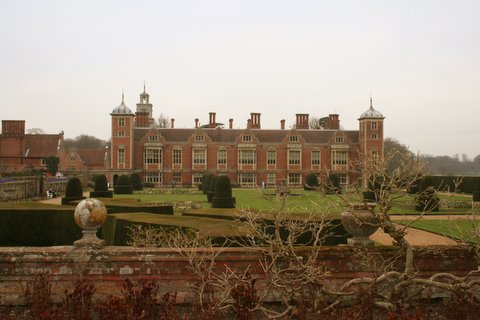
Photo: John Fielding from Norwich, UK · CC BY 2.0 · Wikimedia Commons
Sandringham House is a royal residence near the village of Sandringham in Norfolk, England, UK. Private royal home since the estate was bought in 1862. The free Lokali audio guide runs 7 minutes.
✓ Published October 2026 · how we write these guides
Visitor facts
| Lokali audio guide | 7 min · free |
|---|---|
| Type | Museum |
| Location | Sandringham, United Kingdom |
| Coordinates | 52.8297, 0.5139 |
| Official website | sandringhamestate.co.uk |
| Languages | 50+, in the Lokali app |
The story
Listen first. Gravel crunches underfoot, rooks call from the tall trees, and a cool wind comes in from the flat Norfolk country towards the sea. In front of you stands a long house of warm red brick. It is trimmed with a darker, rust-brown stone and topped with gables, chimneys and small turrets. It does not look like a palace. It looks like a very large country home, and that is exactly what it was built to be.
Sandringham House has been a private home of British monarchs since 1862. This matters more than it might seem. Buckingham Palace and Windsor Castle belong to the Crown, so they pass with the office. Sandringham is different. It passes from one monarch to the next as personal property, the way a family might inherit a farmhouse. When you walk these grounds, you are walking through the royal family's own estate, not an official residence.
The story begins with a worried mother. Queen Victoria and Prince Albert wanted a country home for their eldest son, Albert Edward, the Prince of Wales. They hoped that a quiet life in the countryside, away from the temptations of London, would steady him. The estate was bought for him in 1862. A year later he married Princess Alexandra of Denmark, and the couple made Sandringham their own retreat. The plan to keep him quiet... did not entirely work.
The old house on the site was too small for the young prince and his growing circle of guests. So it was largely pulled down and replaced. The new house was finished around 1870, designed by the architect Albert Jenkins Humbert in a Jacobean style. Jacobean is the English building fashion of the early seventeenth century, with its gables, tall chimneys and patterned brickwork. More rooms followed later, including a ballroom for the endless parties the prince loved.
Look closely at that rust-brown stone around the windows and corners. This is carrstone, a local sandstone dug from the ground in this part of west Norfolk. You will see it in village walls and cottages all across the area. Its deep ginger colour comes from iron in the rock. Paired with the red brick, it gives the house a warm tone, even on a grey day. On a sunny afternoon, the whole front seems to glow.
Now for one of the strangest habits in royal history. The Prince of Wales was a keen shooter, and winter days in Norfolk are short. His solution was simple. He ordered every clock on the estate to be set half an hour ahead of the rest of the country. This became known as Sandringham Time. It gave him more daylight for the shoot. The custom lasted for decades, until his grandson, Edward the Eighth, abolished it in 1936.
This estate has seen some of the most private moments of royal life. King George the Sixth was born on the estate in 1895, at York Cottage, a smaller house close by. His father, King George the Fifth, died here in January 1936. And in February 1952, George the Sixth himself died here in his sleep. His daughter Elizabeth was far away in Kenya at that moment. She became Queen without knowing it, thousands of kilometres from this house.
Here is a detail many visitors miss. The royal Christmas message, now a fixed part of the holiday for millions of people, began at Sandringham. In 1932, King George the Fifth spoke to the nations of the Empire by radio from this house. Twenty-five years later, in 1957, Queen Elizabeth the Second gave the first Christmas message on television, also from Sandringham. A family tradition here became a broadcast tradition around the world.
Christmas is still the season most closely linked with this place. The royal family traditionally gathers here for the holiday. On Christmas morning, they walk a short way through the grounds to the small parish church of Saint Mary Magdalene. Crowds line the path to watch and wave. The church itself is a modest building of local stone, set among trees. It shows how close the house sits to an ordinary country parish.
Before you leave, spend time with the gates. The Norwich Gates are a tall, intricate screen of wrought iron, with leaves, flowers and curling forms worked into the metal. They were a wedding gift from the people of Norfolk and Norwich to the prince and Alexandra. The designer was Thomas Jeckyll, a Norfolk architect. Stand close and follow a single iron stem with your eye. The craftsmanship is far finer than it looks from a distance.
The gardens around the house are open and green, laid out for walking rather than for show. You will find lawns, lakes, mature trees and quiet corners with benches. Queen Elizabeth the Second spent many winters here, often staying into February, close to the anniversary of her father's death. The estate around you is also a working one, with farms, woodland and a royal stud for horses. Much of the land beyond the gardens is open country park.
Not far from the house, the old coach houses now hold a museum. Inside are royal vehicles from different eras, along with photographs and objects from family life on the estate. It is a useful place to see the human side of this story. The cars, the sporting gear and the everyday items make the history feel less like ceremony and more like a family's long memory. Take your time here if the weather turns.
Before you walk on, stand still for a moment and look back at the house. Notice the chimneys against the sky, the rust-brown stone beside the red brick, the line of trees beyond. Listen again for the rooks and the wind. This is a place built for comfort and privacy, and it still carries that quiet feeling. As you walk away, watch for carrstone in the walls you pass. It is the same ground, all around you.
Key facts
What to look for
Practical tips
Common questions
Is there a free audio guide to Sandringham House?
Yes — the Lokali app narrates Sandringham House free of charge in 50+ languages. The guide runs about 7 minutes, covers the history, what to look for on site and practical tips, and works offline once downloaded.
Where is Sandringham House?
Sandringham House is in Sandringham, United Kingdom, at 52.8297, 0.5139. Tap the map link on this page for directions from where you are.
What is Sandringham House known for?
Private royal home since the estate was bought in 1862. Rebuilt around 1870 by architect Albert Jenkins Humbert.
What should you look for at Sandringham House?
Rust-brown carrstone framing the windows and corners. Leaves and flowers worked into the Norwich Gates. Tall clustered chimneys rising above the Jacobean gables.
What should you know before visiting Sandringham House?
Check the season first; the house opens only part of the year. Walk to Saint Mary Magdalene Church through the grounds.
When is the best time to visit Sandringham House?
Come in late afternoon sun to see the stonework glow.
On the map
Opens directions to Sandringham House from your location.
More to see near Sandringham House

Hear Sandringham House in your language
The full story, narrated, in 50+ languages. Download it before you go and it plays offline, at your own pace, with no ticket and no tour group.