
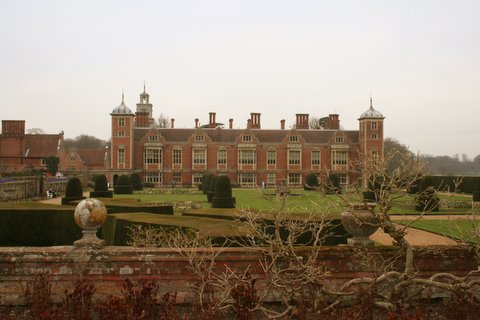
Photo: Rev Stan · CC BY 2.0 · Wikimedia Commons
Holkham Hall is a large 18th-century Palladian country house in Norfolk, England, UK. Built over roughly thirty years from the 1730s. The free Lokali audio guide runs 7 minutes.
✓ Published October 2026 · how we write these guides
Visitor facts
| Lokali audio guide | 7 min · free |
|---|---|
| Type | Museum |
| Location | Holkham, United Kingdom |
| Coordinates | 52.9500, 0.8031 |
| Official website | holkham.co.uk |
| Languages | 50+, in the Lokali app |
The story
Listen first. Out here on the north Norfolk coast, the wind comes in off the salt marshes. It carries the cries of geese and the dry rustle of grass across the open parkland. Ahead of you, a long, pale house sits low against an enormous sky. It does not shout. It simply waits, calm and symmetrical, as if it has been standing in this flat landscape forever. This is Holkham Hall, one of the purest expressions of eighteenth-century Palladian architecture in England.
Palladian is a word you will hear often here, so let us explain it. Andrea Palladio was a sixteenth-century Italian architect. He studied the ruins of ancient Rome and designed villas based on their order, balance and proportion. Two centuries later, wealthy Englishmen fell in love with his ideas. They wanted houses that felt Roman, rational and timeless. Holkham was built to be exactly that kind of house: a Roman villa reborn on a windswept English farm.
The story begins with a young man named Thomas Coke. As a teenager in the early eighteenth century, he set off on a long Grand Tour of Europe. This was a journey of education that rich young aristocrats made through France and Italy. Coke spent years abroad. He studied, collected books and manuscripts, and bought classical sculpture. He came home with a head full of Rome and crates full of treasures. He needed somewhere worthy to put them all.
Coke, later made Earl of Leicester, worked with a remarkable circle. The designer William Kent shaped much of the house and its interiors. Lord Burlington, the great champion of Palladian taste, lent his influence. Matthew Brettingham oversaw the building work on site. Construction began in the 1730s and continued for around thirty years. Coke did not live to see it finished. After his death, his widow, Lady Margaret, carried the work through to completion.
Now look closely at the walls. Many visitors assume the house is built of stone. In fact, it is brick — a pale, buff-coloured brick. Coke wanted his bricks to look like those of ancient Rome, so they were specially made with that soft, sandy tone. From a distance, the colour reads almost like weathered stone. Up close, you can see the fine, regular courses. It is a small detail, but it shows how far Coke went to make Norfolk feel Roman.
Notice, too, the shape of the whole building. A large central block stands in the middle. Four smaller wings extend from its corners, each linked to the main house. From the front, the effect is long and horizontal, matching the flat land around it. The outside is deliberately restrained. There is little decoration, few flourishes. The drama was saved for the inside, where guests would step from plain brick into something quite different.
That something is the Marble Hall. The name is a gentle misnomer. The walls and columns are mostly alabaster, a soft, pinkish-white stone brought from Derbyshire. The room rises in a sweep of fluted columns and a grand staircase. Its design draws on ancient temples and on Roman basilicas, the great public halls of the classical world. Stand at the bottom and look up. The coffered ceiling, divided into sunken panels, pulls your eye towards the light.
Beyond the hall, the state rooms hold the fruits of that long Grand Tour. In the Statue Gallery, classical sculptures stand in niches along the walls. Some are ancient Roman works; others are carefully restored. Paintings by European masters hang in the saloon and the other rooms. Coke also collected rare books and manuscripts, and the library became famous among scholars. Much of what you see was chosen by one man, whose taste still shapes the house today.
Here is something many visitors miss. Holkham is not a museum frozen in time. It is still a family home. Descendants of the Coke family live here, and the current Earl of Leicester still runs the estate. That gives the house a quiet, lived-in feeling. Rooms are used. Gardens are worked. The surrounding farms and village are part of a single estate, managed by one family across many generations.
That farming story matters. In the late eighteenth and early nineteenth centuries, another Thomas Coke, often called Coke of Norfolk, became famous as an agricultural improver. He promoted better crop rotation, livestock breeding and soil care. He hosted large annual gatherings, known as the sheep shearings, where farmers came to watch, learn and debate. Out in the park, a tall monument honours him. Its carvings show ploughs, sheep and cattle — a tribute to farming, not war.
The park itself is worth your time. It stretches out in wide lawns, woodland belts and a long lake. A herd of fallow deer moves across the grass, often in groups under the trees. Look for their pale spotted coats and, in autumn, listen for the low calls of the males. An obelisk stands on rising ground, lined up with the house. These long views were planned. The landscape was designed to frame the hall from every direction.
If you walk north, the estate runs down to the sea. Holkham beach is a vast stretch of sand, backed by dunes and dark pine woods. At low tide, the shore seems to go on forever. The beach became famous on screen as the setting for the final scene of the film Shakespeare in Love. Much of this coastline is now a national nature reserve. Migrating birds rest on the marshes, and the sound of wind and water never really stops.
So take a moment before you leave. Turn back and look at the long, pale front of the hall. See how its straight lines echo the flat horizon. Feel the wind coming off the marshes, and listen for the geese overhead. A young man once came home from Italy and tried to build Rome in a Norfolk field. As you walk away across the grass, notice how well — and how quietly — he succeeded.
Key facts
What to look for
Practical tips
Common questions
Is there a free audio guide to Holkham Hall?
Yes — the Lokali app narrates Holkham Hall free of charge in 50+ languages. The guide runs about 7 minutes, covers the history, what to look for on site and practical tips, and works offline once downloaded.
Where is Holkham Hall?
Holkham Hall is in Holkham, United Kingdom, at 52.9500, 0.8031. Tap the map link on this page for directions from where you are.
What is Holkham Hall known for?
Built over roughly thirty years from the 1730s. Commissioned by Thomas Coke, later Earl of Leicester.
What should you look for at Holkham Hall?
Pale buff bricks made to resemble Roman brick. Fluted alabaster columns rising in the Marble Hall. Coffered ceiling panels above the grand staircase.
What should you know before visiting Holkham Hall?
Walk the park to see the deer herd. Combine your visit with a walk to Holkham beach.
When is the best time to visit Holkham Hall?
Arrive early on summer weekends for easier parking.
On the map
Opens directions to Holkham Hall from your location.
More to see near Holkham Hall


Hear Holkham Hall in your language
The full story, narrated, in 50+ languages. Download it before you go and it plays offline, at your own pace, with no ticket and no tour group.