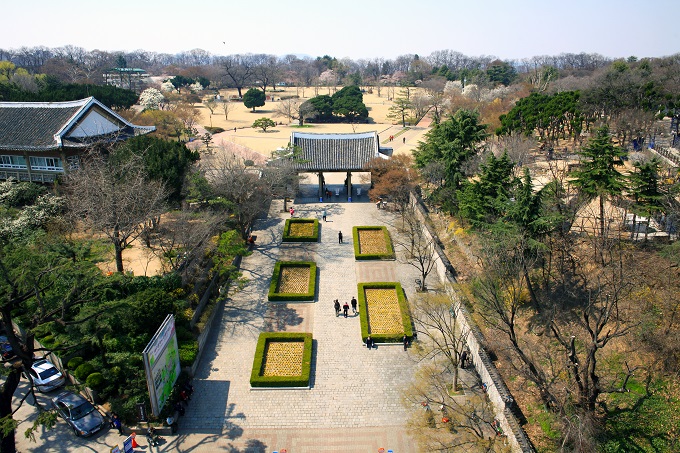
Dalseong Park is a park in Daegu, South Korea. Scenic lakeside park surrounding Daegu's largest artificial lake, with walking trails, a small zoo, and botanical gardens. Most visitors spend 1–2 hours here. The free Lokali audio guide runs 5 minutes.
✓ Verified August 2026 · how we write these guides
Visitor facts
| Time needed | 1–2 hours |
|---|---|
| Lokali audio guide | 5 min · free |
| Type | Park |
| Best for | Family |
| Location | Daegu, South Korea |
| Coordinates | 35.8123, 128.5312 |
| Languages | 45, in the Lokali app |
The story
You walk through the gate and the noise of the city softens. Tall old trees lean over the paths. Somewhere ahead, a bird calls and children laugh. Under your feet is a low grassy ridge, gentle and worn. This ridge is far older than anything around it. This is Dalseong Park.
Dalseong is the oldest park in Daegu. But long before it was a park, it was a fortress. The earth wall you are standing on was built as a defense, raised in the time of Korea's Three Kingdoms, many centuries ago. Old records call it Dalbeolseong. It is thought to be one of the oldest forts of its kind in the whole country.
Look at the shape of the land. The fortress was not made of cut stone. It was made of earth, piled and packed by hand into a long low wall that curves around the park. Grass covers it now. Old trees grow from its sides. But the shape remains, and once you see it, you cannot stop seeing it. You are walking along the top of a wall raised by people very long ago, for reasons of war and defense.
Because of this deep past, the site is protected. In 1963, it was named a historic site of South Korea. It carries the number sixty-two on that national list. So the park is not only a place to relax. It is a guarded piece of the country's memory.
The land has passed through many uses. During a war in the eighteen nineties, foreign troops used the ground as a base. Then, in 1905, it became a public park, open to the people of the city. In 1965, Daegu reshaped it into the organized park you walk through today, with paths and lawns and gardens.
Inside the park stands an old wooden pavilion called Gwanpungnu. It was first built in 1601. It did not always stand here. It once stood at the entrance of a government office, and in 1906 it was moved to this park. Sit near it for a while. Notice the heavy timber and the curved roof, shaped by carpenters more than four hundred years ago.
The park is also home to a small zoo. It opened in 1970. Over the years it has kept many animals, among them Asian elephants, Bengal tigers, and zebras. For families in Daegu, this has long been a favorite place to bring children on a free afternoon. Entry to the park has stayed open and easy for generations.
A change is coming, though. The city plans to move the zoo to a larger home at Daegu Grand Park. That move is meant to be finished around 2027. The animals will have more room there. So if you see the zoo as it is now, know that you are seeing the end of a long chapter.
Beyond the animals, the park holds quiet corners. There is a local history hall. There are stone monuments standing among the trees. There are benches where older residents sit and talk through the afternoon. The pace here is slow. People come to walk, to rest, and to let time pass gently.
Walk the full loop of the old wall if you can. It does not take long. As you go, try to picture the two lives of this place at once. A fortress, tense and watchful, built for defense. And a park, calm and green, built for rest. The same ridge of earth has served both.
This is a good place to slow down between busier stops in the city. Bring a snack. Find a bench. Watch the families and the pigeons and the light through the leaves. The park does not demand anything grand of you. It simply offers shade and quiet and a long view into the past.
Near the entrance you may find vendors selling snacks and cold drinks, and older residents resting in the shade. On weekends the lawns fill with families and the sound of children at play. It is an ordinary, gentle scene. And yet it all unfolds on top of a wall that has watched over this ground for more than a thousand years.
Before you leave, rest one hand on the grassy slope of the wall. Earth packed by people who lived more than a thousand years before you. Cities rose and changed. The streets grew up all around. And still this gentle ridge remains, holding its ground, holding its memory, under the same wide sky.
Key facts
What to look for
Practical tips
Common questions
How long do you need at Dalseong Park?
Plan 1–2 hours. That is the time most visitors spend at Dalseong Park. The free Lokali audio guide adds about 5 minutes of narration you can listen to as you walk, so it fits inside your visit rather than adding to it.
Is there a free audio guide to Dalseong Park?
Yes — the Lokali app narrates Dalseong Park free of charge in 50+ languages. It covers the history, what to look for on site and practical tips, and it works offline once downloaded.
Where is Dalseong Park?
Dalseong Park is in Daegu, South Korea, at 35.8123, 128.5312. Tap the map link on this page for directions from where you are.
What should you know before visiting Dalseong Park?
Walk the full loop of the old earth wall.
What is Dalseong Park known for?
Originally an earthen fortress from the Three Kingdoms era.
What is the best time to visit Dalseong Park?
The park's western shore offers the best views of the water at golden hour.
On the map
Opens directions to Dalseong Park from your location.
More to see in Daegu


Hear Dalseong Park in your language
The full story, narrated, in 50+ languages. Download it before you go and it plays offline, at your own pace, with no ticket and no tour group.