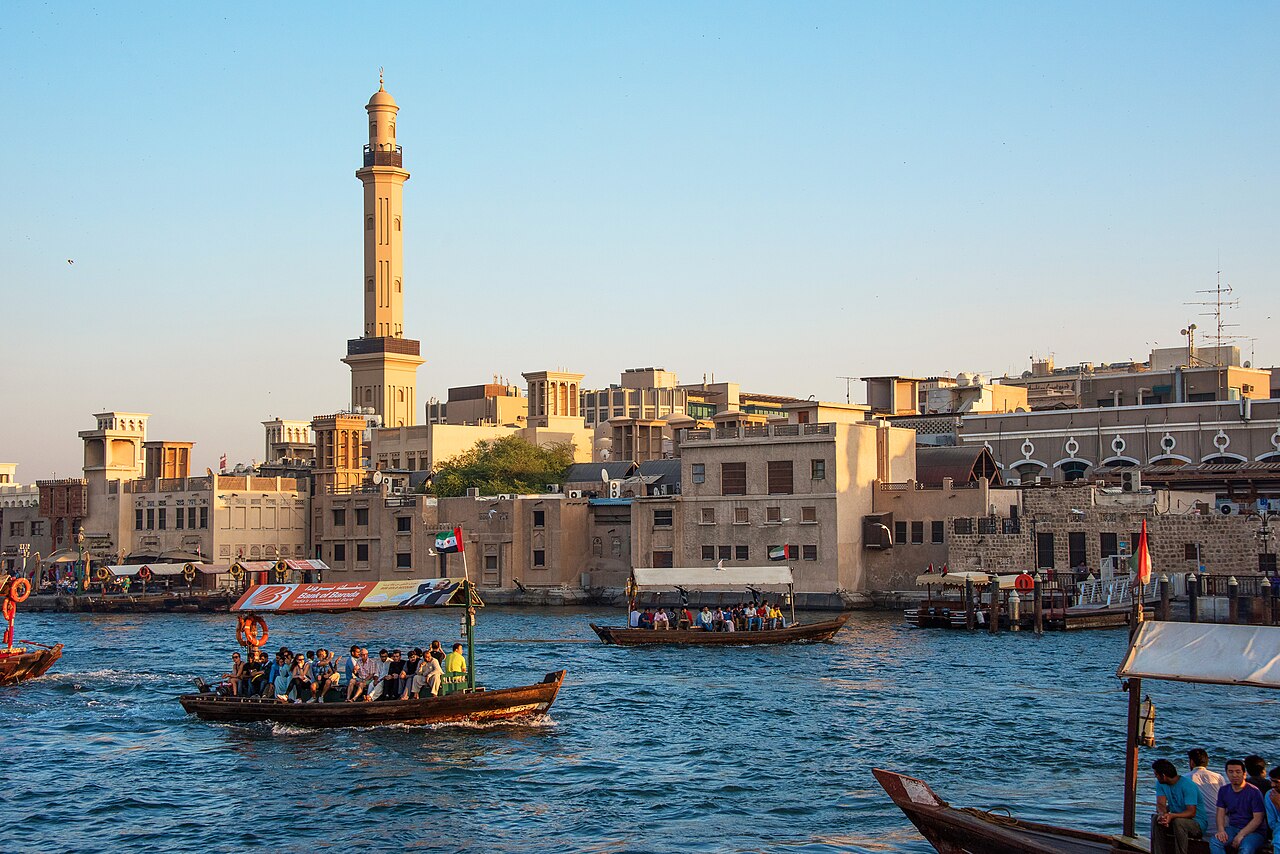
Al Fahidi Historical District
25.2587° N · 55.2958° E · Neighborhood
Al Fahidi Historical District is a neighborhood in Dubai, United Arab Emirates. Dubai's oldest surviving neighbourhood, with restored traditional houses, windtowers, and narrow lanes dating to the 19th and early 20th centuries. Most visitors spend 1–2 hours here. The free Lokali audio guide runs 5 minutes.
✓ Verified August 2026 · how we write these guides
Visitor facts
| Time needed | 1–2 hours |
|---|---|
| Lokali audio guide | 5 min · free |
| Type | Neighborhood |
| Best for | History |
| Location | Dubai, United Arab Emirates |
| Coordinates | 25.2587, 55.2958 |
| Languages | 45, in the Lokali app |
The story
A few steps from the creek, the glass and traffic of the modern city give way to a maze of narrow, shaded lanes between low sand-coloured houses, many topped by tall square wind towers. This is the Al Fahidi Historical District, one of the oldest surviving quarters of Dubai and a window into the city before the towers.
The district dates from the late nineteenth and early twentieth centuries, when it grew as a neighbourhood of merchants, many of them traders from across the Gulf, who built courtyard houses of coral stone and gypsum along the creek. It is among the very few old quarters to survive the city's rapid rebuilding.
Its signature feature is the wind tower, a tall square structure rising from the rooftops, open on its sides to catch any breeze and funnel it down into the rooms below, an ingenious form of cooling in the days before electricity. The skyline of towers here is quite unlike the rest of the city.
The lanes are deliberately narrow and winding, built close to throw shade and channel air, so even at midday they stay cooler than the open streets. Wandering them, with the wind towers above and the occasional courtyard glimpsed through a door, is the heart of a visit.
The quarter was carefully restored after years of neglect, and the old houses now hold art galleries, small museums, cafes, and craft shops, so it has become a cultural quarter as well as a historic one. The mix keeps it alive rather than preserved behind glass.
Among its institutions is the centre for cultural understanding, which runs meals and mosque visits, and a number of small museums and galleries on the city's history, art, and crafts, making the district a place to learn as well as to wander.
The art galleries are a particular draw, showing work by artists from the region in atmospheric old rooms, and an annual arts festival fills the quarter with installations and visitors. It has become a real centre for the city's cultural life.
The cafes tucked into the old houses are among the most pleasant in the city, serving Arabic coffee, dates, and meals in shaded courtyards, a calm place to rest between explorations of the lanes.
The district sits right by the creek, beside the old markets and the boats that cross the water, so it forms part of the historic core of the city that can all be explored together on foot.
The contrast with modern Dubai is the lasting impression. A short distance from the tallest tower on earth, this low, shaded, human-scaled quarter shows the city that existed before the boom, and how people lived with the heat and the trade of the creek.
A few practical notes. The district is free to wander; come in the cooler morning or evening, wear comfortable shoes for the uneven lanes, and allow time to dip into galleries and a cafe. It is easily combined with the creek and the old markets.
Walk the shaded lanes slowly, look up at the wind towers, and step into a courtyard or gallery, and the old Dubai comes quietly back to life around you. This district is the city's memory of itself. When you step back out toward the creek, the modern towers on the skyline tell the rest of the story.
Key facts
What to look for
Practical tips
Common questions
How long do you need at Al Fahidi Historical District?
Plan 1–2 hours. That is the time most visitors spend at Al Fahidi Historical District. The free Lokali audio guide adds about 5 minutes of narration you can listen to as you walk, so it fits inside your visit rather than adding to it.
Is there a free audio guide to Al Fahidi Historical District?
Yes — the Lokali app narrates Al Fahidi Historical District free of charge in 50+ languages. It covers the history, what to look for on site and practical tips, and it works offline once downloaded.
Where is Al Fahidi Historical District?
Al Fahidi Historical District is in Dubai, United Arab Emirates, at 25.2587, 55.2958. Tap the map link on this page for directions from where you are.
What should you know before visiting Al Fahidi Historical District?
Wander in the cooler morning or evening.
What is Al Fahidi Historical District known for?
One of the oldest surviving quarters of Dubai.
What is the best time to visit Al Fahidi Historical District?
Wander the lanes in late afternoon when shadows cool the narrow passages and light turns golden on the ochre walls.
On the map
Opens directions to Al Fahidi Historical District from your location.
More to see in Dubai


Hear Al Fahidi Historical District in your language
The full story, narrated, in 50+ languages. Download it before you go and it plays offline, at your own pace, with no ticket and no tour group.