
Photo: Phillip Capper from Wellington, New Zealand · CC BY 2.0 · Wikimedia Commons
Dunbar Castle is a castle in East Lothian, Scotland, UK. Seat of the medieval Earls of Dunbar and March. The free Lokali audio guide runs 7 minutes.
✓ Published October 2026 · how we write these guides
Visitor facts
| Lokali audio guide | 7 min · free |
|---|---|
| Type | Castle |
| Location | Dunbar, United Kingdom |
| Coordinates | 56.0060, -2.5157 |
| Languages | 50+, in the Lokali app |
The story
Listen first. Before anything else, listen to the birds. Above the harbour wall, a steady, high-pitched call rises from the broken red stone. It sounds almost like a name being shouted over and over — kitti-wake, kitti-wake. Those are seabirds, and they have made their homes in the ruins of Dunbar Castle. The salt wind carries their noise across the water, together with the smell of seaweed and wet rock. You are standing beside one of the most fought-over strongholds in Scotland... and today it belongs mostly to the birds.
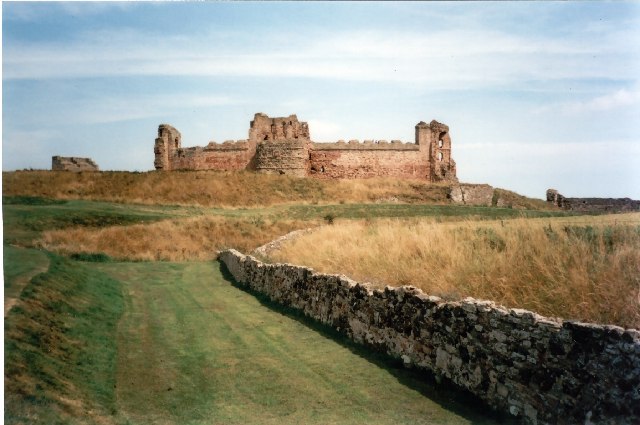
Look at what remains. It is not a neat castle with towers and a gatehouse. It is a cluster of jagged red sandstone fragments, clinging to rocky outcrops at the mouth of the harbour. Some walls lean. Some openings look out onto nothing but sea. The stone has a warm, rusty colour that glows in low sunlight and turns dark and heavy in the rain. Waves have worn the rock beneath it for centuries. It is hard to tell where the natural cliff ends and the human building begins.
That blurred line was the whole point. A fortress here could watch the sea lanes of the Firth of Forth and the coastal road between Scotland and England. Anyone moving an army along this coast had to deal with Dunbar. For centuries, the castle was the seat of the powerful Earls of Dunbar, also known as the Earls of March. In Scottish usage, a march is a border region. These earls guarded the frontier, and their loyalties often shaped the fate of the kingdom.
Because it stood on the road to England, the castle changed hands again and again during the long wars between the two kingdoms. Here is one moment most visitors never hear about. In 1314, after his heavy defeat at the Battle of Bannockburn, King Edward the Second of England fled east. He reached Dunbar, and from here he escaped by boat back to England. Picture a defeated king hurrying down to the water below these walls, leaving his army behind him.
The most famous story of this castle belongs to a woman. In 1338, the Earl of Dunbar was away, and his wife Agnes held the castle. She was known as Black Agnes, probably because of her dark hair and complexion. An English army under the Earl of Salisbury laid siege to the fortress. They expected an easy victory. Instead, Agnes held out for around five months, and in the end the English withdrew.
The tales about that siege are what people remember. According to a popular story, whenever English stones struck the battlements, Agnes sent her maids up onto the walls. Dressed in fine clothes, they calmly dusted the damage away with cloths, as if the attack were a small domestic nuisance. Another tale says that when the English brought up a great siege engine, the defenders dropped a boulder onto it and smashed it. Treat these as legends. But the defence itself is real history, and it made Agnes a lasting Scottish heroine.
Now turn your thoughts two centuries forward, to Mary, Queen of Scots. Dunbar Castle appears again and again in the most dramatic year of her life. In 1566, after the murder of her secretary David Rizzio in Edinburgh, Mary escaped and rode through the night to the safety of Dunbar. A year later, the castle played a darker role. The Earl of Bothwell brought the queen here in 1567, in an event that many historians describe as an abduction. Soon afterwards, he married her.
That marriage led to disaster. Within weeks, Scottish lords rose against Mary and Bothwell. The two sides faced each other at Carberry Hill, east of Edinburgh. Mary surrendered, and Bothwell fled. He never saw her again. The castle that had sheltered the queen now looked like a dangerous symbol. Shortly afterwards, the Scottish Parliament ordered that Dunbar Castle be destroyed, so that no one could use it as a stronghold again.
So the ruin you see is not only the work of weather. It is the result of a deliberate political decision. The walls were broken on purpose. Yet even then, the story was not over. In the nineteenth century, the town needed a better harbour for its fishing boats. Engineers cut a new entrance through the rocks — and straight through part of the old castle site. Stone that had survived sieges was removed to make way for trade.
That is the second surprise of this place. The harbour in front of you, known as Victoria Harbour, and the castle are tangled together. Boats now pass where defenders once stood. If you look carefully at the line between the ruins and the harbour walls, you can see how the newer, neater masonry meets the ragged older stone. It is a clear picture of how a town reshaped its past to serve its present.
A practical word, gently. The ruins are fragile, and for safety they are generally not open for climbing. The best way to experience them is from the harbour side and the nearby paths, where you get clear views without risk. Bring a warm layer, even on a bright day. The wind off the North Sea can be sharp here. And keep a respectful distance from the nesting birds, especially in spring and early summer, when the ledges are crowded with young.
While you are here, it is worth looking back toward the town. Dunbar is a small harbour town with a long main street and red sandstone buildings that echo the colour of the castle. It is also the birthplace of John Muir, the naturalist who later helped inspire national parks in the United States. It feels fitting that this ruined fortress, once a place of war, now shelters a colony of wild seabirds. Muir would perhaps have approved.
So take a last look. Notice how the light falls on the red stone, and how the waves break white against the rocks below. Listen again to the kittiwakes, calling from the ledges where soldiers once kept watch. Kings fled from here. A countess held it against an army. A queen arrived here in safety, and later under very different circumstances. Today the fishing boats rock in the harbour, and the birds go on with their noise. As you walk away, let the sound follow you along the water.
Key facts
What to look for
Practical tips
Common questions
Is there a free audio guide to Dunbar Castle?
Yes — the Lokali app narrates Dunbar Castle free of charge in 50+ languages. The guide runs about 7 minutes, covers the history, what to look for on site and practical tips, and works offline once downloaded.
Where is Dunbar Castle?
Dunbar Castle is in Dunbar, United Kingdom, at 56.0060, -2.5157. Tap the map link on this page for directions from where you are.
What is Dunbar Castle known for?
Seat of the medieval Earls of Dunbar and March. Edward the Second escaped by boat here after Bannockburn.
What should you look for at Dunbar Castle?
Kittiwakes nesting on ledges of the broken red walls. Where neat harbour masonry meets ragged medieval stone. Window openings that now frame only open sea.
What should you know before visiting Dunbar Castle?
View the ruins from the harbour side rather than climbing. Bring a windproof layer for the exposed harbour walls.
When is the best time to visit Dunbar Castle?
Visit in late afternoon for warm light on red stone.
On the map
Opens directions to Dunbar Castle from your location.
More to see near Dunbar Castle


Hear Dunbar Castle in your language
The full story, narrated, in 50+ languages. Download it before you go and it plays offline, at your own pace, with no ticket and no tour group.