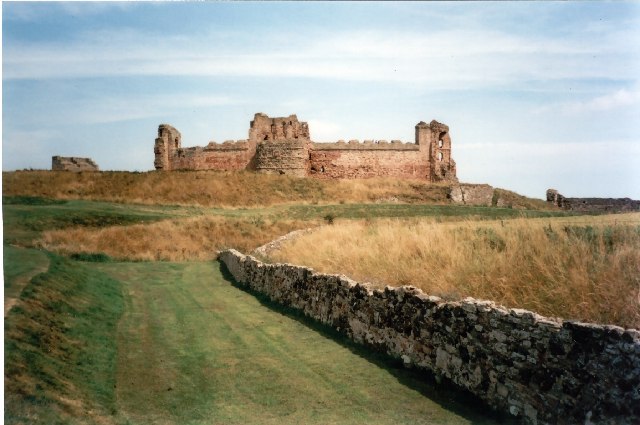
Photo: Lynne Kirton · CC BY-SA 2.0 · Wikimedia Commons
Tantallon Castle is a mid-14th-century fortress east of North Berwick, in East Lothian, Scotland, UK. Built in the mid-fourteenth century by William Douglas. The free Lokali audio guide runs 7 minutes.
✓ Published October 2026 · how we write these guides
Visitor facts
| Lokali audio guide | 7 min · free |
|---|---|
| Type | Castle |
| Location | North Berwick, United Kingdom |
| Coordinates | 56.0564, -2.6506 |
| Official website | historic-scotland.gov.uk |
| Languages | 50+, in the Lokali app |
The story
Listen first. The wind comes off the North Sea and moves through the gaps in the stone. Below the cliffs, waves break against the rocks, and somewhere out over the water, seabirds call without stopping. Under your feet, the grass is short and springy, kept low by salt air and weather. Ahead of you stands a wall of rose-red sandstone, broken and scarred, but still standing across the headland. This is Tantallon Castle, on the coast just east of North Berwick.
Take a moment to notice the shape of the place. The castle sits on a promontory, a tongue of land pushed out into the sea. On three sides, sheer cliffs drop down to the water. Those cliffs were the defence. The builders only needed to block the fourth side, the side facing the land. So that is exactly what they did. They built one enormous curtain wall, straight across the neck of the headland, and let the sea guard everything else.
That simple idea makes Tantallon unusual. It is often described as the last great curtain-wall castle built in Scotland. Most castles of its period were moving towards compact tower houses. Tantallon looks back to an older style instead. It is less a building and more a barrier, a stone screen that seals off a whole piece of coastline. When you stand in front of it, the wall fills your view from side to side. That is the point.
The castle dates from the mid-fourteenth century. It was built by William Douglas, who became the first Earl of Douglas. The Douglases were one of the most powerful families in medieval Scotland. Later the castle passed to a branch of the family known as the Red Douglases, the Earls of Angus. The name helped tell them apart from the main line, the Black Douglases. Both branches were rich, proud, and often in open conflict with the Scottish crown.
Look now at the colour of the stone. The red sandstone was quarried locally, and it changes with the light. On a grey morning it looks dull and brownish. In low evening sun it glows almost orange. Up close, you can see layers in the rock, and places where wind and rain have worn soft patches into hollows. The wall shows centuries of weathering, repair, and damage, all mixed together in one surface.
The curtain wall is anchored by towers. At the centre stands the Mid Tower, the main gatehouse, where visitors once passed through into the inner close. At each end, there are further towers — one of them known as the Douglas Tower, which held the lord's most important rooms. Today much of the interior has gone. Floors have fallen away, and what remains is a tall shell of stairs, window openings, and fireplaces hanging in the air.
Here is something many visitors miss. Before you even reach the great wall, you cross a series of earthworks — ditches and banks cut into the ground. These were outer defences, designed to slow attackers and keep siege guns at a distance. Later owners strengthened them as cannon became more powerful. So the grassy dips you walk across are not natural. They are part of the castle, as deliberate as the stonework itself.
Those defences were tested. The Red Douglases were not always loyal subjects, and Scottish kings came to Tantallon with armies more than once. In 1528, King James the Fifth besieged the castle while it was held for the Earl of Angus, who had fallen out with the young king. The castle held out against his guns. In the end, it changed hands through negotiation rather than assault. Tantallon earned a reputation as a place almost impossible to take.
That reputation lives on in an old local saying. People would say, roughly, that to knock down Tantallon, you would first have to build a bridge to the Bass. It meant something impossible. And the Bass is right there in front of you. Look out to sea. That steep white-topped island is the Bass Rock, and the white is not snow. It comes from a huge colony of gannets, large seabirds that nest there in their thousands.
Yet the saying turned out to be wrong. In 1651, during the wars of the seventeenth century, forces loyal to Oliver Cromwell, led by General Monck, brought heavy guns against Tantallon. After a bombardment lasting around twelve days, the garrison surrendered. Much of the damage you see today dates from that siege. The castle was never fully repaired as a fortress again. Slowly it became a ruin, then a landmark, and finally a place people visit for its views.
The ruin also found a place in literature. Sir Walter Scott, the nineteenth-century Scottish novelist and poet, used Tantallon as a setting in his long poem Marmion. Scott helped turn ruined castles like this one into romantic symbols of Scotland's past. Visitors in his time came to stand here partly because of his writing. In a way, you are following a path that writers and painters walked long before modern tourism arrived.
If you go inside, take time in the inner close, the open space behind the wall. On the far side, the ground runs to the cliff edge, and the sea fills the horizon. Look for the remains of buildings along the edges, and for the old well. A castle on a dry headland needed a reliable water supply to survive a siege. From the top of the wall walk, the coast stretches away towards North Berwick and the conical hill called North Berwick Law.
Before you leave, turn around once more and look at the whole wall. Notice how the light falls across the towers and the empty windows. Listen again to the wind and the gannets out on the Bass. The Douglases, the kings, and the cannon have all gone. What remains is red stone, green grass, and grey sea, much as it has stood for centuries. As you walk back across the old ditches, take that view with you.
Key facts
What to look for
Practical tips
Common questions
Is there a free audio guide to Tantallon Castle?
Yes — the Lokali app narrates Tantallon Castle free of charge in 50+ languages. The guide runs about 7 minutes, covers the history, what to look for on site and practical tips, and works offline once downloaded.
Where is Tantallon Castle?
Tantallon Castle is in North Berwick, United Kingdom, at 56.0564, -2.6506. Tap the map link on this page for directions from where you are.
What is Tantallon Castle known for?
Built in the mid-fourteenth century by William Douglas. Often called Scotland's last great curtain-wall castle.
What should you look for at Tantallon Castle?
Layered rose-red sandstone in the great curtain wall. The Mid Tower gatehouse at the wall's centre. Grassy ditches and banks of the outer earthworks.
What should you know before visiting Tantallon Castle?
Dress for strong wind, even on sunny days. Wear sturdy shoes for uneven grass and steep stairs.
When is the best time to visit Tantallon Castle?
Visit in late afternoon for warm light on red stone.
On the map
Opens directions to Tantallon Castle from your location.
More to see near Tantallon Castle


Hear Tantallon Castle in your language
The full story, narrated, in 50+ languages. Download it before you go and it plays offline, at your own pace, with no ticket and no tour group.