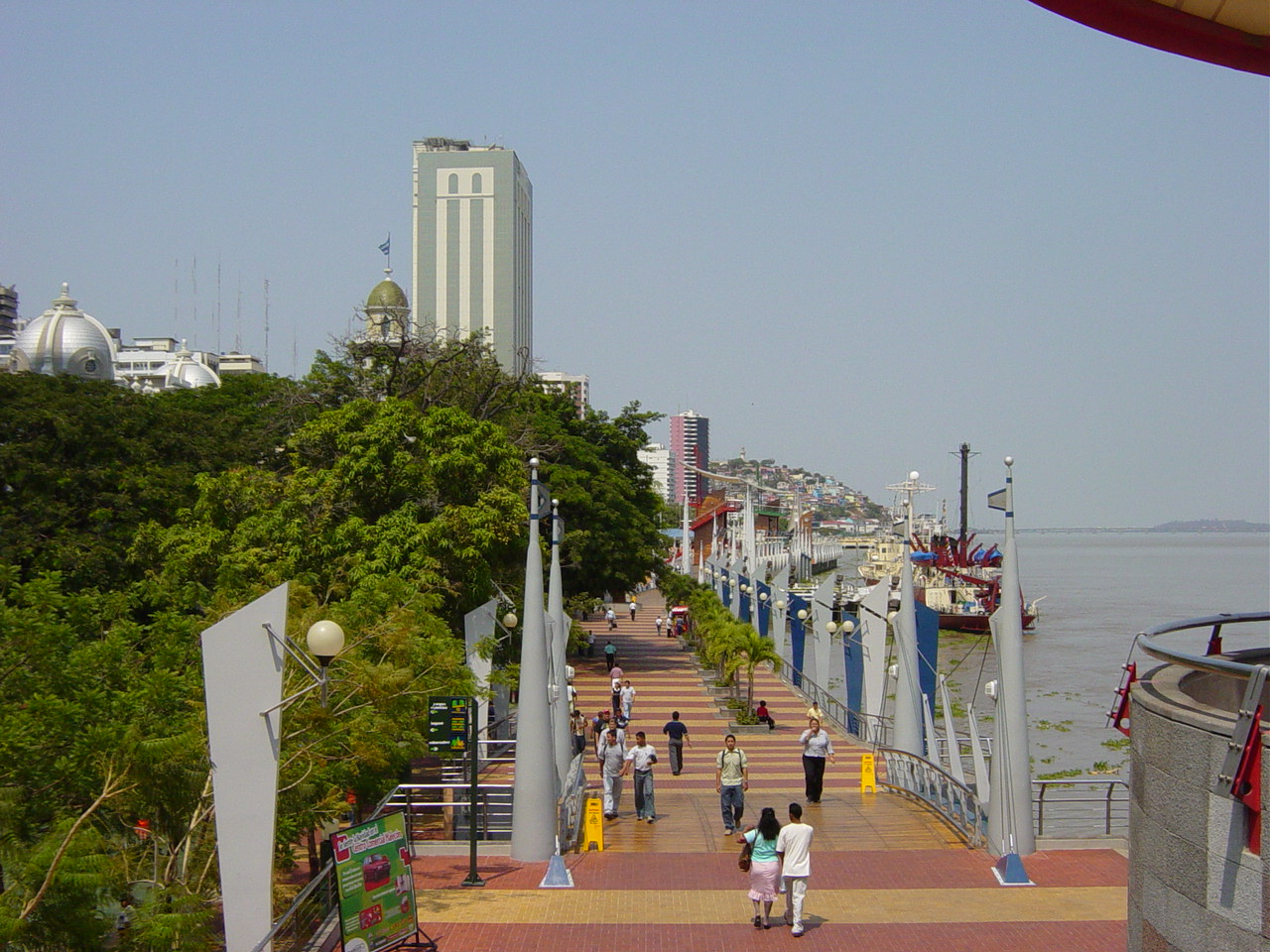
Malecón 2000 is a 2.5-kilometre riverside promenade along the Guayas River, rebuilt in the 1990s as a public space with plazas, museums, gardens, and restaurants. It is in Duran, Ecuador. Most visitors spend 1–2 hours here. The free Lokali audio guide runs 5 minutes.
✓ Verified August 2026 · how we write these guides
Visitor facts
| Time needed | 1–2 hours |
|---|---|
| Lokali audio guide | 5 min · free |
| Type | Waterfront |
| Best for | Editors' pick |
| Location | Duran, Ecuador |
| Coordinates | -2.2097, -79.8660 |
| Languages | 45, in the Lokali app |
The story
The river moves slowly here. Brown water slides past the city, wide and patient. A warm wind comes off the Guayas. Palm leaves click softly above your head. Somewhere a boat horn sounds. You are standing on the Malecón 2000, the waterfront promenade of Guayaquil, and the whole city seems to breathe with the water.
The walkway stretches about 2.5 kilometers along the west bank of the Guayas River. It runs the full length of downtown, from the old market district in the south to the foot of Cerro Santa Ana in the north. Gardens, plazas, monuments, and museums line the route. Locals treat it as their shared front porch. On weekends, it can feel as if half the city is here.
Guayaquil has always lived from this river. The city grew as a port, the main gate between the Pacific Ocean and the farms of the coast. In the nineteenth century, cacao from plantations upstream made local merchants wealthy. The old waterfront, called the Malecón Simón Bolívar, was crowded with docks, warehouses, and sailing ships waiting for the tide to carry them out to sea.
By the late twentieth century, that waterfront had grown tired and unsafe. The city decided to rebuild it completely. The project, named Malecón 2000, opened in stages around 1999 and 2000. Aging docks gave way to gardens, fountains, playgrounds, and shaded walks. Planners from other countries came to study it as an example of how a city can turn back toward its river.
Begin at La Rotonda, the monument at the heart of the promenade. Two bronze figures clasp hands beneath a half circle of tall columns. They are Simón Bolívar and José de San Martín, the two great liberators of South America. They met in Guayaquil in 1822, spoke in private, and left no complete record of their words.
Historians still argue about that meeting. Afterward, San Martín withdrew from public life, and Bolívar carried the independence wars to their end. Stand close to the curved wall and try the local trick: a whisper spoken against the stone on one side can sometimes be heard clearly on the other side.
Walk south and you reach the Crystal Palace, a long pavilion of glass and iron. It began its life in 1907 as a market hall. Today it hosts fairs, exhibitions, and concerts. Its metal frame recalls an age when cities ordered their buildings from distant foundries and assembled them beside the docks, piece by piece.
Back toward the center, a white tower rises with arched windows and a patterned dome. This is the Torre Morisca, the Moorish clock tower, keeping time over the waterfront since 1931. Its four faces look out over the river and the streets. Dock workers and office clerks alike once set their day by it.
Farther north, a giant observation wheel turns slowly above the trees. La Perla opened in 2016 and stands about 57 meters high. A full turn carries you above the rooftops. From the top you see the city grid, the wide brown river, and the flat green island of Santay resting on the far bank.
At the northern end sits the MAAC, the Museum of Anthropology and Contemporary Art. Inside are ceramics from Ecuador's ancient coastal cultures, some shaped thousands of years ago, along with modern Ecuadorian art. Native trees shade the gardens nearby, and in the evening an IMAX dome lights up for films beside the water.
Watch the river itself for a while. The Guayas rises and falls with the ocean tide, though the sea lies many kilometers downstream. Rafts of water hyacinth drift past, torn loose from banks far inland. Small boats cut across the current, as boats have done here for almost five centuries.
The promenade is fenced, gated, and patrolled, so it stays calm from morning until late evening. Families arrive when the heat softens. Vendors sell ice cream, cold juice, and roasted plantain. Children chase each other between the fountains. The city moves around you at an easy walking pace.
At the far north end, the walkway meets the painted houses of Las Peñas and the long stairway up Cerro Santa Ana. That climb is another story. For now, stay at the railing a moment longer. The brown water moved past this shore before the city had a name. It will keep moving long after.
Key facts
What to look for
Practical tips
Common questions
How long do you need at Malecón 2000?
Plan 1–2 hours. That is the time most visitors spend at Malecón 2000. The free Lokali audio guide adds about 5 minutes of narration you can listen to as you walk, so it fits inside your visit rather than adding to it.
Is there a free audio guide to Malecón 2000?
Yes — the Lokali app narrates Malecón 2000 free of charge in 50+ languages. It covers the history, what to look for on site and practical tips, and it works offline once downloaded.
Where is Malecón 2000?
Malecón 2000 is in Duran, Ecuador, at -2.2097, -79.8660. Tap the map link on this page for directions from where you are.
What should you know before visiting Malecón 2000?
Visit in late afternoon for cooler air and sunset light.
What is Malecón 2000 known for?
Promenade stretches about 2.5 kilometers along the Guayas River.
What is the best time to visit Malecón 2000?
Walk it in late afternoon when the light softens and families gather.
On the map
Opens directions to Malecón 2000 from your location.
More to see in Duran


Hear Malecón 2000 in your language
The full story, narrated, in 50+ languages. Download it before you go and it plays offline, at your own pace, with no ticket and no tour group.