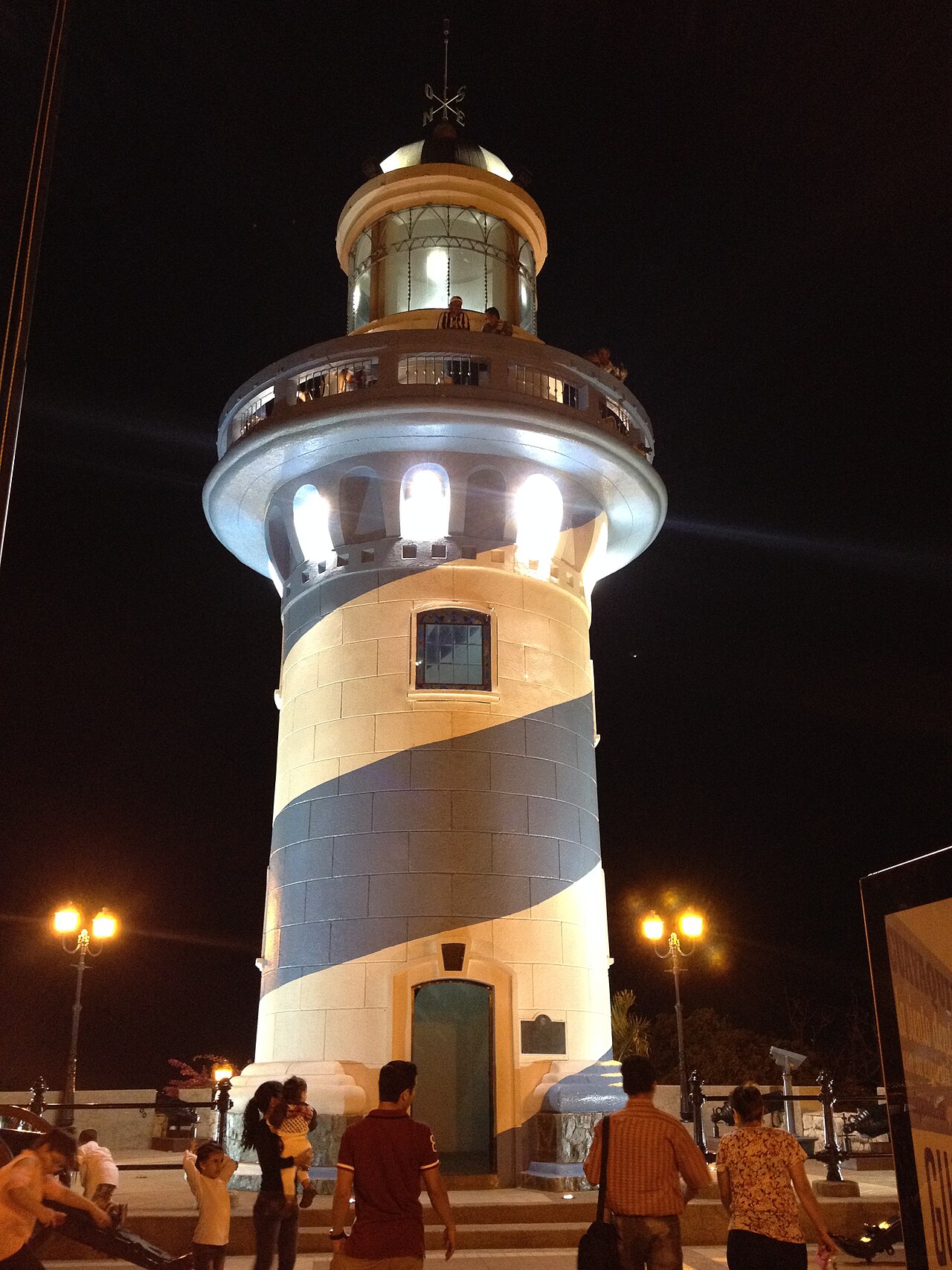
Torre Morisca is a clock tower in the Malecón district built in the early 1900s, offering views across the city and river from its upper levels. It is in Duran, Ecuador. Most visitors spend 30–45 min here. The free Lokali audio guide runs 5 minutes.
✓ Verified August 2026 · how we write these guides
Visitor facts
| Time needed | 30–45 min |
|---|---|
| Lokali audio guide | 5 min · free |
| Type | Viewpoint |
| Best for | Photography |
| Location | Duran, Ecuador |
| Coordinates | -2.2083, -79.8640 |
| Languages | 45, in the Lokali app |
The story
Four white clock faces look out over the river, the streets, and the rooftops of Guayaquil. Below them, arched windows and slim balconies circle a tall, pale tower. Glazed tile catches the sun. The whole structure looks like a piece of southern Spain set down beside a South American river. In a sense, that is exactly what it is.
This is the Torre Morisca, the Moorish clock tower, one of the small landmarks of the waterfront. It stands on the Malecón near where Diez de Agosto street meets the river, ringed by palm trees, with the brown current of the Guayas sliding past just beyond the railing. Ships pass. Joggers pass. The tower stays.
For a port city, public time was serious business. Ships sailed on the tide, markets opened at fixed hours, and customs houses ruled the docks. Everyone needed to agree on the hour. In the nineteenth century, Guayaquil acquired a public clock and set it high above the seat of city government, where the whole port could read it at a glance. Bells and whistles across the harbor answered to it.
The clock outlived its buildings. Fires and rebuilding forced it to move more than once over the decades. Finally, in 1931, the city raised the present tower on the waterfront to give the old clock a permanent home. The design surprised the port: not colonial, not classical, but Moorish. White walls, horseshoe arches, and a patterned dome now rose where cargo had once been piled.
The style has deep roots. It draws on Mudéjar architecture, born in medieval Spain, where Muslim and Christian building traditions mixed for centuries. Horseshoe arches, patterned tile, and slender towers traveled across the Atlantic in books and in builders' memories. In the early twentieth century, such revival styles were fashionable across Latin America, and Guayaquil wanted something memorable.
Walk around the tower slowly. The body is octagonal, rising about 23 meters above the promenade. Each level narrows slightly, like the sections of a telescope. Bands of glazed tile circle the shaft, and small stars and geometric patterns repeat in the tilework. Above the clock faces sits a rounded, patterned dome, closer in spirit to a mosque lantern than to a church steeple.
If the door is open, step inside. A narrow spiral staircase winds up through the core of the tower. The climb is short but steep, and the walls press close around your shoulders. Near the top you reach the clock chamber, where gears, weights, and levers still mark the hours, kept adjusted so that all four faces agree.
From the upper windows, the view repays the climb. The Guayas River spreads wide and brown, dotted with drifting rafts of water hyacinth. On clear days you can follow the water south toward the gulf. The gardens of the Malecón stretch away north and south. Behind you, downtown Guayaquil pushes its rooftops and towers back toward the hills.
The tower's surroundings have changed completely around it. The working waterfront it was built to decorate, once all docks, cranes, and warehouses, became the renovated Malecón 2000 at the turn of this century. Gardens and plazas replaced the cargo sheds. Through all of it, the tower kept its post and kept its time.
A short walk north brings you to La Rotonda, where bronze figures of Bolívar and San Martín mark their famous meeting of 1822. The clock tower and the monument share the same stretch of waterfront, and together they frame the historic heart of the promenade. Palm shadows cross the plaza between them through the afternoon.
People of Guayaquil have a soft spot for this tower. It appears on postcards, on murals, in school drawings, and in the memories of anyone who ever waited for a friend beneath its faces. Meeting at the clock tower has been a habit here for generations, long before phones could find anyone anywhere.
Time in this city has always been a river thing. The tide lifts and lowers the Guayas twice each day. Ships still move with the water, not against it. The clock above you cuts that endless flow into hours and minutes, small and human and easy to hold.
Before you walk on, wait for the minute hand to move once. It is a small event. Nobody else on the promenade will notice it. But the tower has repeated that small event, faithfully, since 1931, and the city has grown up around its patience. Some services are quiet ones.
Key facts
What to look for
Practical tips
Common questions
How long do you need at Torre Morisca?
Plan 30–45 min. That is the time most visitors spend at Torre Morisca. The free Lokali audio guide adds about 5 minutes of narration you can listen to as you walk, so it fits inside your visit rather than adding to it.
Is there a free audio guide to Torre Morisca?
Yes — the Lokali app narrates Torre Morisca free of charge in 50+ languages. It covers the history, what to look for on site and practical tips, and it works offline once downloaded.
Where is Torre Morisca?
Torre Morisca is in Duran, Ecuador, at -2.2083, -79.8640. Tap the map link on this page for directions from where you are.
What should you know before visiting Torre Morisca?
Ask the attendant whether climbing is allowed that day.
What is Torre Morisca known for?
Present tower inaugurated on the waterfront in 1931.
What is the best time to visit Torre Morisca?
The climb is steep and narrow, but the view from the top encompasses the river, the opposite bank, and the sprawl of the modern city.
On the map
Opens directions to Torre Morisca from your location.
More to see in Duran
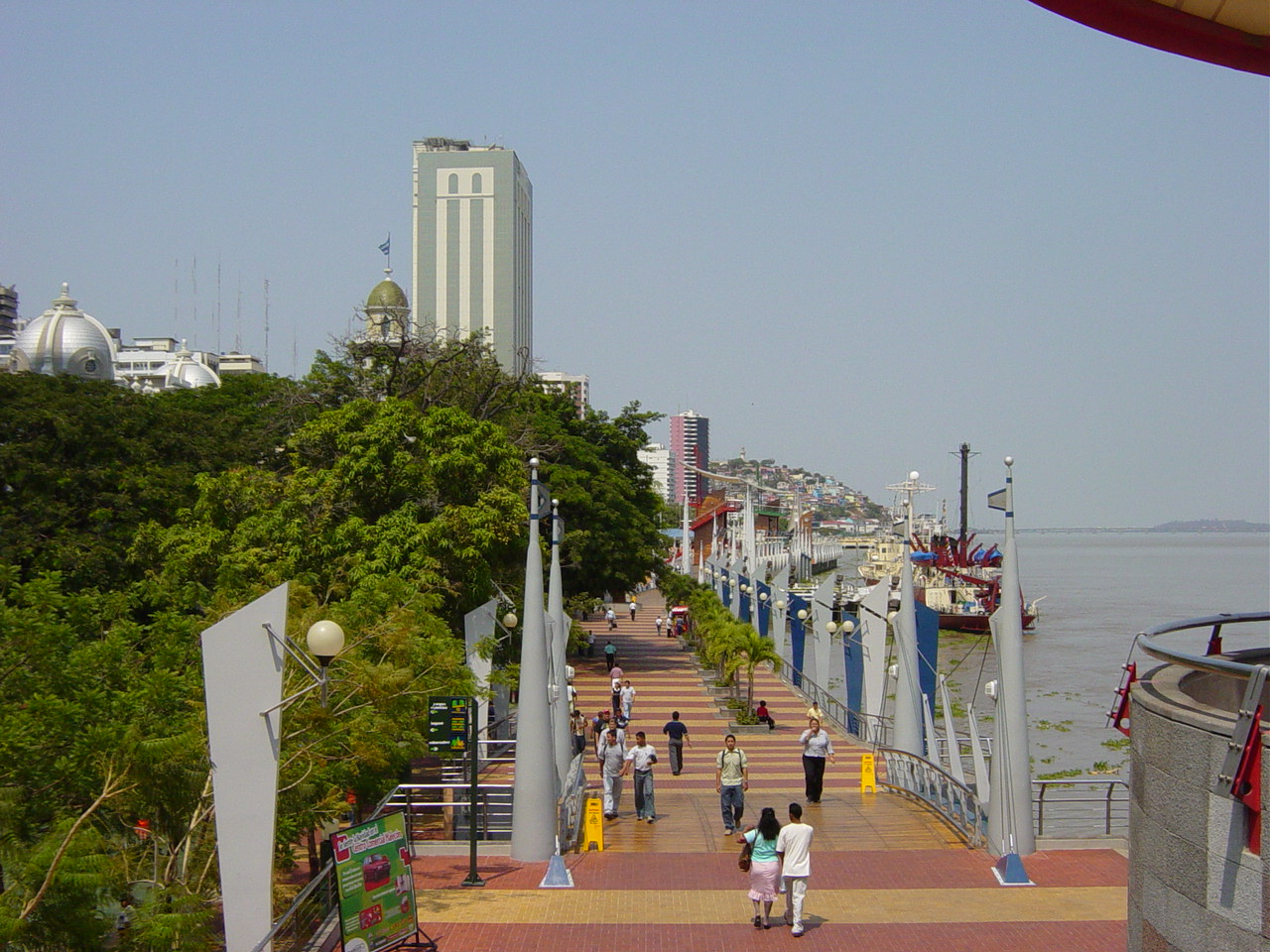

Hear Torre Morisca in your language
The full story, narrated, in 50+ languages. Download it before you go and it plays offline, at your own pace, with no ticket and no tour group.