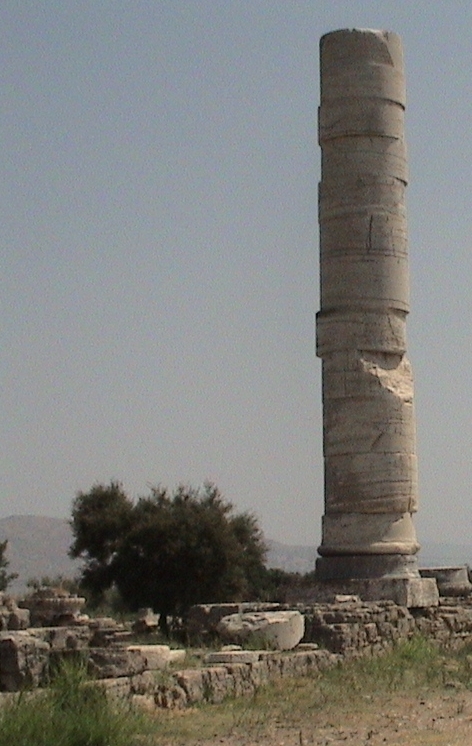
Heraion of Samos
37.6719° N · 26.8856° E · Archaeological Site
Photo: FocalPoint · CC BY 2.5 · Wikimedia Commons
Heraion of Samos is an ancient sanctuary of Hera on Samos. Legend places Hera's birth beside the river Imbrasos here. The free Lokali audio guide runs 6 minutes.
✓ Published October 2026 · how we write these guides
Visitor facts
| Lokali audio guide | 6 min · free |
|---|---|
| Type | Archaeological Site |
| Location | East Samos, Greece |
| Coordinates | 37.6719, 26.8856 |
| Languages | 50+, in the Lokali app |
The story
Listen first. Out here, the loudest sound is often the wind coming off the sea. It moves through the reeds and the dry grass between the stones. The ground is low and flat, close to the coast, and the soil feels soft underfoot. Ahead of you, one tall column rises alone above a wide field of broken marble. That single column is the clearest landmark of the Heraion of Samos, one of the great sanctuaries of the ancient Greek world.
This was the home of Hera, queen of the Greek gods and wife of Zeus. She was the protector of marriage and of women. Many cities honoured her, but Samos made a special claim. Legend has it that Hera was born right here, beside a small river called the Imbrasos, under a shrub known as the lygos tree. The lygos is the chaste tree, a plant with pale purple flowers that still grows in damp ground across the Mediterranean.
That story matters, because it explains why the sanctuary sits where it does. It is not on a high hill, like many famous temples. It sits on marshy land near the river mouth, several kilometres from the ancient city. The place was sacred before any great building stood here. Archaeologists have found traces of worship going back to very early times, with altars and simple shrines that came long before the marble giants.
Now let's think about scale. In the sixth century BCE, Samos was a rich and powerful island. Its ships traded across the eastern Mediterranean. Here, two architects named Rhoikos and Theodoros raised an enormous temple for Hera. It was one of the first truly giant Greek temples. It was also a dipteral design — which means the inner building was surrounded by two full rows of columns, not just one. Imagine walking through a forest of stone.
That first great temple did not last long. Ancient sources suggest it was destroyed, possibly by fire, not many decades after it was finished. The Samians began again, and they planned something even larger. This later temple is linked with the age of Polycrates, the ambitious ruler of Samos in the later sixth century BCE. The Greek historian Herodotus, writing in the fifth century BCE, described it as the largest temple he knew of.
Here is the first surprise. This second temple was never actually finished. Work continued on and off for a very long time, but some columns were never fully carved. If you look closely at fragments on the ground, you may notice drums with rough or uneven surfaces. They are not damaged. They are simply incomplete. The builders were still working when the money, the politics, or the times changed.
Now look again at the lone column. Locals call it simply the Kolona, the column. It is only a part of what once stood here, and it is shorter today than it was in antiquity. Even so, it gives you a sense of height that the low foundations cannot. Stand near its base and look up. Then picture well over a hundred columns like it, crowded together, all shining in pale stone.
The sanctuary was connected to the ancient city by a Sacred Way. This was a processional road, and it was lined with statues and offerings. During festivals, people walked along it from the town to the temple. Today the ancient city lies under the modern harbour town of Pythagoreio, named after Pythagoras, the famous mathematician who was born on Samos. Together, the town and this sanctuary are listed by UNESCO as a World Heritage Site.
Here is the second surprise. Some of the most remarkable objects found at the Heraion came from far away. Excavations, carried out over many decades by German archaeologists, uncovered offerings from Egypt, Cyprus, and the Near East. There were bronze figures, ivory carvings, and objects made in distant workshops. Sailors, traders, and pilgrims left gifts for Hera. The marshy ground helped to preserve some of them, including rare wooden pieces that usually rot away completely.
The sanctuary also produced great sculpture. One famous find is an enormous kouros, a statue of a standing young man, much taller than a real person. Another is a group of figures made by a sculptor named Geneleos, showing members of one family together on a long base. The originals are now protected in the archaeological museum in the island's main town. Here on site, you can see casts that show you where such statues once stood.
Ancient writers also describe rituals connected to Hera's cult statue. According to these accounts, the image of the goddess was carried down to the sea or the river and ritually cleansed. A great festival called the Heraia was held in her honour. The details are not all certain, and some parts of the story may be closer to legend than to fact. Still, they show how closely this place was tied to water, renewal, and ceremony.
As you walk the site, notice how many layers sit side by side. There are foundations of different temples, altars from different periods, and the bases of lost monuments. Later on, Romans added their own buildings, and there are also traces from early Christian times. It is not one moment frozen in stone. It is many centuries, built one over another, on the same patch of sacred ground.
Before you leave, pause by the low stones near the column. Feel the warmth they hold from the sun. Listen for the wind and the insects in the grass. Look toward the sea, and then back toward the hills. People stood on this ground for well over a thousand years to honour a goddess they believed was born here. As you walk away, glance back once more. The single column will stay in view for a long time.
Key facts
What to look for
Practical tips
Common questions
Is there a free audio guide to Heraion of Samos?
Yes — the Lokali app narrates Heraion of Samos free of charge in 50+ languages. The guide runs about 6 minutes, covers the history, what to look for on site and practical tips, and works offline once downloaded.
Where is Heraion of Samos?
Heraion of Samos is near East Samos, Greece, at 37.6719, 26.8856. Tap the map link on this page for directions from where you are.
What is Heraion of Samos known for?
Legend places Hera's birth beside the river Imbrasos here. First giant temple designed by architects Rhoikos and Theodoros.
What should you look for at Heraion of Samos?
The lone standing column rising above the whole field. Unfinished column drums with rough, uncarved surfaces. Casts of the Geneleos family statues on their base.
What should you know before visiting Heraion of Samos?
Visit early morning to avoid the strong midday sun. Bring water and a hat; shade on site is limited.
When is the best time to visit Heraion of Samos?
Visit early morning to avoid the strong midday sun.
On the map
Opens directions to Heraion of Samos from your location.
More to see in East Samos


Hear Heraion of Samos in your language
The full story, narrated, in 50+ languages. Download it before you go and it plays offline, at your own pace, with no ticket and no tour group.