
Tunnel of Eupalinos
37.6945° N · 26.9306° E · Archaeological Site
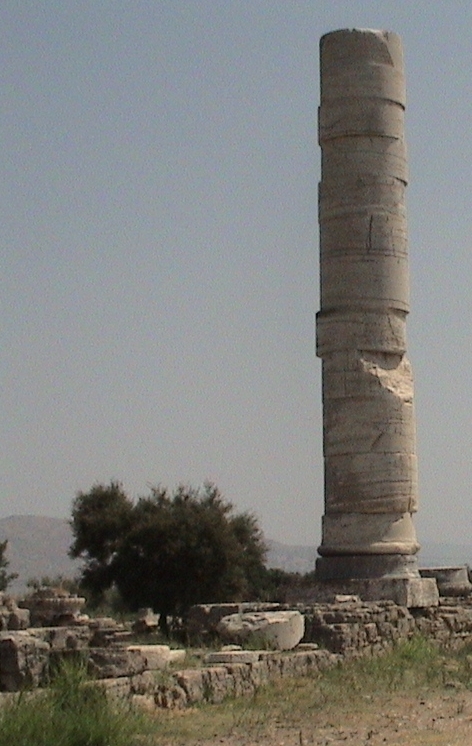
Photo: GrigorisKoulouriotis · CC BY-SA 4.0 · Wikimedia Commons
Tunnel of Eupalinos is an ancient tunnel in the isle of Samos. Built in the sixth century BCE under the ruler Polycrates. The free Lokali audio guide runs 7 minutes.
✓ Published October 2026 · how we write these guides
Visitor facts
| Lokali audio guide | 7 min · free |
|---|---|
| Type | Archaeological Site |
| Location | East Samos, Greece |
| Coordinates | 37.6945, 26.9306 |
| Languages | 50+, in the Lokali app |
The story
The air changes first. A few steps into the hillside, the warm Aegean light falls away behind you, and the stone around you turns cool and slightly damp. Your footsteps sound closer now, almost muffled. The walls are rough, chiselled limestone, close enough to touch on either side. Somewhere ahead, the passage runs straight into the dark of the mountain. This is the Tunnel of Eupalinos, and you are walking inside one of the great engineering puzzles of the ancient world.
Let us start with the problem it solved. In the sixth century BCE, the city here on the southern coast of Samos was growing powerful. It sat by the sea, with a good harbour, but its best fresh water came from a spring on the far side of the hill above you. A city that depends on an open water pipe is a city that an enemy can cut off. The answer was bold. Instead of running water around the mountain, the Samians would run it straight through.
The man who ruled Samos at that time was Polycrates, a tyrant in the old Greek sense, meaning a ruler who took power outside the traditional order. He was ambitious, wealthy, and fond of grand building projects. The engineer he relied on was Eupalinos, who came from the city of Megara on the Greek mainland. We know his name because the historian Herodotus recorded it. That is rare. Most ancient builders vanished without a trace, but this one was remembered.
Herodotus wrote about Samos in the fifth century BCE, and he was clearly impressed. He described three works of the Samians as the greatest in the Greek world. One was a huge temple to the goddess Hera. Another was a long stone breakwater protecting the harbour. The third was this tunnel, cut right through a mountain. Standing here, you are inside one of the three things a famous ancient traveller thought worth telling the world about.
Now for the first surprise. Eupalinos did not dig from one side only. His teams started at both ends of the hill at the same time and dug towards each other. Two groups of workers, with hammers and chisels, chipping through solid rock in the dark, trying to meet in the middle. The full length is just over a kilometre. Without compasses, without modern surveying tools, the two tunnels found each other. The error at the meeting point was remarkably small.
How did he do it? Scholars still debate the exact method. It almost certainly involved careful measurement over the top of the hill, or around its side, to set a straight line and a matching level at both entrances. Some of the measuring work is still visible. On the walls, researchers have found painted marks and Greek letters that appear to record distances along the tunnel. Think of them as the working notes of ancient surveyors, left on the rock.
Here is the second surprise, and it is a clever one. Near the place where the two teams met, the tunnel does not run perfectly straight. It bends. Engineers believe this zigzag was deliberate. If you are digging blind and you are worried about missing the other team side by side, a sharp change of direction makes it far more likely that the two passages will cross. It is a simple idea... and it shows a mind that planned for its own mistakes.
As you walk, notice something else. The passage you are in is not where the water flowed. The water ran in a separate channel, cut lower down, often to one side of the walkway. In some places this trench drops surprisingly deep. Why? The main tunnel was dug almost level, so the two teams could meet. But water needs a gentle slope to keep moving. So the builders cut a second channel underneath, sloping steadily down towards the city. Clay pipes inside it carried the water.
That detail changes how you see the whole place. This was not one tunnel, but two systems working together. The upper passage gave the workers space to move and to carry out broken rock. The lower channel did the real job of moving water. Look at the walls and you will see the marks of the tools. Each scar in the stone is a single strike, made by a person working by the light of a small oil lamp.
The aqueduct kept working for a very long time. Long after Polycrates was gone, water continued to flow through the hill into the town below. Over the centuries the tunnel fell out of use and parts of it filled with debris. In more recent times it was cleared, studied and restored. Today it is part of a UNESCO World Heritage Site that also includes the ancient town of Pythagoreio and the great sanctuary of Hera nearby.
That name, Pythagoreio, is worth a moment. The modern town takes its name from Pythagoras, the mathematician and philosopher who was born on Samos in the same broad era. It is tempting to link the geometry of this tunnel to him, and people often do. But there is no evidence that he had anything to do with it. Still, it is a striking thought. The same small island produced a famous mind for numbers and one of the first great feats of applied geometry.
A few practical words as you move through. Parts of the passage are narrow and low, so watch your head and take your time. The floor can be uneven and slightly slippery. If you feel closed in, it is fine to pause and breathe — the entrance is never truly far. And if you can, stop for a moment, switch off any light you carry, and simply listen. The silence inside a mountain is a very particular kind of silence.
When you return to the daylight, turn and look back at the slope of the hill. It looks ordinary — scrub, rock, the sound of insects in the heat. Nothing on the surface tells you that a straight line of human work runs right through it. Below you lies the harbour town, still drinking from the same island it always has. Carry that picture with you as you walk on: a hill, a spring, and two teams of workers reaching for each other in the dark.
Key facts
What to look for
Practical tips
Common questions
Is there a free audio guide to Tunnel of Eupalinos?
Yes — the Lokali app narrates Tunnel of Eupalinos free of charge in 50+ languages. The guide runs about 7 minutes, covers the history, what to look for on site and practical tips, and works offline once downloaded.
Where is Tunnel of Eupalinos?
Tunnel of Eupalinos is near East Samos, Greece, at 37.6945, 26.9306. Tap the map link on this page for directions from where you are.
What is Tunnel of Eupalinos known for?
Built in the sixth century BCE under the ruler Polycrates. Engineer Eupalinos came from Megara on the Greek mainland.
What should you look for at Tunnel of Eupalinos?
Chisel marks left by individual tool strikes on the walls. The deep water channel cut below the walking passage. Painted Greek letters marking ancient survey measurements.
What should you know before visiting Tunnel of Eupalinos?
Wear closed shoes with grip for the uneven, damp floor. Book your visit in advance, as group sizes are limited.
On the map
Opens directions to Tunnel of Eupalinos from your location.
More to see in East Samos



Hear Tunnel of Eupalinos in your language
The full story, narrated, in 50+ languages. Download it before you go and it plays offline, at your own pace, with no ticket and no tour group.